
Women of Algiers: “The Rediscovered Apartment”
An Exhibition That Revives Memory, Restores Voice, and Reclaims Women’s Presence
Najwa Rahim
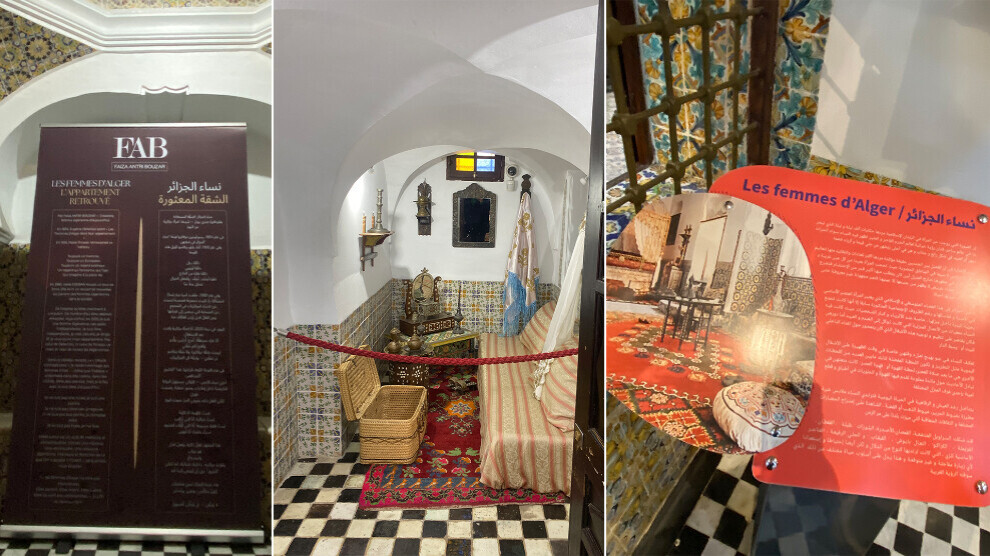
Algiers — The exhibition “Women of Algiers: The Rediscovered Apartment” sheds light on the presence of Algerian women in collective memory by revisiting both their tangible and intangible heritage. It highlights women’s role in shaping cultural identity through clothing, rituals, and everyday customs.
Designer Faiza Antri Bouzar affirmed that the exhibition is not limited to telling a personal story, but rather aims to showcase the intangible cultural heritage of Algerian women, including embroidery, tailoring, traditional garments, and daily practices passed down through generations.
The exhibition continues to welcome visitors at the Bardo Museum in the capital Algiers after its launch in late 2025. Its duration has been extended until the end of January, offering the public a broader opportunity to explore this artistic and cultural project, which seeks to restore recognition to Algerian women, empower them to reclaim their voices, tell their own stories, and reinforce their symbolic presence in historical and cultural memory.
The exhibition was organized by Algerian designer Faiza Antri Bouzar, who explained that both the exhibition and the artistic collection she launched under the name “Qadar” (Destiny) are the result of a journey back into family and social memory. She noted that the initial spark came from the “Karakou Algiers”, one of the oldest and most beautiful traditional garments in Algeria, considered a symbol of feminine identity in the capital. She inherited it from her grandmother, and for her it was not merely a traditional outfit, but a living piece infused with the spirit of its wearer and carrying an entire story within its threads.
She explained that her grandmother wore this Karakou in 1913, and that she herself wore it again in 1986 when moving from primary to middle school.
“I was thirteen years old at the time—the same age at which my grandmother got married. This piece became a link between two generations and a symbol of the evolution of women’s status in Algerian society.”
Faiza Antri Bouzar added that the exhibition goes beyond a personal narrative, shedding light on the rich heritage of embroidery, tailoring, traditional clothing, and behavioral practices of Algerian women—forms of intangible cultural heritage transmitted from grandmother to mother, then to daughter and granddaughter.
“These elements must not be forgotten; they are part of our identity and our daily lives.”
She also emphasized that a significant source of inspiration came from the famous painting “Women of Algiers in Their Apartment” by French painter Eugène Delacroix. She pointed out that although Delacroix visited Algeria briefly, it is not certain that he truly grasped the full and authentic image of Algerian women. Therefore, Algerian women today have the right to present their genuine image and tell their own stories—from their clothing to their behavior and way of thinking.
Traditional Clothing: A Daily Art of Algerian Women
The exhibition also reflects the richness of Algeria’s traditional clothing heritage and women’s daily customs. Some historical images portrayed women in Islamic countries as living in an enchanting world filled with lavish jewelry and ornate garments, appearing in their finest attire while adhering to modesty—often dictated more by custom than by doctrine.
Despite social restrictions, women enjoyed considerable freedom within the home, especially among wealthy families and notable figures, where they were exempt from household chores assigned to servants and slaves. Their role was mainly focused on managing family affairs and tasks related to the inner courtyard of the house, known as “Wast al-Dar.”
The Hammam: Rituals of Purity and Beauty
She explained that the hammam was—and still is—a place of purification and cleanliness, a space for bathing and social interaction. Beyond its health role, it is an integral part of Algerian women’s daily lives, particularly in affluent urban homes such as the Bardo Palace, where families ensured the presence of a private hammam equipped with all its necessities.
She noted that the exhibition offers a sensory experience that brings together fashion, art, and social history. The Karakou and family heirlooms are transformed into an expressive and spiritual language that tells profound stories about identity and society.
“Every piece carries a story, and every moment documents real people and lived experiences. Qadar is not merely a fashion collection or an exhibition; it is a journey through memory, a living narrative, and a celebration of both heritage and modernity.”