
Sara, Rojbîn, and Ronahî… Three Paths, One Fate
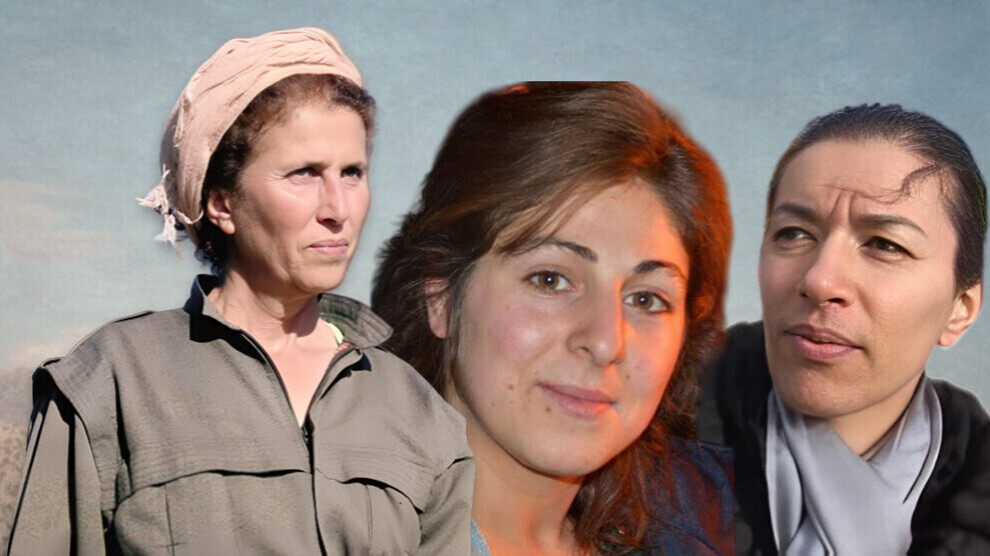
More than a decade after the assassination of Sakine Cansız, Fidan Doğan, and Leyla Şaylemez, Kurdish women still march, holding their photos, demanding truth as if they walk among them.
Akhîn Bahar
News Center — On January 9, 2013, news spread of an attack in the French capital, Paris, targeting the Kurdistan Information Office. The attack resulted in the assassination of Sakine Cansız (Sara), one of the prominent founders of the Kurdistan Workers’ Party (PKK); Fidan Doğan (Rojbîn), the representative of the Kurdistan National Congress in Paris; and Leyla Şaylemez (Ronahî), a member of the Kurdish youth movement.
The assassination came at a time when Abdullah Öcalan was holding meetings in İmralı in 2013 with the aim of pushing toward a democratic solution to the Kurdish issue. This timing gave the crime a wide resonance and sparked a wave of anger in Turkey and around the world. Official meetings between Öcalan and the government delegation, along with the İmralı delegation composed of deputies from the Peace and Democracy Party (BDP), had begun just days before the attack to pave the way for a negotiation process to resolve the Kurdish issue.
After the crime, France’s stance highlighted its international dimension. French Interior Minister Manuel Valls announced that the attack would be uncovered in all its aspects. However, the authorities imposed secrecy on the investigation file. Although this decision was lifted in 2014, it was reinstated shortly thereafter.
The Link Between the Massacre and Turkish Intelligence (MİT)
Eight days after the massacre, Ömer Güney was arrested and detained, and interrogated on charges of “committing murder in cooperation with a terrorist organization.” During the investigation, information began to emerge indicating a connection between Ömer Güney and the Turkish National Intelligence Organization (MİT).
It was revealed that Ömer Güney arrived in Ankara on August 22, 2012, and applied the following day for an electronic passport at the Ankara Security Directorate. Two days later, he received his new passport. Investigations also showed that he entered and exited Turkey 13 times within a single year. Flight records revealed that 19 days before the massacre, he traveled from Paris to Ankara via Istanbul, stayed for three days, and then returned the same way.
Suspicions regarding his ties to Turkish intelligence were reinforced when a person appeared on a television channel claiming to have worked with MİT and confirmed a link between the agency and Ömer Güney. Audio recordings were leaked showing his communication with MİT operatives, and a telecommunications company confirmed that the phone line used belonged to the intelligence headquarters, further strengthening the accusations.
Investigations into the massacre continued until 2015, when a decision was made to refer Ömer Güney to trial, with the first hearing scheduled for January 23, 2017.
The Suspicious Death of the Killer
Thirty-six days before the date of his first court hearing, it was announced on December 17, 2016, that Ömer Güney had been transferred to hospital after his health deteriorated, where he later died. With the announcement of his death, the case was left without a defendant and the lawsuit was automatically dropped.
Following objections by the case’s lawyers, a new preliminary investigation was opened in April 2017 into the role of Turkish intelligence in the massacre. In March 2018, the families of the three Kurdish women filed a request to include the “masterminds and accomplices” in the investigation. As a result, a judge specializing in counterterrorism cases was appointed.
Meanwhile, the public prosecutor in Ankara, who was overseeing a parallel investigation there, expressed the opinion that the crimes might have been an “internal liquidation.” However, public opinion continues, every January, to organize protest events pointing to the real perpetrators and demanding the truth be revealed.
The question remains: who were the women targeted in the January 9, 2013 massacre? Sara, Rojbîn, and Ronahî… and what made each of them a target in her own right?
Sara: She Gave Her Heart to That Struggle
When she said, “I am in love with this struggle,” her struggle was one of faith, revolution, and resistance leading to a great end. Sakine Cansız, who insisted on freedom and devoted her life to what she called “the struggle,” was born on February 12, 1958, in the village of Tekhê Khalil in Dersim, Northern Kurdistan.
She began working in factories as a laboring woman, but she did not defend only her own rights; she participated in organizing workers to defend everyone’s rights. Yet she did not find what she was seeking within the leftist movements in Turkey.
From Dersim to Ankara, Sakine Cansız forged her path to become one of only two women who participated in the first founding congress of the Kurdistan Workers’ Party (PKK). Her presence within the party marked the beginning of a new journey for Kurdish women as a whole.
Prison: A Source from Which Resilience Erupted
In 1979, shortly before the 1980 coup, Sakine Cansız was arrested in Kharput (Elazığ), where she was subjected to the most brutal forms of torture. Despite the harshness surrounding her, she began organizing women who were imprisoned after the military coup, becoming their voice and backbone inside the cells. When Esat Oktay Yıldıran was appointed head of internal security at Diyarbakır (Amed) Prison and systematic torture began, Sakine’s resistance turned into a “flame of hope” from which prisoners drew their strength.
On December 26, 1990, Sakine Cansız was released from Çanakkale Prison. As soon as she arrived in Istanbul, she participated in founding the first women’s framework there, drafted the internal regulations of the National Women’s Association (YKD), and was one of its leading founders. She also contributed, alongside Kurdish intellectuals and artists, to the establishment of the Mesopotamia Cultural Center (MKM), and took part in the activities of Free People magazine and Free Country newspaper.
However, the weight of repression in Turkey granted her only five months of open activity. On May 1, 1991, she left the country via Atatürk Airport on a Greek plane. After a short period in Europe, she headed directly to Damascus to continue her path without hesitation or delay.
“I Hear My Heartbeats”
Sakine Cansız describes her journey to Damascus:
“We land at Damascus Airport. I hear my heartbeats, as if I am about to see the Leader at any moment. A strange excitement. The last time I saw him was at the founding congress. I returned to the ‘Günaydın’ apartment and left after one day. Thirteen years had passed. After years of prison, during which shrouds were torn to pieces, I was reaching the most beautiful period of my life. During that time, much had changed, and I would learn it step by step—sometimes stumbling, sometimes struggling with contradictions—but the Leader had not changed much. When he asked me, ‘How did you find me?’ I replied, ‘My Leader, you are still young, you remain strong, and this made me very happy.’”
“You Love the Mountains… You Will Unite with Them”
Sakine Cansız spent six months at the Masum Korkmaz Academy. When the time came for her to head to the mountains, Abdullah Öcalan bid her farewell with words that still echo in memory:
“Go, Sakine… you love the mountains. You will unite with them… I await news of your success.”
After that farewell, she continued on her path, weaving—until the day of her assassination—a legendary story that remains etched in the movement’s memory. Today, thousands of Kurdish women continue to follow in her footsteps, carrying her message and continuing her cause.
Ronahî’s Journey
Leyla Şaylemez, known as Ronahî, was born on January 1, 1988, in the Yenişehir district of the city of Mersin. Her family chose the name Leyla in honor of Leyla Qasim, one of the prominent symbols of Kurdish women’s struggle. The family’s roots trace back to the Lice district in Amed, but pressure and repressive practices forced them to leave their homeland. Mersin was the first stop of this displacement, where she grew up.
Leyla’s father was forced to migrate to Germany, and in 1994 Leyla joined him with her five siblings. The family settled in the city of Halle in the state of Saxony-Anhalt, where they endured long years of struggle under harsh living conditions.
Leyla grew up in this environment, surrounded by Kurdish culture that remained present in her home and conscience. She participated in Kurdish folklore groups, and after completing nine years of schooling and beginning university preparation, she gradually became acquainted with the Kurdish movement.
She began her activism within the youth ranks in 2008, moving between several European countries. In 2010, she joined the PKK, but two years later she had to return to Europe due to health issues, where she resumed her political work. During her activities in Hanover—a city with a heavy presence of Turkish intelligence—she was under constant surveillance by German police, which led her to move to Paris to continue her work.
Leyla Şaylemez’s greatest wish was to participate in Newroz in Amed. At a time when she was playing a prominent role in guiding and inspiring youth, she was targeted in Paris, where she was assassinated, leaving behind an indelible mark.
Rojbîn… A Child Born in the Heart of the Maraş Massacre
Fidan Doğan, known as Rojbîn, was born on January 17, 1982, in the village of Mali Botan, located between the districts of Elbistan and Nurhak in Maraş. She was the second of four children. After the Maraş massacre and the waves of displacement that followed, her family settled in France. Her parents had left first, while Fidan remained in the village until the age of nine with her aunt, grandfather, and grandmother. She later joined her family on the migration journey, and in France she became acquainted with the Kurdish freedom movement.
Fidan Doğan was known as a woman highly sensitive to what was happening around her, with a strong sense of justice. Through her activities in Europe, she contributed to making the Kurdish cause—especially the struggle of Kurdish women—visible at the international level.
She spoke French fluently and worked in the bureaucratic field. In 2002, she assumed responsibility for the Paris representation of the Kurdistan National Congress (KNK), and in 2011 became head of the Kurdistan Information Office, where she was later assassinated. For nearly ten years, she was known for her diplomatic and bureaucratic work. She was a peaceful figure, active in Europe, particularly in Paris and Strasbourg, home to the European Court of Human Rights, and maintained contact with many European politicians.
Fidan Doğan was known for her strong human relations, patience, fighting spirit, and positive outlook, leaving a lasting impression on all who knew her. Her mother, Fatma Doğan, described her as follows:
“Rojbîn was a very honest child, clear in everything, she did not like lying. If she started something, she would say: I will not leave it incomplete. I have five children—two sons and three daughters—and Rojbîn was my youngest daughter. She was deeply connected to her people and her cause, and when it came to her cause, she would not listen to anyone. She was sixteen when she began going with her friends to the association. She was always thinking: how can I participate in politics? How can I be useful to the cause?”
Fidan Doğan continued her struggle for the existence of the Kurdish people until the day of her assassination, just like her two comrades.
Sakine Cansız grew up on stories of the atrocities experienced by her people during the Dersim massacre (1937–1938) and waged a struggle against racism, religious fanaticism, and gender discrimination. Fidan Doğan was four years old during the Maraş massacre (1978) and dedicated her life to democracy, freedom, and justice. Leyla Şaylemez was born far from her homeland of Amed due to escalating pressure on Kurds and spent her life on the roads of migration, yet she struggled for her land.
In targeting these three women, Kurdish women as a whole were targeted. Today, women demand accountability from the real perpetrators. In Turkey and France in particular, Kurdish women are once again preparing this year to take to the streets on January 9 and 10 to demand justice.