
The Resistance of Tishreen Dam: A Popular Epic that Foiled the Plans of the Turkish Occupation
Following over 100 defensive rotations and sacrifices against Turkish-led attacks on the Tishreen Dam, the popular resistance in northeast Syria prevailed. Women participated, seeing this defense as an extension of their struggle and Kurdish resistance hi
Berjêm Cûdî
Kobani —For four months, the people of North and East Syria took turns guarding Tishreen Dam against attacks by the Turkish occupation and its mercenaries, who sought to cross the dam and expand their influence east of the Euphrates. They also attempted to use the dam as a pressure card against the peoples of the region by cutting off water and electricity. However, popular resistance stood as a major obstacle to the occupation’s plans.
On January 8, 2025, the people of North and East Syria decided to head toward Tishreen Dam and form human shields to protect it, in an attempt to repel attacks by the Turkish occupation and its mercenaries. The first convoy set out from various cantons of the region toward the dam, but almost upon arrival it was subjected to intense shelling, resulting in the killing of five civilians and the injury of sixteen others.
Despite the severity of the attacks aimed at forcing the convoy to retreat, the people continued their march until they reached Tishreen Dam, where they lit torches and expressed a collective stance through popular marches, affirming their determination to protect the dam. From that day on, a systematic rotation process began, whereby each time a new convoy from one of the cantons would head to Tishreen Dam to carry out its role in protecting it.
The resistance continued for more than one hundred days, and on May 5, 2025, the Autonomous Administration of North and East Syria announced the conclusion of the dam protection activity, confirming that its objectives had been achieved and praising the steadfastness of all participants.
Throughout the four months of resistance at Tishreen Dam, children, women, youth, and the elderly participated, alongside couples, families of martyrs, people with disabilities, and all components of society. Each participant contributed their effort with a free spirit and a high sense of responsibility, carrying thousands of memories that remain engraved in their conscience. Many of their stories remain unfinished, while their names have been recorded in the register of the dam’s resistance as part of the memory of this event.
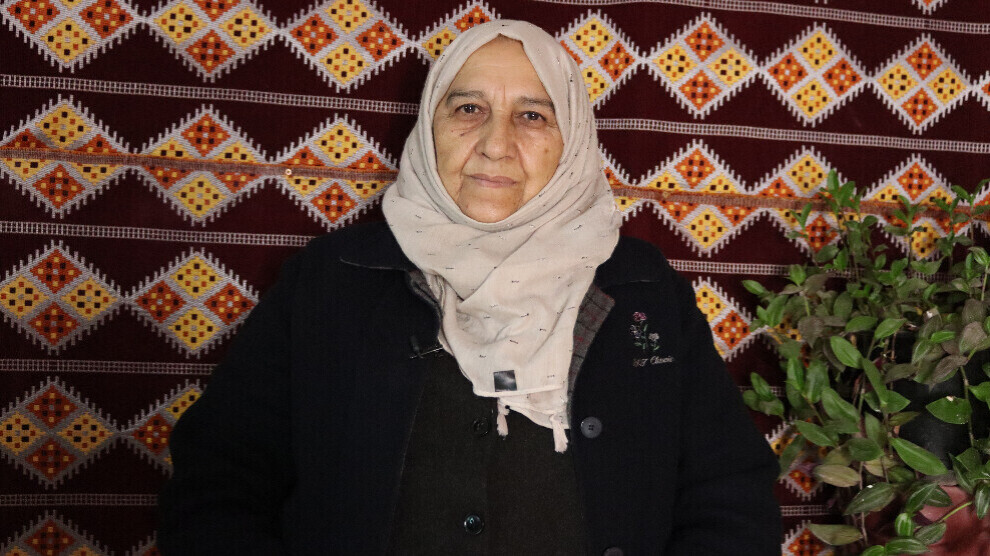
Aisha Afandi from the city of Kobani is considered one of the most prominent symbols of this resistance. She went to Tishreen Dam three times, becoming a symbol of steadfastness and determination in the region. Speaking on the first anniversary of the dam’s resistance, she said they had fulfilled the promises they made:
“Before we talk about the resistance of Tishreen, we must pause for a moment at the reality of our feelings. The women of Kobani have been struggling for many years, especially the mothers of martyrs who made a vow of victory and freedom over the graves of their sons.”
She added, “The mothers of martyrs and all the women of Kobani carried this promise in our hearts, and here we are continuing to walk their path with steadfastness.”
She described recalling her emotions at the moment she decided to participate in the rotation:
“During the course of the resistance of Tishreen Dam, I kept telling myself: if we have offered countless sacrifices in our revolution, and if we have pledged to walk in the footsteps of the martyrs, then reaching Tishreen Dam with our own bodies is the highest form of loyalty to this revolution and to these promises. With this determination, we placed our will and our souls in the front line of defense of the dam, and we proved that we are continuing on the path we chose.”
Aisha Afandi linked her previous participation in the resistance of Kobani against ISIS with what happened at Tishreen Dam, saying:
“When we decided to head to the dam, we knew full well that this was our path, and that it was the place where we would fulfill our pledges and never retreat, just as we stood firm in Kobani.”
She emphasized that “it was impossible to leave our forces alone around Tishreen Dam. From the very first moment, we made revolutionary people’s war the basis of our march. Here we are once again placing ourselves on the front lines at Tishreen Dam. The resistance of the Kurdish people is one wherever it exists; just as people stood at the borders and guard points to protect Kobani during its battle, they stood with the same determination and resolve at the dam.”
The first convoys heading to Tishreen Dam faced direct and intense shelling. During the first fifty days of resistance, 24 people were martyred and 221 others were injured. Aisha Afandi described what she experienced at that time, saying:
“I was part of the second convoy, and I will never forget how we were directly targeted by shelling. In that attack, the driver of an ambulance was martyred, and a large number of civilians were injured.”
She added, “The shelling did not stop for a single moment. The road was completely destroyed, and we were forced to get out of the vehicles and walk three kilometers until we reached the dam.”
She continued:
“When I remember those scenes, I ask myself where all that courage and strength came from. But I know its source is the legacy of the martyrs and the promises we made to them. That is why I did not feel fear. We remained firm in our stance, determined to reach our destination no matter the cost.”
Aisha Afandi summarized one hundred days of resistance at Tishreen Dam in these words:
“When one of the mothers of martyrs kissed the soil of Tishreen Dam, she was in fact embracing the very place where her son had risen as a martyr.”
She added, “One of the participants said, ‘We are greater than death.’ She repeated the same phrase once said by the martyr Zahra during the resistance of Kobani, and before her by the martyr Mazlum in Amed Prison. Such stances and decisions do not come from nothing, but from the legacy, dignity, and hopes of the martyrs and the hopes of their children.”
She explained that with this spirit, the resistance of the dam was completed:
“With this determination, we bid farewell to our martyrs with dignity and treated our wounded—whom we could not transfer to Raqqa or Kobani due to the shelling—using the limited resources available to us.”
She noted that “in response to the shells, we would form dabke circles and sing revolutionary songs. In those moments, we remembered the guerrilla dance, when fighters used to say that despite snow, rain, and shelling, they succeeded in carrying out their missions and then danced to celebrate their success. That is why we danced and continued our activity despite all circumstances. Instead of sitting in sorrow, crying and wailing, we celebrated victory with our dances and our determination.”
In concluding her remarks, Aisha Afandi affirmed that the resistance waged at Tishreen Dam has become a great legacy in the history of the Kurdish people and the region:
“The maps that were being drawn for Kurdistan and the Middle East changed thanks to this resistance and thanks to the project of Leader Abdullah Öcalan. I have always said that we tore those maps apart, and that the blood of our martyrs erased them from memory. We drew our own map and changed the course of history. With this spirit, we crowned our resistance at the dam with victory. And if necessary, we are ready once again, with the same spirit, to head to Ashrafieh, Sheikh Maqsoud, Afrin, Girê Spî, and Serêkaniyê as well.”