
Women at the Forefront… Iran’s Protests Renewed as Public Anger Refuses to Subside
An article by journalist Jinda Amara
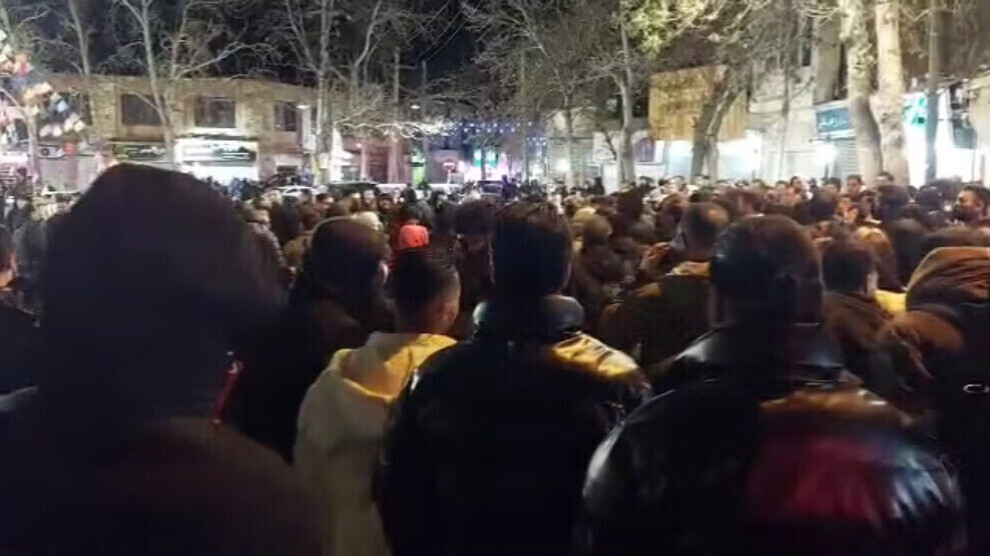
On December 28, 2025, Iran witnessed a new wave of popular protests against the regime’s policies. Although the initial spark was ignited by workers protesting economic deterioration, the essence of the uprising reflects an accumulation of public anger over repression, restrictions, arrests, and torture, with people clearly declaring, “Enough is enough.”
This time, protests were concentrated in the capital, Tehran, where various segments of society took to the streets to express their rejection of state policies that have turned daily life into a cycle of pressure and fear. Repression has become a daily reality affecting activists, artists, women, and others, through arrests, harsh sentences, and even executions.
Because of this reality, the public no longer accepts the regime’s policies—a fact clearly demonstrated by the recent protests, which once again confirmed that Iranian society is no longer willing to endure the authorities’ practices or recognize their legitimacy.
The situation in Iran is no longer what it once was. Society has undergone a radical transformation and is no longer the society the regime could subdue through repression and arrests. The state is also no longer capable of intimidating people as it once did. Iran has been mired for years in a complex political, military, social, and economic crisis, while society lives in a state of deep tension as a result of the regime’s misguided policies.
At the same time, the regime has entangled itself in power struggles with dominant forces, a conflict that has only exacerbated internal crises. Despite attempts to project strength, reality reveals the regime’s incapacity: it is unable to resolve its internal crises or escape the cycle of regional conflict in which it is embroiled. As a result, it seeks to place the burden of its failure on society.
The regime believes repression can bring society back under control, but unfolding developments confirm that repeating failed policies offers no solutions. Instead, it deepens problems and brings the country closer to further social explosion.
In recent days, Tehran has seen a new wave of popular mobilization, which quickly spread to cities across Eastern Kurdistan—from Kermanshah to Ilam, Sanandaj, Urmia, Hamedan, Lorestan, and beyond. Protests continue to expand day by day, just as they did during the “Jin, Jiyan, Azadî” (Woman, Life, Freedom) uprising that united Iran’s peoples against the regime.
Despite officials’ attempts to defuse public anger through statements focused on the economic crisis, the protests have grown far beyond living conditions alone. Society has clearly begun rejecting the existing system, a reality reflected in protesters’ slogans and demands.
Women, youth, workers, students, and all segments of society are not protesting solely because of economic hardship, but in opposition to decades of repression. The crisis in Iran is far deeper than the economic dimension—something everyone understands. For 47 years, the regime has imposed darkness on society through religious laws, confiscating the people’s will and freedom.
Since the establishment of the Islamic Republic, the regime has never enjoyed genuine popular acceptance. Despite periods of apparent calm, protest energy has always remained latent within society. Every crisis resulting from the regime’s policies has turned into a new spark of public anger, as seen in the uprisings of 2010, 2018, and 2019.
As in every previous instance, Iranian authorities have responded to people’s demands and protests with excessive violence. Instead of listening to the voice of the streets, this round of protests was met with killing, arrests, and direct repression. Information coming from inside the country indicates dozens of killed, injured, and detained individuals, with no details available about the fate of those arrested. Despite weak internet access and the absence of media coverage, some videos circulating on social media reveal authorities firing directly at protesters.
Nevertheless, the people’s stance remains clear and decisive. They no longer accept a system that deprives them of their most basic rights. This position was evident during the “Jin, Jiyan, Azadî” uprising. After the wave of mass protests subsided, the regime believed the uprising had ended, but the Iranian people kept the flame of revolution alive. It reignited once again in the December 28 mobilizations, which represent a direct continuation of the spirit of that uprising. In other words, the uprising never truly ended; it continues wherever its spark remains alive.
As always, women are at the forefront of this uprising, because they are the most affected by the authorities’ policies. The economic crisis hits them first, undemocratic policies restrict their lives before others, and a conservative society fueled by state policies imposes the heaviest constraints on them. As a result, women’s anger is more visible, and they confront the regime with greater determination.
From this point forward, what Iran needs is a democratic society and democratic politics, as these are the only means capable of addressing the economic crisis and resolving social problems. This truth must be acknowledged, because all the alternatives offered by the regime over past decades have failed to pull the country out of its crises. Iranian society wants a democratic system, and this demand has become unmistakably clear.
If the Iranian government wishes to overcome its political, military, social, and economic crises, it must begin by listening to the people’s demands and abandoning its policies of intimidation and repression. Experience has repeatedly shown that the people no longer fear execution, arrest, or security pressure. Today, it is clear that Iranians are determined to change the regime.
For this reason, people continue day after day to raise their voices in the streets without retreat, confronting attacks with steadfastness and resolve, affirming that the will for change has become stronger than the tools of repression.
It must be reiterated that the call for “Peace and a Democratic Society,” launched by Leader Öcalan on February 27, 2025, also holds special significance for the Iranian government. The country will not be able to protect itself from external threats except by adopting this perspective, nor will society achieve stability and live in an atmosphere of peace without following this path.