
Rojhilat and Iran: Women Resist Against Dictatorship
Journalist Bêrîvan Şaho said protests in Rojhilat and Iran reflect decades of injustice and public anger, emphasizing that the will of free women has become the essential foundation for the liberation of society.
Hêlîn Ehmed
Silêmanî – On January 28, 2025, widespread protests erupted in Rojhilat (Eastern Kurdistan) and Iran as a result of the deep economic, political, and social crisis. Despite the Iranian regime's attempts to suppress dissenting voices, the protests have grown stronger day by day, entering their third week with even greater momentum. Authorities have responded to the demonstrators with live ammunition and mass arrests.
According to reports, nearly 18,000 people have been arrested so far, while the death toll may exceed 20,000. Women have played a pivotal role in these protests, standing at the forefront and facing arrest, torture, and even death, because the Iranian regime fears women's voices and their free will.
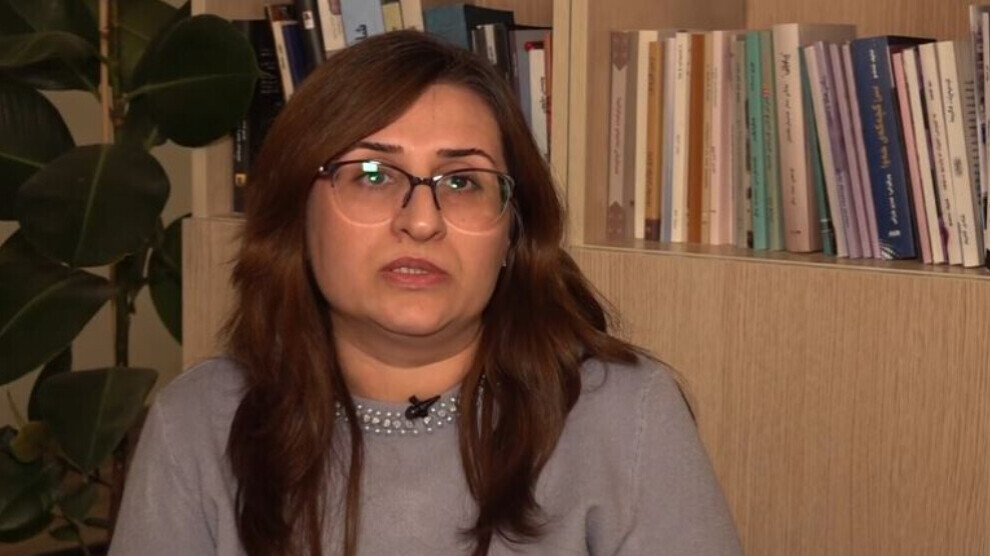
Journalist Bêrîvan Şaho says that for many years, the people have been living in a state of discontent with the Iranian regime. But for more than fourteen days, the masses have taken to the streets in protest against this regime. "Despite the deteriorating economic conditions, this uprising fundamentally reflects the accumulated anger and hatred of Iranians toward the dictatorial authority. This anger is the result of decades of injustice." She explained that after the Jin Jiyan Azadî uprising, the existing regime tightened its grip and intensified its campaigns of arrests and torture against civilians. “According to unofficial statistics, more than two thousand people were executed in Rojhilat and Iran after that uprising, which further fueled the anger of the people who today face a brutal and dictatorial authority in their pursuit of their rights.”
She believes that the Iranian regime’s policy of arrest, execution, and torture aims to silence voices opposing its policies. “Despite the arrests and executions, Iranians take to the streets to reclaim their rights and liberate East Kurdistan and Iran from the grip of dictatorship. This discontent has spread to other regions where the regime pursues a policy of repression, arrest, and torture, especially in areas where the issues of Kurdish rights, nationalism, and identity are raised, and which are now at the forefront of the resistance.”
Bêrîvan Şaho recalled the pivotal role women in Rojhilat and Iran played in the struggle and resistance. "They possessed a fighting spirit deeply rooted in the region's geography and specific circumstances. History testifies that they were never absent from the battlefields, whether against colonial powers like Russia and Britain, or in confronting the Iranian dictatorship, where they were subjected to the most brutal forms of oppression and exclusion."
She added that on March 8, 1979, between 8,000 and 15,000 women took to the streets, declaring their rejection of marginalization policies and affirming that women are not merely a silent element in society, but a force capable of leading change. "Over time, women's struggle escalated, culminating in the 'Jin Jiyan Azadî' uprising, which revealed that societal freedom cannot be achieved without women's freedom. Since then, women have been at the forefront of decision-making, leading the way in activities and protests, and forging a new path for resistance."
She affirmed that the Iranian regime, in an attempt to extinguish this spirit of liberation, continued its policies of repression through arrests, executions, and the exploitation of women in the cycle of drug addiction to weaken them and break their will. "They did not back down," she said, "but rather continued to build their unity and unify their voices, becoming today at the forefront of the confrontation with tyranny, proving that the will of free women is the primary condition for the liberation of society as a whole."
She emphasized that women, through their unity and solidarity, offer a genuine alternative that unites their voices and goals, making their struggle an extension of a long history of resistance, not merely a return to the past. The role of women today transcends mere demands; it has become fundamental in formulating alternatives capable of rebuilding social reality and establishing the values of justice and rights in the Middle East.
Bêrîvan Şaho concluded her speech by emphasizing that the people's demand is to end the authority of oppression, a demand that enjoys global support, because no dictatorial regime can last long in the face of people's rejection of it. "The only way to achieve rights and justice lies in building a real unity among the peoples of the region, so that the forces that confronted the dictatorship become a vanguard leading the change, and the voice of the masses becomes one in all cities and towns," explaining that the unity of the peoples and their descent into the streets as one front is the only way to end the Iranian dictatorial authority, and establish a future based on freedom, dignity and justice.