
Sama Bakkdash: Syria’s Stability Collides with Regional and International Interests
Syria faces a critical phase where regional and international interventions intersect with internal fragility, making inclusive political dialogue essential to reflect people’s aspirations and achieve security, stability, and sustainable development.
Asmaa Mohammad
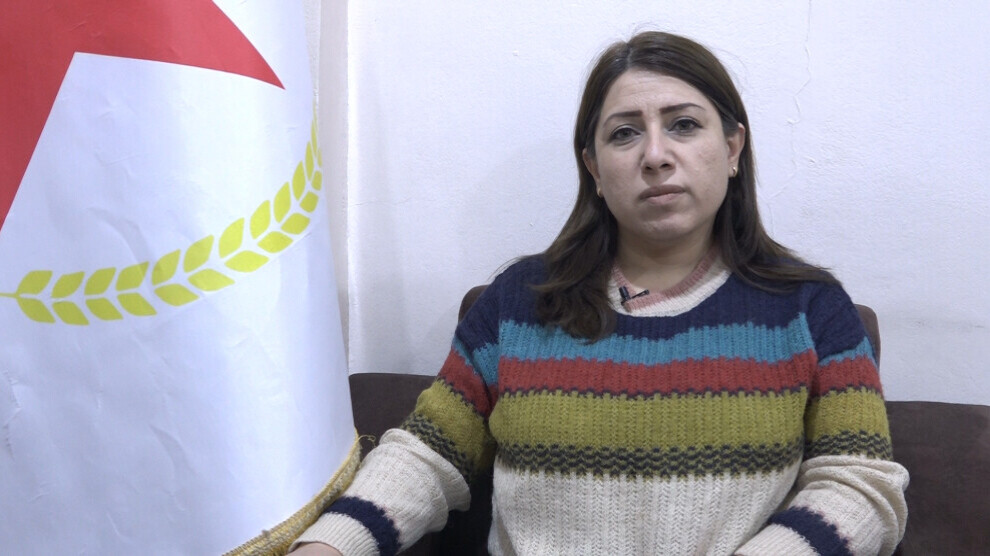
Qamishlo — Sama Bakkdash, spokesperson for the Democratic Union Party (PYD), affirmed that comprehensive political dialogue among all Syrian forces, along with the participation of women and youth in decision-making, constitutes a fundamental pillar for building a democratic, stable, and secure Syria—free from regional and international interventions and authoritarian practices.
The absence of security, political, and economic stability poses a major obstacle to reconstruction and development, and hinders the possibility of formulating a sustainable political system that represents all Syrians and guarantees their basic rights.
In this context, the urgent need emerges for an inclusive political dialogue that brings together all Syrian democratic forces, including women’s organizations that played a pivotal role in the revolution, as well as youth and civil society. Such a dialogue is essential to protect women’s gains and to establish a strong foundation based on active participation and equality in decision-making.
This dialogue is viewed as a key pathway to overcoming authoritarian centralization and achieving a democratic, multi-component Syria capable of safeguarding citizens’ rights, strengthening security and stability, and laying the foundations for sustainable economic and social development. Today’s challenge lies in unifying the political vision among all Syrian parties and achieving genuine internal consensus, free from external dictates and regional interests—enabling the Syrian people to shape their own future and build a Syria worthy of their sacrifices and aspirations for freedom, dignity, and democracy.
Participation Is Not a Choice, but a Fundamental Pillar of Any Political System
In this regard, PYD spokesperson Sama Bakkdash stated that Syria is currently passing through a critical and complex phase that requires all political actors to act responsibly and to fully open themselves to a serious and comprehensive dialogue, free from any external dictates or influences, in order to ensure the formulation of a future that reflects the aspirations of the Syrian people and achieves the desired stability, security, and democracy.
She explained that comprehensive dialogue must include all political forces, including women’s movements and organizations that played a central role in the Syrian revolution and contributed to protecting women’s rights and strengthening their participation in political and social life. She stressed that this participation is not optional, but rather a fundamental pillar of any future political system capable of representing all Syrians and achieving justice and equality.
Bakkdash pointed out that the Autonomous Administration of North and East Syria represents a living model of a democratic society, where active participation of all components—including youth, women, and diverse communities—can be built upon to form a solid foundation that establishes political stability, enhances security, creates opportunities for economic and social development, and reinforces the values of democracy and pluralism.
She further emphasized that the lack of security, political, and economic stability is closely linked to stalled progress, noting that advancement cannot be achieved without integration among these dimensions. She added that “ongoing attacks on civilians, the targeting of infrastructure and places of worship exacerbate the suffering of the Syrian people, hinder reconstruction and development efforts, and deepen the sense of uncertainty and anxiety among citizens.”
Regional and International Interventions
Regarding regional and international interventions, Bakkdash stated that such interference—particularly by the Turkish state—has played a decisive role in obstructing the Syrian process through policies targeting areas of North and East Syria, influencing political agreements, and intervening in coastal regions, Daraa, Suwayda, and the Golan, in ways that serve external interests at the expense of the Syrian people.
She clarified that these interventions are not a marginal issue, but rather a core factor that has obstructed any internal consensus and rendered Syrian decision-making hostage to international and regional agendas. “Any genuine and sustainable solution will only be achieved when decisions are in the hands of Syrians themselves, free from external pressure and interests,” she said.
The Syrian people have endured years of war, killing, and displacement, and the continuation of escalation and conflict serves only external powers, Bakkdash noted. Meanwhile, the Syrian people are in dire need of peace and security, the building of just political institutions, development, and the guarantee of human rights and citizenship.
She stressed that solidarity among democratic forces, youth movements, and women’s organizations represents the only path toward building a stable Syrian future. “Women’s participation in political leadership, diplomacy, and negotiations is a major achievement of the revolution and must be a fixed pillar of the future political system, reflecting their sacrifices and historic contributions to the defense of human rights and democracy.”
Bakkdash concluded by emphasizing that 2026 must be a year that brings peace, security, stability, and democracy to all Syrians. “Organized popular forces are capable of unifying their political vision. Constructive and comprehensive dialogue among all components—including women, youth, and civil society—is the path to achieving freedom and dignity, building a Syria that represents all Syrians away from authoritarian and centralized rule, preserving the gains of the revolution, and opening real horizons for comprehensive democratic development.”