
Moroccan Writer Documents Women’s Fragility and the Journey of Self-Reconstruction in Her Novel
Moroccan wirter Fatima Zahra Mahfoud,in her novel “I Survived Alone,” opens a discussion about women’s position within society, condsidering that women still face stereotypical modls that diminish their emotional and psychological worth. Hanan Hart
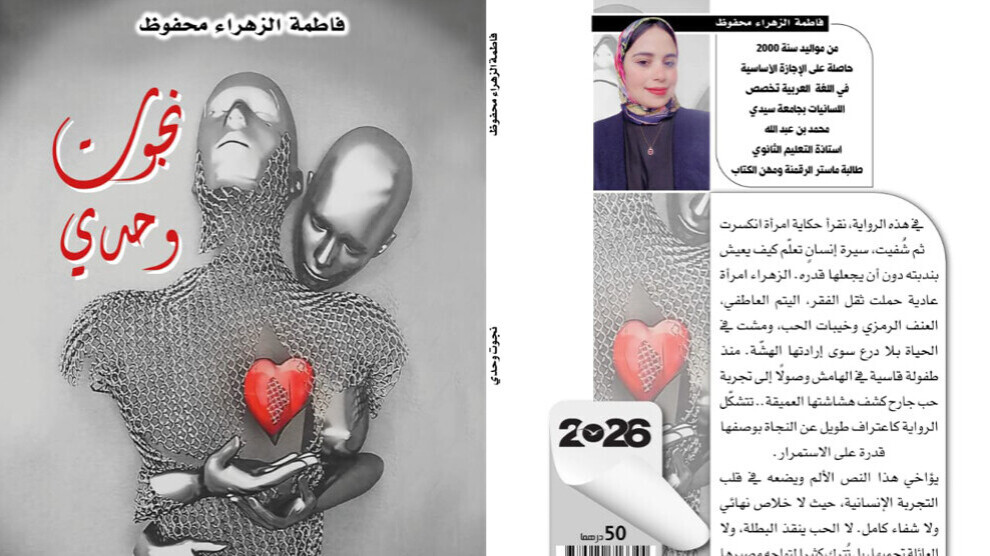
Morocco – In her new work "I Survived Alone," novelist Fatima Zahra Mahfoudh blends fiction and reality, presenting a feminist experience that goes beyond individual confession. She highlights early trauma, invisible emotional violence, and harmful attachment as extensions of social structures that sometimes place women in the position of perpetual victim. The novel traces the biography of a woman who grew up on the margins, burdened by poverty, emotional orphanhood, and lack of family containment—from a harsh childhood in the countryside to a destructive love experience that revealed her inner fragility despite her social and professional success.
The novel does not present love as salvation, but rather reveals how a relationship based on emotional manipulation and narcissism can reproduce childhood wounds and push a woman to lose herself in the name of the need for security. Nevertheless, the text does not fall into a discourse of pity or simplistic condemnation, but rather expands the questioning of the social and psychological structures that make women more vulnerable to attachment. The novel also opens discussion on emotional violence, narcissism, representations of love, and the experience of individual survival for women.
The Path of Survival and Self-Reconstruction in the Feminist Experience
Moroccan writer and novelist Zahra Mahfoudh stated that her new work titled "I Survived Alone" is a novelistic biography blending fiction and reality, sharing a feminist experience that transcends the boundaries of self-confession toward social sharing of the experiences of women who lived in different contexts within society.
She believes that feminist writing is not merely individual confession or writing for the self, but rather a social questioning of the experience of a class of women who lived emotional, psychological, and social fragility. She added that this is the fundamental role she sought to embody in this work, affirming that survival in the novel is not presented as a heroic victory, but as a path toward self-reconstruction.
She adds that survival means first coexisting with pain, then understanding life deeply through it, considering that the transition from the position of the "silent victim" to that of an active agent is the essence of this path. In this context, she evoked a saying by Russian writer Fyodor Dostoevsky that pain is the source of all deep consciousness, indicating that suffering may be an entry point to perceiving deeper truths.
Zahra Mahfoudh pointed out that overcoming pain does not occur without passing through a stage of frustration, which she considers a first step before reaching the summit. She stressed that survival is not the end of the story but its beginning. From here, her personal experience and the experience of many women in a society where stereotypical perceptions still diminish women and place them in ready-made molds, imposes, in her words, the necessity of writing and breaking barriers in order to achieve survival.
Emotional Violence and Childhood Wounds in the Path of Survival
In the novel, the author addresses emotional wounds and miserable childhood as foundational to later pain, explaining that early deprivation may lead to unbalanced emotional relationships, where a woman seeks attachment to people who are not suitable for her or to relationships based on control. She considers that a poorly founded past continues to control the present, and that pathological attachment is merely an extension of an unhealed early loss.
The novel also touches on emotional violence, which she describes as hidden and silent violence in society that leaves no visible physical traces but causes deep psychological harm, often hiding behind slogans of fear, jealousy, or even caring.
Zahra Mahfoudh believes that permanently placing women in the position of victim indirectly contributes to perpetuating this pain, calling for a conscious discussion about ways to save women from this "silent volcano" that may turn them into soulless bodies.
She pointed out that economic and professional independence, despite its importance, remains a necessary but insufficient condition for achieving balance, as psychological support and collective institutions for awareness and sensitization are necessary, especially since women are subjected, in her words, to invisible violence primarily, and there are many who are married but unhappy due to fear of society or of revealing the psychological pressure they experience.
She affirmed that feminist writing does not imply superiority between women and men, nor does it monopolize the expression of the feminine experience for women alone—men are also capable of that. However, women, in her view, are more able to convey the details and nuances of this experience by virtue of living it. She stressed that writing is neither a new birth nor a final victory, but rather a tracing and a stage for rebuilding the self and starting anew.
She emphasized that writing was for her a space for thinking and the beginning of healing, declaring, "Yes, I survived," but then noted that many have not yet healed, and that her work is directed to them to be light and hope. She addressed a message to every reader, male or female, that treatment, healing, and survival are possible no matter how long the road.
In conclusion, Moroccan writer and novelist Zahra Mahfoudh stressed that writing was for her a cry of exhaustion, liberation, and healing, echoing the saying she believes in: "I write to liberate myself."