
“Dunyazad”: A Novel of Loss That Gave May Telmissany a New Life
Egyptian novelist May Telmissany believes women writers today are bolder, exposing taboos and writing autobiographically through confessional narratives, despite what she calls persistent reader voyeurism in contemporary literary culture globally.
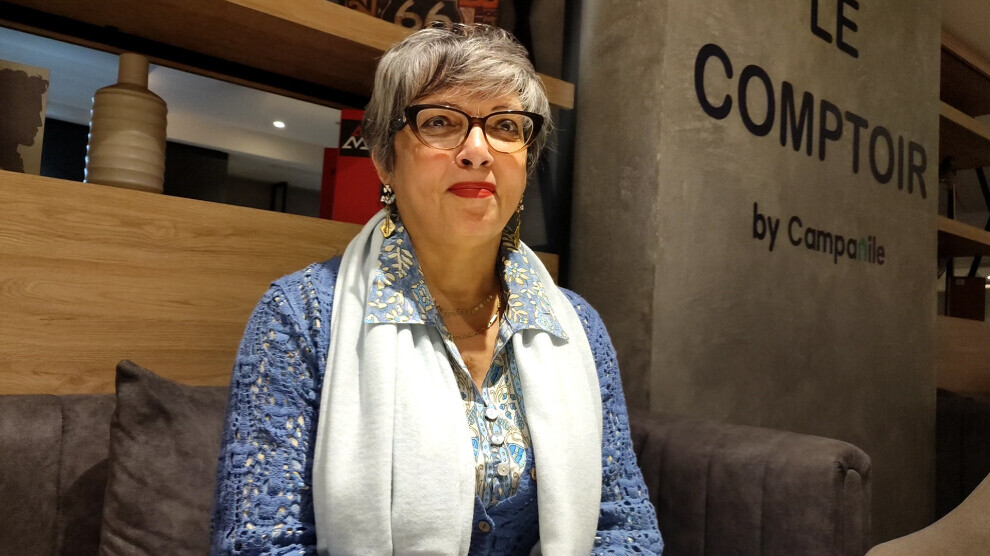
Zuhour Al-Mashriqi
Tunis — Egyptian novelist May Telmissany affirmed that writing from the self restores a woman writer’s freedom and grants her space for confession away from the judgments imposed by society. She noted that the boldness of today’s women writers in revealing silenced issues represents an important step toward restoring the value of the female voice in Arabic literature.
The novel “Dunyazad” brought May Telmissany back to life and is considered a luminous landmark in Arabic fiction, particularly in women’s literature. Despite nearly three decades having passed since its publication, it continues to enjoy remarkable success and sustained critical interest.
Telmissany explains that Dunyazad, her first literary work, was written in 1995 and published two years later in Egypt and abroad as an autobiographical novel. It is marked by a clear break from the dominant narrative styles of its time and carries a degree of fictionalization imposed by the nature of the novel as a genre.
She pointed out that the novel stems from an event that shook her life, as she chose to recount her experience in the hospital after losing her only daughter, “Dania Zad,” who was stillborn. She described writing at that time as an attempt to document the daily reality of grief and loss experienced by a mother who loses her child at birth, as well as a means of resisting loss by “creating a new child” through writing.
She explained that she sought to approach the experience of loss from multiple angles — from the protagonist’s loss of her job, to the loss of the family home or a close friend — as a way of reflecting on the pain of loss and its various manifestations from a feminine perspective.
The novel received wide critical acclaim in Egypt and was translated into eight European languages. Telmissany noted that with every renewed celebration of the novel, nearly thirty years after its publication, she feels that Dunyazad is still alive and continues to affect women readers. This, she says, is because motherhood does not receive the space it deserves in creative writing, despite touching a deeply sensitive chord.
Writing from the Self
Telmissany noted that she began writing in the 1990s, a period marked by widespread interest in autobiographical writing among authors of both genders. She pointed out that when a reader approaches an autobiographical novel written by a woman, the reader is often a “voyeur,” peering into the female self — even when the writer speaks of fictional experiences or characters — as if seeking to uncover her psyche, longings, and desires purely out of curiosity.
Today, women writers no longer hide behind characters; instead, they openly declare that they write from their own selves. This, she explains, surprises the voyeuristic reader with a degree of boldness and literary exposure, free of fear or shame. In Egypt, for example, novelist Miral Al-Tahawy wrote about her belonging to the Bedouin world, her movement between rural and urban spaces, and her personal experiences with various ideological currents. Poets such as Iman Mersal and Fatma Kandil have also written from personal experiences; the latter recently published “Empty Cages,” in which she explores her relationship with her family.
Telmissany believes that such writings represent attempts to restore the value of women writers, allowing them to confess freely and understand the self away from moral judgments, pressures, and boundaries imposed by society — particularly the community of readers.
Writing in the Context of Migration
Due to May Telmissany’s movement between Egypt and Canada, her relationship with writing has changed depending on the place she came from or resided in. “I imagine that if my migration had been to France, which is culturally closer to me, my relationship with place would have been different compared to migrating to Canada, an Anglophone and relatively young society,” she said.
She noted that migrants in Canada made her feel like “a stranger among strangers,” given that the country is no more than two hundred years old and that nearly everyone shares the experience of migration — a reality that granted her a certain degree of freedom.
She added that Canada’s cultural and civilizational diversity facilitated her integration as a writer. However, a challenge emerged in her attempts to publish academic research, as this field, according to her, does not show the same interest in her intellectual orientations and concerns. This led to the marginalization of some of her ideas and efforts, making her feel positioned on the margins of the Arab minority there, within cultural formations that do not celebrate literature.
Regarding gatherings that bring together women writers and intellectuals, Telmissany stressed their importance despite their rarity, due to the lack of sufficient attention given to literature. She emphasized the necessity of such forums as spaces for discussing shared issues, exchanging ideas and experiences, and enabling comparisons from which everyone can benefit.