
Kurdish Political Prisoners in Iran Send a Message of Support to Kobani and Rojava
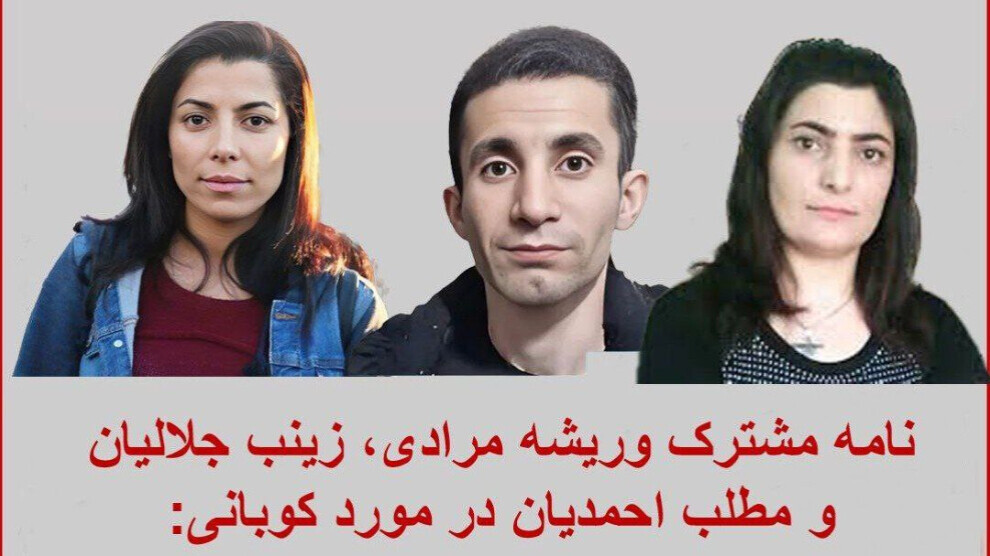
Three political prisoners said violence in Kobani and Rojava reflects a recurring Middle Eastern pattern, repeatedly devastating civilians throughout history, in their joint message of solidarity .
News Center — Reactions continue at both the regional and international levels regarding developments related to Kobani and Rojava, with positions ranging from statements of solidarity and calls for resistance to political analyses warning of the recurrence of violent patterns in the Middle East.
Three Kurdish political prisoners—Zeinab Jalalian, Werisheh Moradi, and Motaleb Ahmadian—issued a unified message expressing their support for the resistance of Kobani. The message stated:
“The time has come for the people of Kurdistan, the youth of Iran, and all freedom-seekers and Kurds to stand alongside Rojava. What is happening today in Kobani and Rojava is clear evidence of the repetition of the same historical pattern of violence in the Middle East, especially in Kurdistan—a vicious cycle that has repeatedly annihilated civilians, besieged them, and subjected them to repression.
The Battle of Kobani in 2014 was not merely a military confrontation; it was a defense that transcended state borders and political equations. In that battle, more than 815 defenders were martyred, including members of the resistance forces and civilian men and women, ranging in age from a seven-year-old child to a seventy-year-old woman. They held their defensive lines and resisted so that Kobani would not fall—clear testimony to the historic role of the people in resisting the dark forces of ISIS.
Today, efforts to strip resistance of its meaning continue through pressure on the people of Rojava, the weakening of Kobani as a symbol of resistance, and attempts to redefine resistance as failure. ISIS and its renewed violent variants have re-emerged in new forms with the support of regional and global powers. However, these superficial changes cannot eliminate the true meaning of resistance.
The experience of the people of this region has proven that resistance is not futile when it is grounded in awareness, the free will of society, and the inherent right to self-defense. We, the Kurdish political prisoners in Iran—who ourselves are caught in the grip of the same forces of repression—have been deprived of standing in the trenches of this defense. Yet this deprivation does not absolve conscious consciences of responsibility.
The time has now come for the Kurdish people, the youth of Eastern Kurdistan and Iran, and all freedom-seekers—not through slogans, but through genuine solidarity, humanitarian support, and public assistance—to stand alongside the people of Rojava, to preserve the meaning of resistance, and to once again prove that defending humanity, dignity, and freedom can achieve victory on the ground.”