
Palestinian poet Alaa Al-Qatraoui documents Palestinian pain through her writing
Palestinian writer Alaa Al-Qatraoui has authored works including Venus and the Ballerina, The Church Bells, and The Minaret and the Domes, intensifying her writing during Gaza’s assault.
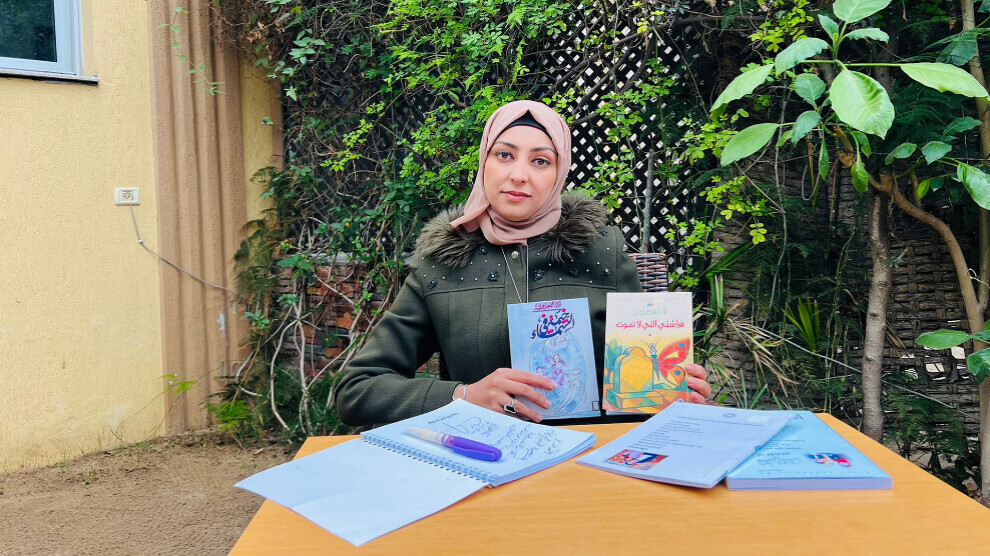
Rafeef Aslim
Gaza – Palestinian writer and poet Alaa Al-Qatraoui has intensified her literary production since the beginning of what she describes as the genocidal war on the Gaza Strip. Through books and poetry collections, she documents what she has lived through during this period, addressing the world to say that she is here, in this stricken place. In her writing, she portrays love, life, hope, struggle, loss, and a wide range of human emotions.
Al-Qatraoui explains that her journey began after graduating with a degree in Arabic language from one of the Palestinian universities. She worked as a teacher with the United Nations Relief and Works Agency (UNRWA), then decided to publish her first poetry collection in 2012 titled “When the Air Trembles.” Since then, her literary and poetic production has continued, with women as the central protagonists of her work.
Alaa Al-Qatraoui has won several awards. Her 2022 collection “A Waterwheel Trying to Sing” received the Al-Baltin Youth Award. This was followed by her collection “The Birds Steal My Bread,” which won the Fadwa Tuqan Poetry Award in 2025. Her work “My Butterfly That Does Not Die” was longlisted for the Sheikh Zayed Award, and most recently, her collection “A Tent in the Sky” received the Suad Al-Sabah Award for Palestinian Creativity.
She noted that these collections were not her only accomplishments. She also wrote a poetic play titled “Orkida,” as well as another book titled “Kinan Speaks to Me,” a series of narrative texts in which she imagined her child—who was killed during the assault—speaking to her while she responds. She emphasizes that loss is one of the harshest human emotions a person can experience, yet she has transformed those feelings to keep the memory of her children alive in books read by the world, lifting the veil on what she describes as the brutality of Israeli forces’ crimes.
“Pain is shared despite the differences in historical eras.”
When Al-Qatraoui received the Fadwa Tuqan Poetry Award, she felt as though she had received the banner from the great Palestinian writer and must continue what she began. Palestine, she says, passes the banner to its children—especially its women creators—entrusting them to speak of the shared pain across generations, despite differing historical periods. They are united by one dream: the liberation of the land and the establishment of their independent state.
From Venus and the Ballerina to The Church Bells, and from The Minaret and the Domes to the Palestinian woman, Alaa Al-Qatraoui has written about mothers, daughters, and sisters in all their forms: the slain, the wounded, the widow, and the grieving mother. Yet she has tried, as much as possible, not to strip these women of life’s beauty despite the surrounding darkness and the suffering they have endured. Those who hold her poetry collections see life overcoming death and hope rising above loss.
“If I die, draw my name beside me as a butterfly… I love butterflies, but I have found no balcony in the sky for them to fly. Hang a star on my gravestone so I may tell it, even in absence, that despite my siege I am still trying to walk toward you.” Though she writes these lines about death, she clarifies: “I write ‘if I die,’ but I do not want death. As a Palestinian woman, I deserve love, life, creativity, and brilliance.” She sees herself as a phoenix rising from the rubble, striving to create life from nothing.
The assault changed her style, she says: “Committed literature has taken on a clear role in my life. As a poet emerging from a grieving people, I express them. And as a mother of four children who were lost during the assault, I have become more committed to the Palestinian cause.” She adds that while she has always known the brutality of the occupation, the world as a whole has now witnessed it, especially as the majority of victims were civilian children and women who bore no responsibility for what happened.
She believes that every Palestinian woman deserves to be written about—the one who searched for her children under the rubble, then shrouded and buried them; who lived in a tent, lit fires to cook her food, endured hunger, and dressed her own wounds. She is a model worthy of writing, particularly as she has suffered for 75 years, since the Nakba of 1948, never tasting rest, as though inheriting pain and suffering from those before her. Every woman, she says, is a poem and a novel—no text can fully do her justice.
Al-Qatraoui concludes that writing gives her wings. Through her work, she strives not to forget her experience and not to allow the lost to become mere numbers. She attempts to revive what can be revived through a poem, a collection, a play, or a prose text. She is convinced that death belongs to their killer and life belongs to them, and that every sorrow has a story and a history. “When I write, I feel victorious. If I lose my life during the genocide, it will be enough that my texts live on and convey what I longed to express.”