
40 Years, Enough”: When Feminist Content Creation Becomes Resistance and a Rewriting of the Narrative
The program “Rana Huna” opens a feminist space for creativity and training, where personal experiences are transformed into documentary films addressing family law and violence, affirming that the struggle for equality is continuous, not seasonal.
Najwa Rahim
Algeria — “40 Years, Enough” is not merely a protest slogan, but the distillation of four decades of waiting, postponed questions, and diminished rights under the Family Code. From this awareness emerged the “Rana Huna” program, a feminist initiative that chose to transform silent anger into images, silence into voice, and personal experience into conscious content demanding real—not symbolic—equality.
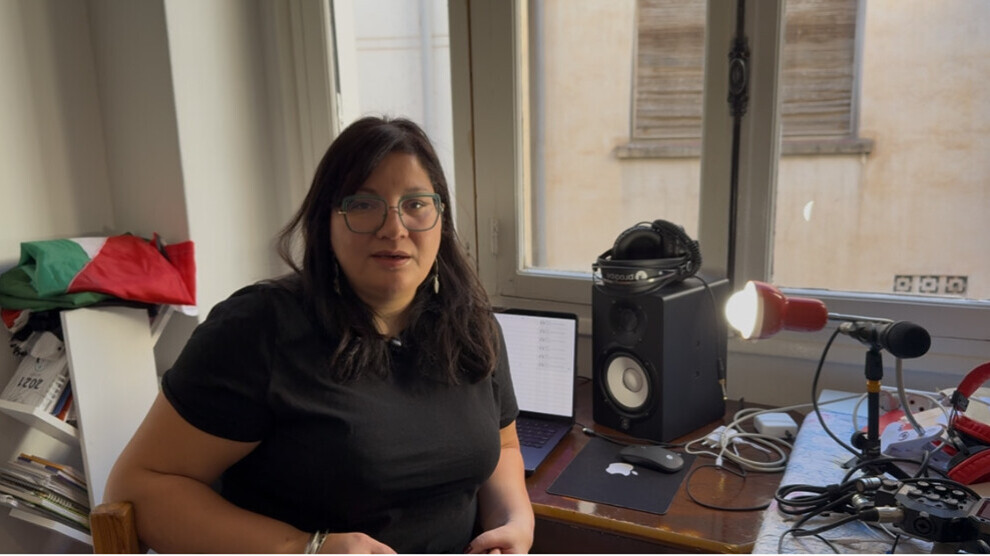
Amal Hajjaj, editor-in-chief of the Feminist Newspaper and supervisor of the “Rana Huna” program, explains that the second edition was a critical extension of the first rather than a repetition. After reopening applications under new conditions, feminist activists from various associations participated, adding intellectual and field diversity to the experience.
From an organizational standpoint, previous shortcomings were addressed, with greater emphasis placed on training quality, workshop content, and the practical process—from idea development to execution and directing—leading to the anticipated outcomes of this long journey.
Over nearly a full year of regular and intermittent training, 14 trainees from different provinces benefited from a comprehensive program combining sound, image, writing, editing, and short documentary filmmaking. The workshops were not merely technical; they evolved into open discussion spaces marked by creativity, where experiences, questions, and differences intersected. Through screenings of documentaries and previous works, participants’ understanding of content creation diversity expanded, while they were encouraged to refine their ideas and choose perspectives that genuinely represented them.
Based on these discussions, the supervisors adopted a fundamental principle: freedom of expression and choice. No specific topic was imposed, nor were participants forced into predefined angles. Yet—perhaps precisely because of this freedom—most works naturally converged around issues at the heart of the Family Code: violence, alimony, the difficulty mothers face in obtaining passports for their children, discrimination, and inequality. These themes emerged directly from women’s lived experiences and are currently being developed into short documentary projects.
The choice of the slogan “40 Years, Enough” was deliberate, coinciding with the fortieth anniversary of the Family Code’s enactment, as a conscious feminist attempt to reopen debate around a legal text that continues to directly shape women’s lives. The goal, as the program’s organizers stress, is to revisit core provisions to ensure real equality and justice—not merely cosmetic reforms.
In parallel with the 16 Days of Activism Against Gender-Based Violence, the program launched its first podcast series addressing violence in all its forms: economic, psychological, social, and domestic. The aim was not to produce event-driven content, but to break away from seasonal approaches that turn women’s suffering into temporary consumable material. Violence, as revealed by these episodes, is not an exceptional event but part of a daily reality that cannot be ignored or postponed.
Works Rooted in Feminist Conviction
At its core, “Rana Huna” seeks to change the narrative: to break stereotypes and challenge certain media practices that reduce women’s issues to testimonies summoned only during annual campaigns, without genuine concern for the issue or its context. What the program offers instead are works rooted in feminist conviction—produced and directed by activists who chose to tell stories in their own voices and share the experiences of women who have lived through violence, discrimination, and exclusion, with the aim of raising awareness rather than exploitation.
The publication of some of these works during the training period generated notable engagement, as other women reached out to the Feminist Newspaper or directly to the activists, expressing a desire to share their own experiences. This confirms that the content created a safe space for expression and fostered collective awareness around long-silenced issues, while the remaining documentaries—requiring more time and effort—are still in production.
Feminist Struggle Is Measured by Continuity, Not Seasons
As for the future, a third edition remains possible. More importantly, however, the Feminist Newspaper’s studio has become a permanent space for production and the regeneration of ideas, and a meeting point for women’s stories from diverse fields—a space grounded in the belief that change is cumulative, and that feminist struggle is measured by continuity, not by seasons.
In conclusion, Amal Hajjaj, editor-in-chief of the Feminist Newspaper, states:
“Despite all obstacles, and at the core of this path, the feminist demand remains clear and simple: real equality between genders in all fields. When women pay the same taxes and bear the same burdens, it is only logical that they enjoy the same rights.”