
How Do Sudanese Women Journalists Face the Challenges of the Ongoing Conflict in Their Country?
The conflict between the Sudanese Armed Forces and the Rapid Support Forces has continued since April 2023, leaving tens of thousands dead and nearly 13 million displaced, amid UN warnings of the world’s worst humanitarian crisis.
AYA IBRAHIM
Sudan — Sudanese women journalists face major challenges amid the ongoing conflict in Sudan, beginning with the journey of displacement, through the psychological trauma caused by its consequences and the loss of loved ones, in addition to professional challenges represented by their inability to access accurate information in order to convey it to audiences. This exposes them to accusations of lacking credibility in news reporting.
Inability to Access Information
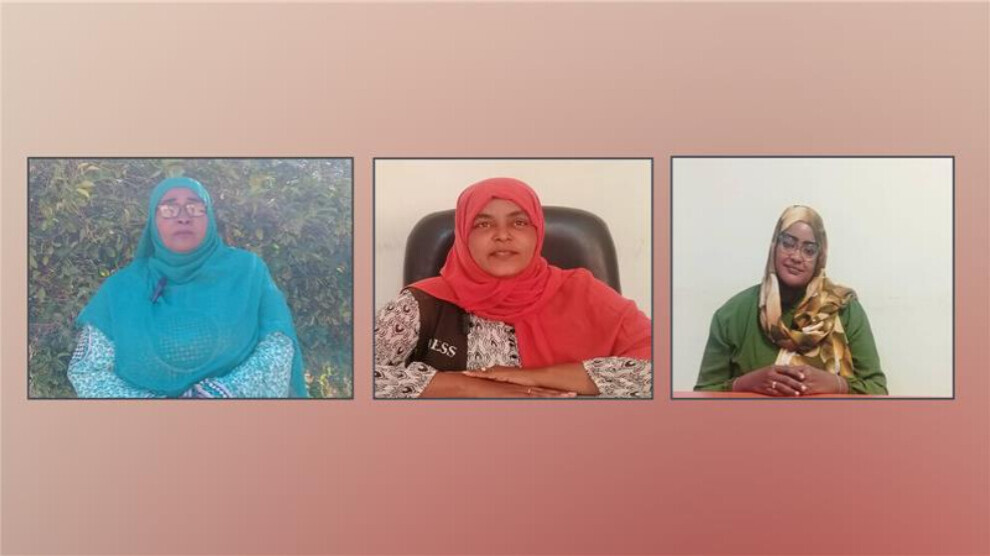
Ghada Othman Jawish, an official at the Supreme Council for Culture and Media, confirms that women journalists in her country face significant challenges under the current situation in Sudan, represented by the ongoing conflict between the army and the Rapid Support Forces, and the divisions caused by the war.
She explained that the conflict has resulted in widespread displacement among women journalists, leading to instability in their lives, in addition to the spread of media platforms on social media that circulate news. This, in turn, has led to the erosion of their rights and their inability to access information.
She also pointed out that the conflict has caused major economic impacts reflected in the decline of the financial compensation received by women journalists, expressing her sorrow over the loss of the lives of some women journalists and the disappearance of others.
In a recent report, the Sudanese Journalists Syndicate documented the killing of 14 journalists and media workers during 2025, along with dozens of violations that included enforced disappearances, arrests, legal prosecutions, as well as threats and defamation campaigns targeting journalists, both male and female, inside and outside Sudan.
Ghada Othman Jawish described the report as revealing the conditions of Sudanese women journalists, who face compound targeting that includes arrest, defamation, and threats, amid additional social and security constraints that hinder their access to protection and support.
A Call to Return to Work
For her part, journalist Rawah Mohammed Hussein affirms that “Sudanese women journalists are distinguished and capable of delivering information, and many of them have expressed themselves and succeeded in making their voices heard despite the challenges they face, especially in conflict areas where the protection of women journalists is absent, forcing them to take risks in order to fulfill their mission.”
She confirmed that the conflict has a major impact on women journalists who are unable to practice their media work normally. However, she believes that they “can find opportunities in training and capacity building to highlight their skills, as they are capable of producing news and proving themselves under the most difficult circumstances.”
She extended her greetings to Sudanese women journalists for their work under these conditions and for confronting challenges, calling on those who have stopped working to return and rise again.
The International Criminal Court has issued accusations against the Rapid Support Forces for committing war crimes and crimes against humanity during the siege of the city of El Fasher in North Darfur and taking control of it, including mass executions, the use of rape as a weapon of war, and the digging of mass graves to conceal evidence.
Based on investigations, sexual violence, including rape, is being used as a weapon of war in Darfur. According to estimates by UN experts, the Rapid Support Forces killed between 10,000 and 15,000 people in the city of El Geneina in West Darfur.
An Environment Dominated by Media Disinformation
Meanwhile, journalist Hijazia Mohammed Saeed believes that the challenges facing women journalists combine the risks of armed conflict, professional difficulties, and the inability to access information and news in an environment dominated by media disinformation, weak resources, and psychological challenges resulting from displacement and killings suffered by many Sudanese women.
She pointed out that there is difficulty in conducting live coverage, in addition to some women journalists being subjected to defamation, arrest, and systematic killing by the Rapid Support Forces