
Newroz in Eastern Kurdistan: A Strategy of Survival and Continuity of Struggle
As war, repression, and the January 2026 massacre loom over Eastern Kurdistan, Newroz raises a question: is celebration amid violence escape or resistance?
Shilan Saqzi
News Center — In societies that have experienced structural violence and wars, collective rituals often go beyond cultural boundaries and transform into a political arena. In such circumstances, holidays are no longer merely representations of tradition; rather, they become a form of resistance and a reclaiming of social time from the logic of war and power.
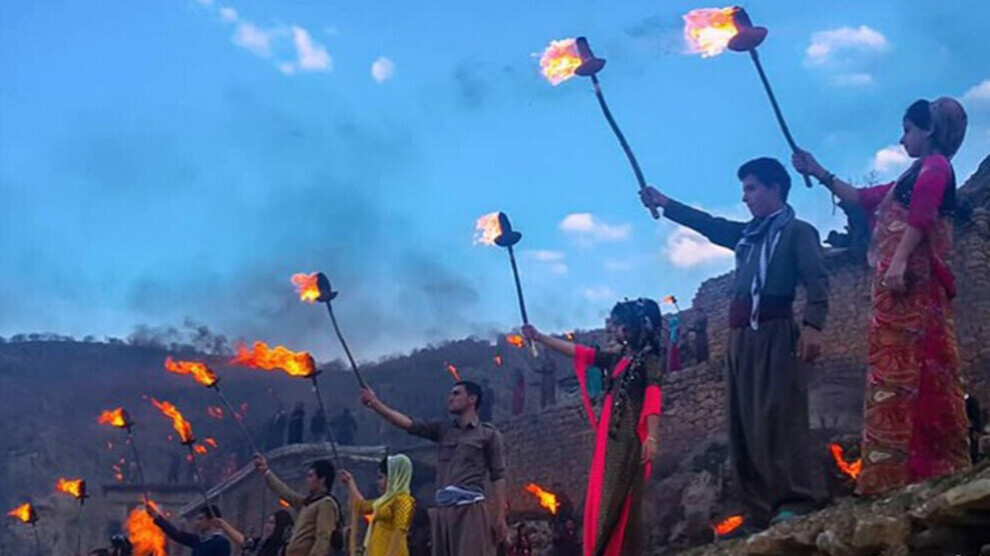
Newroz in Kurdistan can also be understood within this framework. Celebrating it on the brink of a regional war and under internal repression does not simply mean continuing a historical tradition; it represents a form of political presence — a collective affirmation that life is capable of reproducing itself even at the heart of organized violence. From this perspective, Newroz in this geography is not merely a holiday, but a conscious act in the face of a politics of death.
Newroz as a Ritual of Resistance and a Political Act
After the January 2026 massacre in East Kurdistan, and as the war between Iran, Israel, and the United States — along with tensions between Iran and some Arab states — entered its third week with Newroz approaching, a key question emerges: how is Newroz celebrated in Kurdistan as a political act?
Can celebrating Newroz under such circumstances be considered a “collective decision to live” in the face of the logic of death? A moment in which the community refuses to become merely an object of war, linking cultural time with political time.
In this geography, bodies are still exposed to violence, anger remains present, and society exists in a state between survival and transition. In such conditions, mourning could only gain meaning if it was quickly translated into action.
In contrast, in other parts of Iran, the dominant response has been a return to mourning rituals and elegies — as if there were a single political time in which everyone experiences the same historical moment.
This contrast is not moral or emotional; no one is “less sad” or “more sad.” Rather, it reflects a clash between two different systems of time and emotion.
For East Kurdistan, entering into the logic of sacred mourning at that historical moment was not a relief for pain, but rather deadly. The war was ongoing, bodies remained targets, and any pause would practically serve the machinery of repression.
If mourning becomes dominant under such conditions, it may transform from a source of resistance into a tool of submission. Here, authority attempts to impose the “emotional economy” of the center onto the margins — an economy that contradicts the logic of survival and continuity.
This is precisely where Newroz gains meaning beyond a cultural ritual: it becomes a form of “alternative political time,” a time in which society sets its rhythm against that of war and repression, rather than suspending life.
Ultimately, the issue is not denying mourning, but redefining its form and timing. The real question is not whether to grieve or celebrate Newroz, but: what kind of mourning, and at what historical moment, serves life?
Newroz in Kurdistan: A Political Counter-Thesis to Death
Newroz in Kurdistan cannot be understood as a neutral cultural celebration. What has emerged in East Kurdistan — especially in Kermanshah, Ilam, and recently Urmia — over the past two years represents a qualitative transformation in the relationship between politics, the body, and time.
In this context, Newroz does not suspend politics, but rather suspends the logic of authority. It is a moment in which society refuses to perform the role of the “grieving subject” imposed upon it.
In conditions of both regional war and internal repression, refusing to embody the “defeated subject” becomes a political act in itself — demonstrating that authority cannot fully control social time, even at the peak of violence.
This Newroz is not a return to “normal life,” but a redefinition of life itself as a field of struggle.
If political mourning is one of the main tools of power based on the logic of death — used to reinforce fear and suspend action — then Newroz in East Kurdistan stands on the opposite side of this logic.
Celebrating Newroz in the midst of war carries a dual meaning: it affirms the continuity of society and reclaims the future from within a state of emergency.
This is not a denial of loss, but rather a refusal to remain permanently in mourning. Loss is transformed into a temporary condition rather than a dominant political state.
Thus, Newroz is not a celebration of forgetting, but a rejection of permanent mourning — a rejection that directly disrupts systems built on glorifying death.
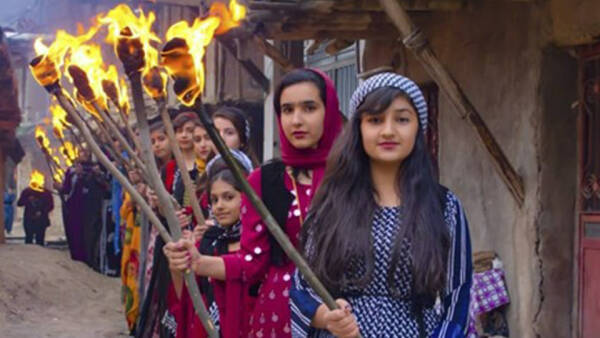
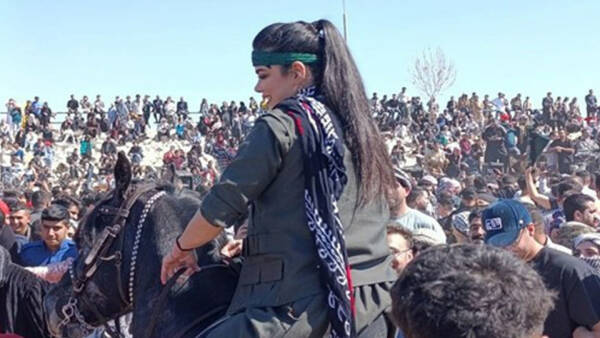
In such a context, even elements like dancing, clothing, fire, and singing transcend cultural symbolism and become tools for reconstructing the political sphere — reclaiming space, time, and the body.
Newroz in East Kurdistan becomes a conscious political intervention — not naive optimism, but an act aimed at disrupting the economy of fear.
Its implicit message is clear:
“Life, when it organizes itself, disarms death.”