
Sidar Khalaf: We Will Not Allow Women to Be Marginalized in the New Syria
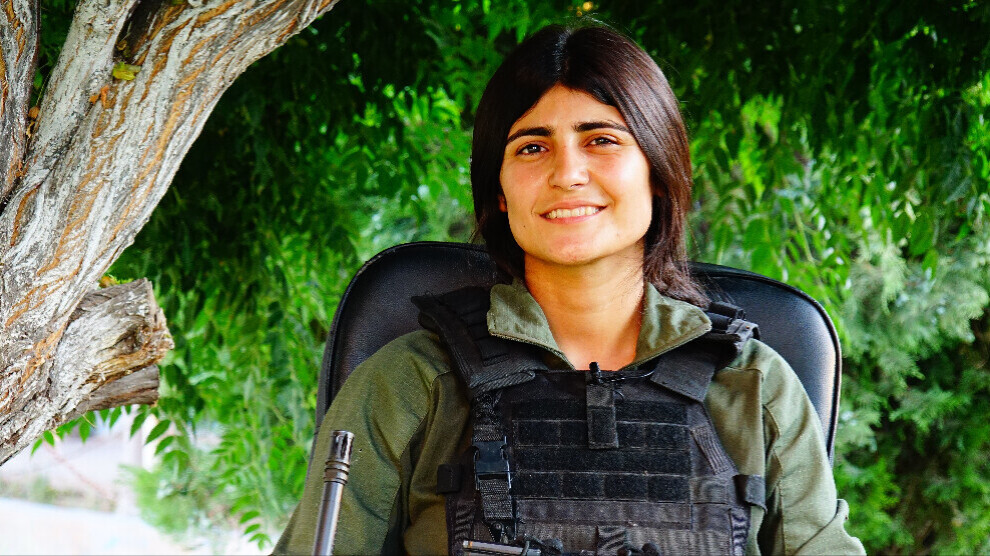
Between defending the land and building women's role, Sidar Khalaf, General Administrator of the Internal Security Forces – Women's Branch, affirms that women who made sacrifices demand an active role in shaping Syria's future.
SORKEL SHEIKHO
Tal Tamr — Rojava represents more than just the smallest part of a Kurdistan divided by borders; it is a land nourished by the blood of thousands of fighters who came from various parts of Kurdistan, alongside international fighters who stood with it in the battle to defend it.
Since the outbreak of the July 19, 2012 revolution in Kobani, the region has paid a heavy price, with tens of thousands of fighters becoming martyrs, laying the foundations of a political and social project that continues to this day, while later generations have carried the responsibility of protecting what was achieved and continuing the path the martyrs began.
Sidar Ma'sum Khalaf, General Administrator of the Internal Security Forces – Women's Branch, is one of the figures who has lived through the revolution's various stages. In 2016, moved by the martyrdom of her sister Berivan, she left school and joined the Internal Security Forces, beginning a journey that took her from the fronts of Raqqa, Deir ez-Zor, and al-Hol camp, to the current phase of restructuring the Internal Security Forces under the January 29 agreement between the Syrian Democratic Forces and the Syrian interim government.
The Revolution Changed the Meaning of Life and Women's Path
Sidar Khalaf says the shift from a life of school and home to carrying arms was not easy, but it gave her a new meaning to life, explaining that the revolution was the turning point that made her understand the reason for her struggle and her identity: "After I saw my relatives and friends joining the Internal Security Forces, I too developed a love for joining these forces and becoming part of them. Before that, we didn't see or feel any life beyond school and home. But once I became part of this revolution, I understood why I live, and I understood how to come to know myself."
She added that the difference between traditional life and the life of a woman engaged in the revolution resembles a struggle between two different forms of awareness and two different cultures, affirming that the revolution opened the door for women to learn their history, defend themselves, and reclaim their identity: "There's no doubt that family life and life within the Internal Security Forces – Women's Branch are completely different; they're like a struggle between two different forms of awareness, two mindsets, two cultures. Through the revolution, we learned how a woman protects herself, how she comes to know her history, and how she reclaims her identity."
She continued: "For a person to suddenly find themselves having left home and books behind to carry a weapon, and to have the burden of protecting the security and safety of an entire community placed on their shoulders — that was not easy. There were difficulties, but we also gained very valuable experiences that helped us build our characters."
She stressed that the people of Rojava did not wait for others to come and defend them, considering it illogical for outsiders to rush to protect the region while its own youth stood by as spectators. She said they took up arms in defense of their people, confronted ISIS and the Turkish occupation, and took part in dozens of security operations to protect the community.
From a Dream of Medicine to the Path of Struggle
She affirmed that Kurdish women refused to submit or accept the life of subjugation and servitude that extremist organizations tried to impose on them. She added that the struggle was not only in defense of the land, but also of dignity, identity, and women's right to manage their own lives and society, noting that women have moved beyond traditional roles, choosing instead the path of struggle, knowledge, and historical inquiry.
Sidar Khalaf revealed that her childhood dream was to become a cardiologist, but the conditions Kurds endured in Syria, being denied their rights and identity, and then the outbreak of the revolution, completely changed the course of her life. She noted that what gave them the most strength were the words of liberated women who said they had shed the "garment of servitude" and reclaimed their freedom, considering the reclaiming of Kurdish identity and the liberation of women from subjugation to be the greatest achievement made.
"We Have Rights That Must Be Recognized"
Speaking about Syria's future, Sidar Khalaf criticized the disregard for women's will during the transitional phase, affirming that women's rights are not a favor granted by any authority, but inherent rights that must be enshrined in the constitution, regardless of whether women took part in combat or not: "After fifteen years of war against terrorism and occupiers, and with the change of government in Syria, failing to recognize women's will is a deliberate policy. We will continue our struggle until our rights are enshrined in the constitution. But we will not wait, nor will we make ourselves dependent on the interim government to recognize our constitutional rights, because these rights are already our fundamental rights."
She considered that any government that does not recognize women's right to participate and to take part in decision-making does not, in essence, recognize the mother, sister, or daughter within society: "A government that does not accept women's presence in decision-making positions is, in the reality of its own consciousness, also failing to recognize the mother, the sister, and the daughters of its society."
She added that women who fought and made sacrifices will not return to the "garment of servitude," stressing that true Islam calls for justice and equality, while extremist groups use a radical interpretation of religion to restrict women and exclude them from public life.
She affirmed that Syria is entering a new phase today, and that a new state cannot be built with an old mindset that excludes women. She said that equality between women and men, the rule of justice, and guaranteeing women's rights in the constitution must be among the pillars of Syria's future, since women were essential partners in the struggle and must also be partners in building the state.
She warned against repeating the historical mistake that followed the First and Second World Wars, when women participated in fighting only to later be excluded from negotiating tables and peacemaking. She affirmed that the women of Rojava will not accept a repeat of this scenario, and will not allow the sacrifices of fifteen years to be reduced to decisions made by men alone.
Sidar Ma'sum Khalaf, General Administrator of the Internal Security Forces – Women's Branch, concluded by affirming that women will not stand by as mere spectators at the negotiating table, but will demand to be full partners in shaping Syria's future, in decision-making, and in determining the fate of women and peoples — considering that the sacrifices made during the years of the revolution grant them this right, one that cannot be ignored or taken away fromated.