
The Clay Oven…A Profession Forced by War That Threatens Women’s Health in Gaza
Amid smoke from burning plastic and the flames of a clay oven she built herself, a Palestinian mother continues her Daily struggle for a livelihood, after the war destroyed her career and made her the family’s breadwinner.
NAGHAM KARAJA
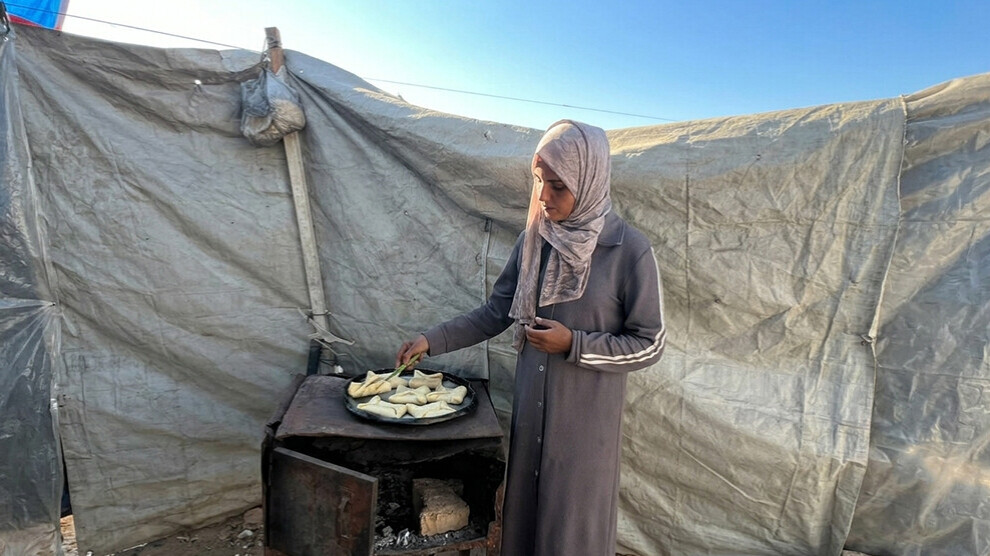
Gaza — The first rays of morning sun filter into a worn tent near the port west of Gaza City, as Aliya Abu Jarad sits before a small oven she built with her own hands from clay. She leans over it carefully, pushing scraps of nylon bags and pieces of plastic into its mouth. The fire ignites quickly, and thick black smoke rises, wrapping around the place — she doesn't pull away from it but leans in closer still, even as her eyes constantly water and her chest tightens with every breath she inhales.
From eight in the morning until seven at night, the woman in her thirties spends her hours in front of this primitive oven, making bread and a few simple baked goods to sell for a handful of shekels — barely enough to cover a single day's needs for her family of six. As sweat pours from her brow under the blazing summer sun, the work offers her nothing more than a temporary way to postpone hunger.
Before the war, Aliya Abu Jarad's life looked nothing like this scene. A graduate of a primary education program, she had been waiting to begin her career inside a classroom, passing knowledge on to children, and building for herself a future befitting the years she had spent at university. But the war stole those dreams from her, turning her university degree into a piece of paper powerless to help her or secure her a job.
Wiping her eyes, worn out from the smoke, she says: "I used to dream of standing in front of a blackboard as a teacher, but today I stand in front of a clay oven. I never imagined I would reach a point where inhaling poison is the price of feeding my children."
After a year and a half of forced displacement to Khan Younis, she returned to Gaza City, but not to her home in Beit Lahia in the north of the Strip — Israeli forces had destroyed it and leveled it to the ground. She found herself living inside a tent no more than a few meters wide, surrounded by scraps of fabric that barely block the heat of the sun or the wind, while the sandy ground has become a permanent bed for her and her children.
In that cramped corner, she made her only workplace. She had no money to buy a proper oven or safe fuel, so the solution was to build an oven out of clay and burn whatever she could find to keep it going — plastic, nylon, and remnants of materials whose composition she doesn't even know, but which she knows all too well are harming her body with every passing day.
She says: "I feel like the smoke lives inside me. My eyes hurt constantly, and sometimes I can't even open them from the burning — but if I put out the fire, I'll go back to my children with no bread."
The damage is no longer limited to her eyes; a persistent cough and shortness of breath have become constant companions as she continues sitting for long hours in front of the toxic smoke, because she sees no other option that offers even the minimum income.
With firewood prices rising and supplies running out, keeping the oven running has become possible only through a new risk — accompanying her husband to the town of Beit Lahia, an area still extremely dangerous, to gather remaining pieces of wood among the rubble. There, death becomes a possibility present with every step.
Lowering her voice as she recalls those moments, she says: "Every time I go out to collect firewood, I hug my children and say goodbye to them. I'm afraid I won't come back to them, but I go anyway, because I can't bear to see them hungry, and because the oven won't work without wood."
The hardest part of those trips is thinking about her infant daughter, who hasn't yet turned two and needs milk and diapers every day — needs that have become a burden beyond the family's ability to bear.
She recounts: "I leave thinking about my baby the whole way there. I'm afraid something bad might happen to me, but I'm also afraid she'll cry because there's no milk. Between fear and hunger, I don't have an easy choice."
One Battle After Another
When she returns at sunset, her suffering doesn't end. The tent sheltering her has become a breeding ground for rodents and insects that have spread due to accumulated waste and rubble. She spends part of the night keeping rats away from her children, and another part trying to soothe them after insect bites that no longer leave their bodies.
She says bitterly: "My work at the oven ends, and another battle begins inside the tent. I fear for my children from everything — from hunger, from illness, from insects, even from sleep."
The years of war haven't only drained her health but have also stolen her features; she looks older than her actual age, as responsibility, fear, and exhaustion have carved their marks on her face. And yet, she still refuses to give up or simply wait for humanitarian aid, which has become scarce and irregular.
Instead, she searches for an opportunity that would preserve her dignity, following announcements from women's organizations and centers, hoping to join a small economic project that could provide her with a safe oven, equipment to protect her from the smoke, and a proper place to continue her work, away from the sandy ground and the flames of burning plastic. She affirms: "I'm not looking for charity — I'm looking for a real job opportunity."
The war has forcibly reshaped the lives of women in Gaza; women who were once teachers, employees, or university students now work in grueling jobs that offer no minimum protection or stability. And yet, they continue their struggle in silence, driven by a will to survive and a deep belief that holding their families together has become a form of daily resistance.