
Children's tables are empty... the nutrition crisis in Kermanshah under the shadow of war and inflation
The sharp rise in food prices and the massive collapse in purchasing power have reduced the tables of many families in Kermanshah, East Kurdistan. This crisis has affected children more than others, pushing them toward hunger and malnutrition.
Sara Bourkhezri
Kermanshah – In the small, imagination‑filled world of children, colors always occupy the first place – colors that shine in their drawings and live in their dreams. But what fills their world most is the world of food and colorful sweets – a world rich in flavors, aromas, and the simple joys of life that give childhood its true meaning. However, this colorful world has long been extinguished for many children. Their tables no longer carry color or variety; they have been covered with shades of gray and black.
This is the story of children living on the margins of Kermanshah city in East Kurdistan, amidst poverty, food shortages, and neglect, fighting every day to survive. Children who no longer have a choice between different colors; they have been forced to choose between hunger and hunger – the harshest choice that can ever be imposed on a child.
Since the beginning of the war in Iran, along with escalating imposed economic disruptions, food prices have witnessed a sharp and unprecedented rise. The collapse of the national currency's value under the rule of the Islamic Republic of Iran has reduced the population's purchasing power to its lowest levels, to the point that many families are unable to secure the most basic necessities of life.
Under these circumstances, people's daily challenge is no longer about choosing the quality of food, but about the ability to satisfy hunger itself – a tragedy that is in itself a disaster in the twenty‑first century, in a country that possesses this amount of natural resources.
Tables shirnking day by day
Bodria L., a woman living in the Shahiad neighborhood of Kermanshah, Speaks with concern about the current economic conditions and their impact on her children’s nutrition. She says:” the price of a kilogram of chicken has reached 400,00 tomans. How can i afford to buy it amid this insane inflation? Everything has multiplied in price many times over, and we no loner have any ability to buy. İ can make do with a piece of bread and endure hunger, but what about my children? They are young and innocent. How long can i confort them with a tasty meal and deceive them?
This mother is just one of thousands of women who have become unable to secure the most basic necessities of life for their children in recent months under the weight of runaway inflation.
According to data from the Iranian Statistics Center, the inflation rate in food commodities since the beginning of the war has reached about 115%. This figure simply means that the prices of most food items have more than doubled. This insane price increase came at a time when the Iranian national currency had lost nearly half its value, in a collapse approaching 100%.
For women like Bodria L., the coincidence of these two factors – unprecedented price hikes and the collapse of the currency – means that even the simplest necessities of life have become out of reach.
Children in marginalized neighborhoods
Field visits to marginalized neighborhoods in Kermanshah show that a large portion of these children were already living in extreme poverty even before the war broke out. However, the outbreak of war and the unprecedented rise in prices have made their nutritional situation more catastrophic than ever.
In many families, meat has disappeared from the table for years, after becoming a commodity completely beyond people's ability. Families that used to buy chicken once a month now rely on chicken wings, necks, or feet to secure the minimum of food – parts that were previously considered waste. Mothers say they buy these parts only to maintain a meat‑like flavor in the food so that children do not feel deprived. In some homes, even these cheap cuts are distributed by rationing, as mothers prefer to abstain from eating so that enough remains for their children.
Ali N., a chicken seller in the Karnaji neighborhood of Kermanshah, says: "I have been selling chicken for years, but now, after everything has gone up in price, people can no longer afford to buy chicken. There is a woman whose husband died and she has two children. She comes every few days and begs me to save chicken feet and wings for her to cook for her children. What else can she do? She is forced to find any way to fill her children's hunger. A person really doesn't know what to say. The situation gets worse every day."
The seller says he has been in this profession for many years, but he has never seen people unable to buy such a basic commodity. This account is not merely an individual experience; it is an indicator of the enormous economic pressures on low‑income families, especially female breadwinners – pressures that have made tables smaller, food choices more limited, and deprived children of healthy nutrition.
This mother is just one of thousands of women who have become unable to secure the most basic necessities of life for their children in recent months under the weight of runaway inflation.
According to data from the Iranian Statistics Center, the inflation rate in food commodities since the beginning of the war has reached about 115%. This figure simply means that the prices of most food items have more than doubled. This insane price increase came at a time when the Iranian national currency had lost nearly half its value, in a collapse approaching 100%.
For women like Bodria L., the coincidence of these two factors – unprecedented price hikes and the collapse of the currency – means that even the simplest necessities of life have become out of reach.
Children in marginalized neighborhoods
Field visits to marginalized neighborhoods in Kermanshah show that a large portion of these children were already living in extreme poverty even before the war broke out. However, the outbreak of war and the unprecedented rise in prices have made their nutritional situation more catastrophic than ever.
In many families, meat has disappeared from the table for years, after becoming a commodity completely beyond people's ability. Families that used to buy chicken once a month now rely on chicken wings, necks, or feet to secure the minimum of food – parts that were previously considered waste. Mothers say they buy these parts only to maintain a meat‑like flavor in the food so that children do not feel deprived. In some homes, even these cheap cuts are distributed by rationing, as mothers prefer to abstain from eating so that enough remains for their children.
Ali N., a chicken seller in the Karnaji neighborhood of Kermanshah, says: "I have been selling chicken for years, but now, after everything has gone up in price, people can no longer afford to buy chicken. There is a woman whose husband died and she has two children. She comes every few days and begs me to save chicken feet and wings for her to cook for her children. What else can she do? She is forced to find any way to fill her children's hunger. A person really doesn't know what to say. The situation gets worse every day."
The seller says he has been in this profession for many years, but he has never seen people unable to buy such a basic commodity. This account is not merely an individual experience; it is an indicator of the enormous economic pressures on low‑income families, especially female breadwinners – pressures that have made tables smaller, food choices more limited, and deprived children of healthy nutrition.
The face of hunger in the streets of Kermanshah
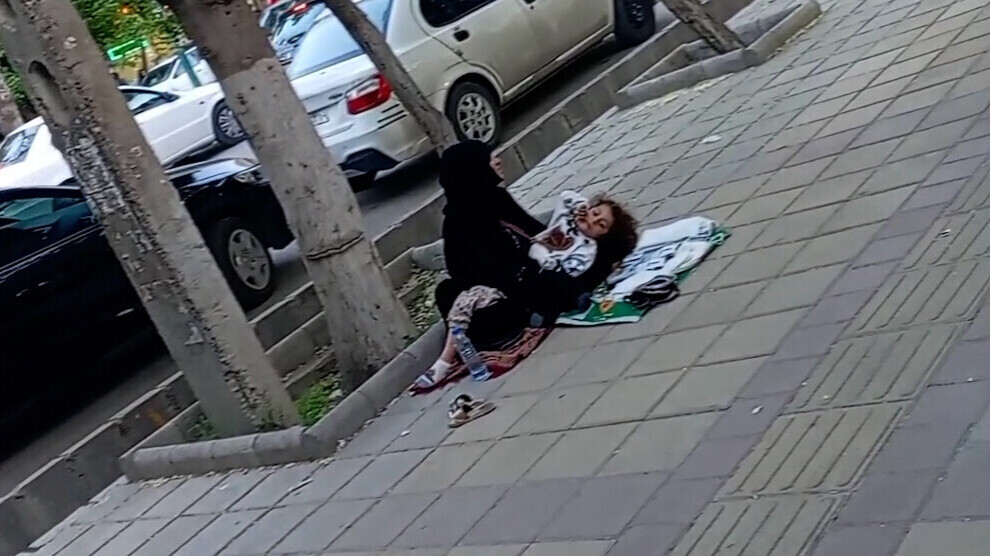
But to understand the depth of the nutrition crisis among children in Kermanshah, there is no need to sneak into the dilapidated, damp houses on the city's outskirts or search for hungry children in the darkness of marginalized neighborhoods. It is enough to walk a few minutes in the city's streets – the sight of children sitting in their mothers' laps, driven by need to beg for survival, is more eloquent than any statistic or report.
These children have spent their entire short lives in poverty and hunger; a generation raised in deprivation before they even had a chance to live their childhood. Based on the available data and analyses, it can be said with greater certainty that the conditions of children in Kermanshah – a province that ranks second in the country on the misery index according to official statistics – have become even more catastrophic as a direct and indirect result of the war.
In general, it can be said that the economic situation of society, under government decisions that never stop beating the drums of victory in the war, is experiencing a deep and draining collapse. This collapse is not limited to numbers and graphs; it is directly reflected in people's daily lives, placing children at the forefront of the most affected groups.