
Rural Women in Yemen... Growing Presence and Pivotal Role in Agriculture
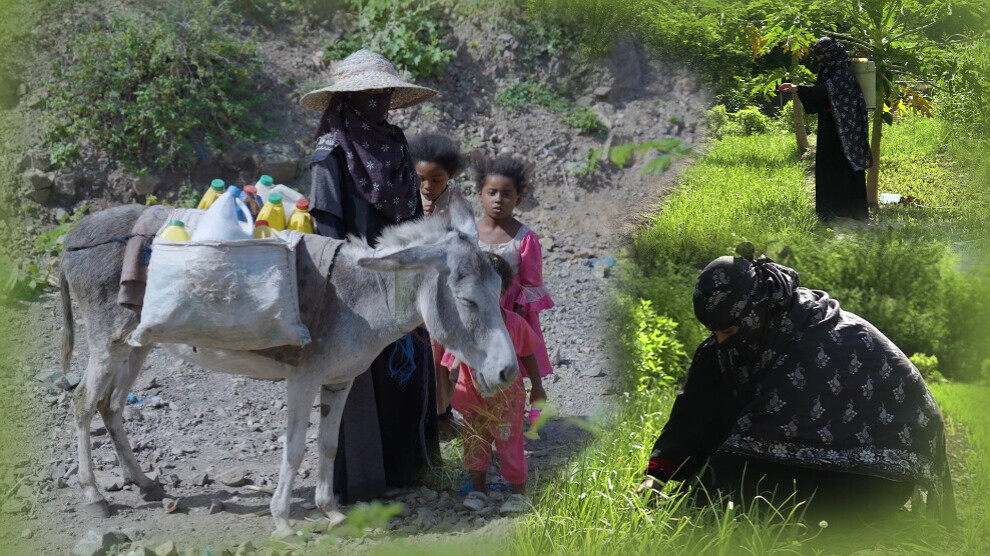
Yemeni women are vital to agriculture and family livelihoods, working long hours in farming, herding, and fetching water, while also contributing to household income.
RAHMA SHANZOUR
Yemen — Studies by the World Bank indicate that approximately 95% of women in rural Yemen work continuously in agricultural activities, highlighting the need to expand awareness and extension programs, and to enhance opportunities for their economic empowerment.
In the city of Taiz, in the Al-Dabab area, Fatima Qaid Saeed (58 years old) recounts a part of this suffering. For years, she has worked cultivating vegetables which she sells in local markets to secure her family's needs. She says: "I have worked in agriculture for many years; it is my only source of livelihood, and from it I provide for my family and help raise my children. We start work at sunrise, and our day does not end until sunset—watering crops and caring for them."
She adds that recent years have become more difficult due to water scarcity, as available quantities no longer suffice to irrigate her farm, forcing her to spend long hours, from morning to evening, searching for water to save her crops.
She explains: "The biggest problem we face today is water scarcity. Often I spend hours searching for water so that the crops do not die. Water scarcity has affected our production, and we have begun to lose part of our harvest due to drought."
The challenges do not stop at the water crisis; the deterioration of economic conditions in the country has led to a decline in citizens' purchasing power, which has affected her sales, as she can no longer sell her entire farm production as she used to.
She says: "Even when production is good, we do not find buyers as before, because the economic situation has made people unable to buy everything we offer in the markets."
Fatima Qaid Saeed affirms that rural women play a pivotal role in supporting the family through continuous work in agriculture, fetching water, and livestock rearing, noting that she has been able to raise her children and support her family thanks to her work in agriculture, despite harsh conditions and growing challenges.
Double Suffering Between Agriculture and Herding
The suffering of rural women is not limited to agriculture alone; many of them combine farming with livestock rearing to secure their families' needs.
In the same area, Maryam Mohammed (62 years old) recounts another aspect of rural women's lives. She works daily in herding sheep and raising animals, alongside her participation in various agricultural tasks. She says: "I go out at dawn to collect grass to feed the sheep, then I continue working all day between caring for animals and tending to the farmland. There is no time for rest."
She adds: "Every day we begin a new journey of struggle for our families. We plow the land, cut trees, harvest fruits, water crops, and herd livestock. All these tasks are done by women despite their difficulty."
She affirms that her continued work, despite her advancing age, is due to her responsibility to support her family, noting that rural women now bear increasing burdens under difficult economic conditions and have no choice but to continue working to secure a living.
A New Generation of Suffering
This reality is not limited to older women but is also experienced by girls and young women in rural areas. Khuloud Faisal (21 years old), a housewife, says that rural women bear most of the responsibilities of daily life, both inside and outside the home.
She adds that rural women's lives are exhausting, especially during summer. "We suffer greatly with high temperatures, yet agricultural work is more intense during this season, making working hours longer and more arduous."
Regarding her stopping her education, she says: "Most girls study until secondary school, then get married, and do not get the opportunity to complete their education, because some rural communities still view a woman's place as the home and agricultural work."
The testimonies of Fatima, Maryam, and Khuloud reflect the reality of thousands of rural women in Yemen, who bear the responsibilities of agriculture, livestock rearing, and household management amid increasing challenges—most notably water scarcity, weak agricultural support, deteriorating economic conditions, limited educational opportunities, and the persistence of some social customs that restrict girls' futures. This makes empowering and supporting rural women a necessity for enhancing food security and improving livelihoods in rural communities.