
Raids, arrests, and digital restrictions… Report documents targeting of women journalists in Turkey
The Mesopotamia Women Journalists Association (MKG) reported in February an increase in violations against women journalists, emphasizing that press freedom and the public’s right to information face systematic targeting.
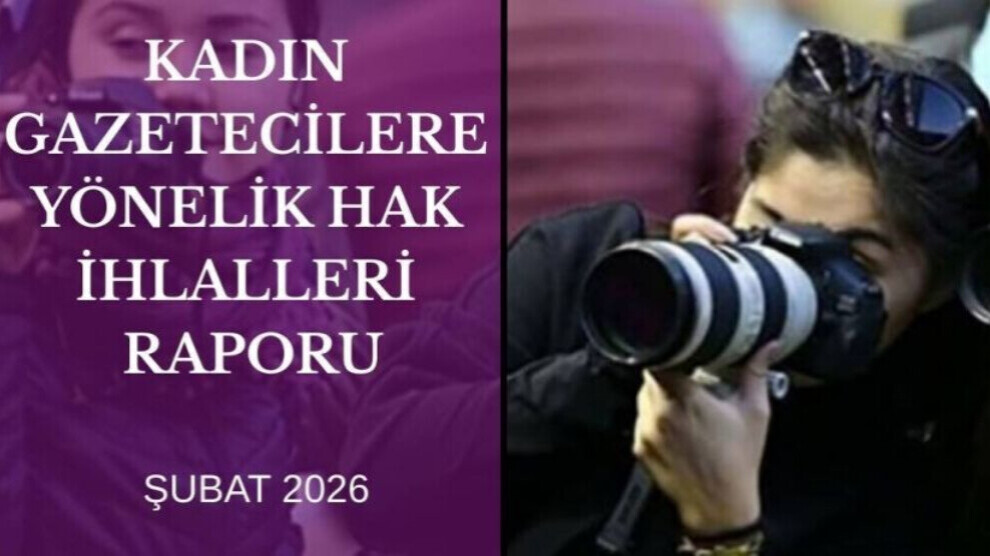
Amed — The media landscape in Turkey is witnessing a noticeable rise in violations against journalists amid growing restrictions on freedom of expression and the journalistic working environment. Reports indicate that journalists are facing raids, arrests, digital restrictions, and field assaults that hinder them from carrying out their work.
The Mesopotamia Women Journalists Association (MKG) released its February report on human rights violations against women journalists, emphasizing that journalists’ right to report news and the public’s right to access information are being “systematically targeted.” The report drew attention to the increasing pressure and violations faced by women journalists while performing their duties and warned of their impact on media freedom and the safe flow of information to the public.
The report highlighted violations faced by journalists during February, noting that throughout the month journalists experienced home raids, detentions, arrests, physical assaults, obstruction and ill-treatment in the field, criminalization through legal procedures, and restrictions on access to digital space. While the public role of journalism was suppressed through security policies and a climate of impunity, journalists were targeted in multiple ways, either because of their professional activities or because of their identity as women.
“Journalism is being criminalized”
The report noted that operations targeting free and opposition journalism effectively obstruct news coverage and also target journalists’ workplaces. It stated that criminalizing media workplaces and restricting journalists’ visibility on digital platforms is not only an attack on journalists but also a violation of the public’s right to access the truth. Such practices, aimed at silencing women journalists and suppressing their voices, narrow the democratic public space and make access to truth more difficult.
“Targeting women journalists”
The report stressed that journalism is not a crime, and that following news, taking photographs, conveying information for the public interest, documenting events on the ground, and publishing them are essential elements of freedom of expression and press freedom. It emphasized that targeting women journalists constitutes a serious violation of their rights to equal citizenship, freedom of expression, and the principles of democratic society.
The report called for an end to detention, arrest, prosecution, and violent practices against journalists. It also urged effective investigations into law enforcement interference and mistreatment that hinder journalists’ work in the field and warned against protecting perpetrators through impunity. The association demanded an immediate halt to digital censorship practices, the removal of restrictions on access to news content and media accounts to guarantee freedom of expression, and the lifting of all limitations on press and expression freedoms in line with international human rights standards.
The association reaffirmed in its report that it will continue to stand with journalists to expose human rights violations and strengthen solidarity, stating: “We will continue to stand with journalists to make human rights violations visible and to strengthen solidarity.”
Raids and detentions
According to the report’s statistics, authorities raided the homes of four women journalists in February. Five others were detained and four were arrested, while five women journalists were subjected to ill-treatment. The report emphasized that women journalists are targeted in multiple ways, either because of their work or because they are women.
The report added that two journalists faced investigations in February, with charges filed against one of them. Three journalists were penalized, receiving 18-day suspended prison sentences and a fine of 1,800 Turkish lira. There are currently 12 ongoing cases involving 14 individuals, while five journalists remain in prison.
It also stated that journalists were beaten, obstructed, and mistreated in the field throughout February. On February 1, police intervened to prevent journalists from covering the Rojava Solidarity Day march in Ankara. On February 13, Sevim Saylam, a correspondent for Evrensel newspaper covering a collective bargaining process for the Çankaya Municipality in Ankara, was obstructed and mistreated.
The report noted that on February 3, Turkish police raided the ETHA News Agency in Istanbul, confiscated equipment, and arrested several journalists. A few days later, the agency’s editors Nadia Gurbuz and Pinar Gayip, as well as journalist Elif Bayburt, were arrested.
It also reported that messages and books sent by MKG members in solidarity with ETHA journalists were returned on February 23 under the pretext that the shipment was “not accepted.”
According to the report, eight websites and seven social media accounts were blocked during the past month, including the Mesopotamia News Agency WhatsApp channel. Access to the agency’s accounts, as well as the Yeni Yaşam and JINNEWS accounts on X, was restricted. The agency’s YouTube channel was closed and its TikTok account was also blocked.
Under the heading “List of Detained Journalists,” the report listed the following names: Elif Bayburt (ETHA), Khadija Duman (Atılım Gazetesi), Nadia Gurbuz (ETHA), Ozden Kenik (TRT), and Pinar Gayip (ETHA).