
Mothers on the Lines of Protection… Qamishlo Women Take Up Arms Against Threats
Amid escalating security tensions and mobilization, women in Qamishlo emerged as a primary defense, taking up arms to protect homes, neighborhoods, and land despite sacrifices.
ASMAA MOHAMMAD
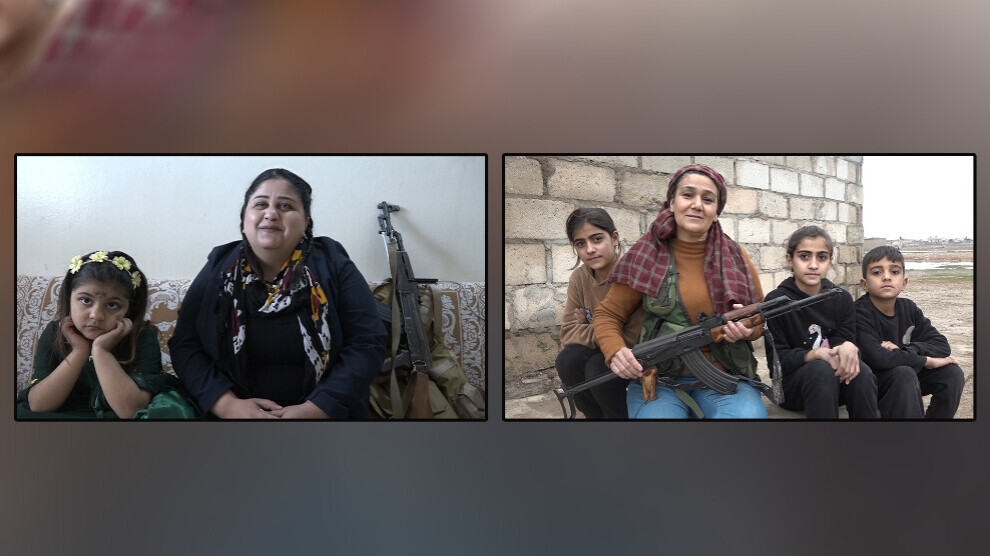
Qamishlo – Women from the city of Qamishlo in Rojava confirmed that taking up arms was not driven by a desire for war, but rather an unavoidable choice imposed by security tensions and the declaration of general mobilization. They found themselves directly responsible for protecting children, homes, and neighborhoods, while supporting the forces tasked with defending the region—stemming from a belief that motherhood, in times of danger, transforms into an act of protection and resistance that does not allow retreat.
The Results of Protection Have Become Tangible
Laila Ali Al-Din Hassan, a mother of three, explained that carrying a weapon was not a choice born out of a love for conflict, but a forced response to exceptional circumstances created by recent developments.
“The declaration of general mobilization placed a direct responsibility on residents—especially women—to protect neighborhoods and homes. Women did not hesitate to stand alongside the forces responsible for safeguarding the region,” she said.
She added that women involved in protection conduct day and night patrols, fulfilling their duties around the clock without interruption. Despite the harsh conditions, the work has not stopped, as the primary goal remains protecting children and preserving the dignity of the community.
“We are not lovers of war, but the current reality has forced us to carry arms to defend ourselves, our dignity, and the future of our children.”
Hassan noted that the security tensions have not targeted a single community, but have affected all components of the region—Kurds, Syriacs, Arabs, as well as Alawites, Druze, and others—strengthening women’s sense of responsibility to unite in protecting the social fabric and preventing any attempt to destabilize the area.
She explained that women took to the streets and assumed protection duties with all their determination, emphasizing that even in the absence of weapons, they are ready to defend themselves and their children by all possible means.
“Women support the forces defending the frontlines, while also spreading throughout neighborhoods and among residents to ensure security and protect everyone.”
The declaration of general mobilization, she said, contributed to the arrest of several suspects who attempted to undermine the region’s security, stressing that the efforts made were not in vain. The results of protection have become tangible on the ground, with a growing sense of safety and stability.
“This protection is carried out with love and collective will, far removed from any personal interests.”
In a deeply human moment, Hassan revealed that she accompanies her young daughter while carrying out protection duties so she can remain by her side at all times.
“This behavior stems from a mother’s feeling that her responsibility does not stop at her own children, but extends to all children in the region. Women have not fallen short during this phase; rather, they have played a central and effective role, particularly in community protection.”
She noted that women of all ages—from young girls to elderly women—have demonstrated remarkable strength and readiness to confront any potential threat.
“Women support one another and will not allow any party to violate the dignity of the people. Kurdish women, who have confronted the most dangerous terrorist organizations, foremost among them ISIS, have proven that their will cannot be broken and that they will face all threats.”
Laila Ali Al-Din Hassan concluded by stressing that unity is the only path to overcoming injustice.
“The Kurdish people, through their cohesion and unity, will not be defeated.”
Preventing Any Threat or Infiltration Endangering Civilians
For her part, Awaz Ali said that the recent security situation in the region pushed women to take up arms to protect their children and homes. She emphasized that this decision aimed to prevent any threat or infiltration that could endanger civilians, especially with most young men deployed on the frontlines.
“Today, women are playing a dual role,” she said.
“Young men and women are fulfilling their duties on the frontlines, while women inside neighborhoods take on protection and support tasks—carrying arms and standing alongside the forces defending the region.”
She affirmed that when a mother feels danger approaching her home or children, she instinctively becomes an unbreakable force.
“We will not allow any enemy to uproot us from our land or threaten the safety of our children. We will do everything in our power to defend them without hesitation.”
Awaz Ali added that, in addition to bearing arms, women provide various forms of support—preparing food, staying awake at night, guarding neighborhoods, and participating in night patrols—to maintain security and stability.
“Women are ready to sacrifice their lives for the land,” she said, calling on every woman capable of defending her children not to retreat from this duty.
According to Awaz Ali, women are no less courageous or strong than the men on the frontlines.
“A woman carrying a weapon is evidence of her awareness, strength of thought, and deep sense of responsibility toward protecting children and society. Women stay awake through the night and continue through the day in carrying out protection duties, without fatigue or retreat