
Islamabad Bombing Brings ISIS Back into the Spotlight, Raises Fears of Regional Expansion
The bombing of Imam Barqa Mosque in Islamabad, which killed 31 people, has reignited concerns over the return of ISIS in Pakistan and fears of its regional expansion amid fragile security conditions and escalating sectarian violence.
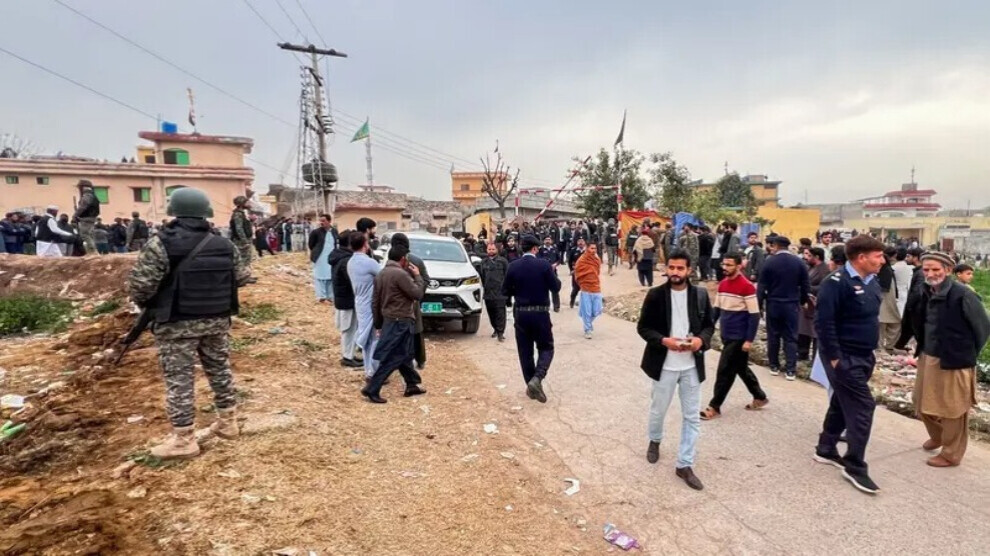
News Center — Security experts have warned of a renewed resurgence of ISIS, its expansion of influence, and its reassertion of presence at a time when many countries are witnessing violence, conflicts, and wars.
The death toll from the bombing that targeted the Shiite Imam Barqa Mosque in Pakistan’s capital, Islamabad, has risen to 31 killed and more than 169 injured, according to Pakistani police on Saturday, February 7.
The Pakistani newspaper Dawn reported that the explosion occurred during Friday prayers in the Shahzad Town area inside the mosque, where hundreds of worshippers had gathered when the blast detonated, resulting in a large number of casualties.
The attack has sparked widespread fears of ISIS’s return to the forefront in Pakistan, especially as the group has claimed similar attacks in previous years targeting the Shiite minority in various parts of the country. Observers believe that carrying out such an attack in the heart of Islamabad—an area usually subject to strict security measures—reflects ISIS’s ability to rebuild its networks and conduct sophisticated operations in sensitive locations.
Security experts warn that ISIS is seeking to exploit Pakistan’s fragile security situation and sectarian divisions to expand its influence and reassert its presence in South Asia, at a time when the country is witnessing a rise in violence in the provinces of Balochistan and Khyber Pakhtunkhwa, some of which has been claimed by groups linked to ISIS or the Taliban.
This bombing is considered the deadliest attack in terms of casualties in the Pakistani capital since September 2008, when a suicide truck bombing killed 60 people and destroyed part of a luxury hotel.
Regional Risks
The return of ISIS to carrying out attacks of this magnitude in Pakistan’s capital does not only pose an internal threat, but also raises fears of its expansion across borders into Afghanistan and India, and possibly other parts of South Asia. Analysts emphasize that ISIS is seeking to reinvent itself as a transnational force, taking advantage of security chaos and weak regional coordination in counterterrorism efforts.
With continued security breaches and growing sectarian violence, the risks appear to be compounded not only for Pakistan but for the entire region, as ISIS’s expansion could pose a cross-border threat that revives memories of years of bloodshed and chaos.
The attack comes amid escalating activity by ISIS’s branch known as “Wilayat Khorasan,” which is currently considered one of the most brutal and active ISIS affiliates. This branch has carried out a series of deadly attacks in recent years in Afghanistan and Pakistan, targeting civilians and religious minorities in an attempt to ignite sectarian strife and destabilize the region.
Although ISIS lost most of the territory it once controlled in Iraq and Syria since 2017, it did not disappear. Instead, it restructured itself as a global network of cells and branches spread across conflict zones.
In Iraq and Syria, ISIS remains active in desert and rural areas, relying on hit-and-run attacks. The risks have intensified, particularly after attacks carried out by jihadists from Hayat Tahrir al-Sham in northern and eastern Syria, where the Syrian Democratic Forces had been responsible for preventing the escape of ISIS members from prisons. These attacks and the takeover of several prisons led to the smuggling of many ISIS members, while prisons were evacuated of the group’s detainees, posing an extremely serious threat.
In Africa, ISIS elements control large areas in Mali, Niger, and Burkina Faso, while its branch in Nigeria (ISWAP) remains active, alongside its presence in the Congo and Mozambique. In Yemen, Libya, and Egypt’s Sinai Peninsula, ISIS still has pockets and cells that carry out sporadic attacks. In addition, sleeper cells exist in other regions such as Algeria, Tunisia, the Caucasus, the Philippines, and Saudi Arabia.
The recent Islamabad bombing highlights the danger of this strategy, revealing that ISIS is capable of striking the hearts of heavily fortified capitals and is seeking to reinvent itself as a global threat—not limited to Pakistan or Afghanistan, but extending to the Middle East, Africa, and other regions. With the continuation of such attacks, the risks appear to be escalating—not only to the internal security of targeted states, but to regional and international stability as a whole.