
A Poet Who Combines Poetry and Prose to Document Kurdish Women’s Experiences
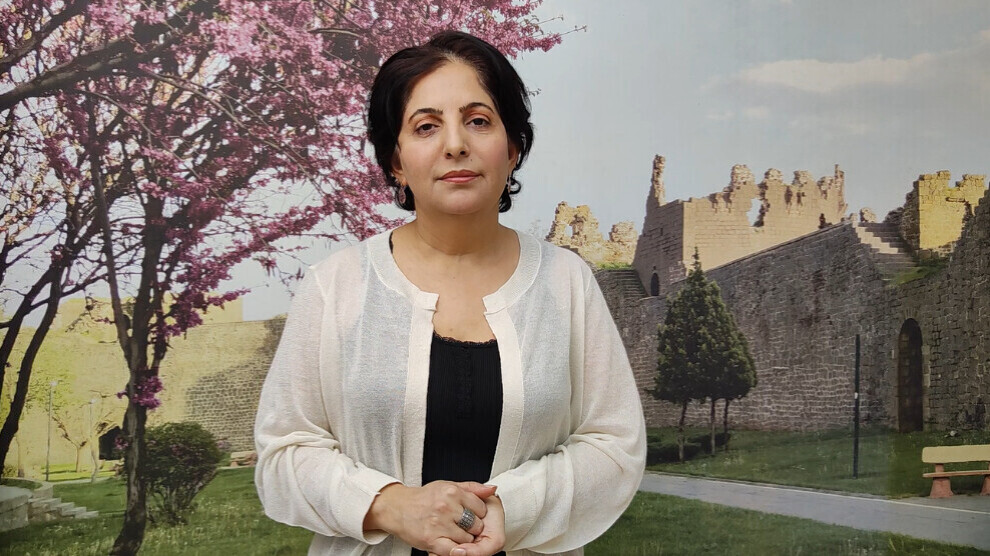
Christine Ozbey, a Kurdish writer and poet, combines poetry and prose to document Kurdish women’s experiences, emphasizing writing in her mother tongue to preserve identity and give women a voice.
Benevsh Sterk
Amed – Every woman carries within her a world of her own, weaving through it her emotions and experiences, and expressing her feelings, hopes, heartbreaks, constraints, and sorrows through various literary and artistic works. Among these women is the writer and poet Christine Ozbey, who combined different roles in life and excelled in expressing them.
Christine Ozbey began her literary journey with poetry, attempting to give the voice of women a distinctive tone and resonance. Her first book was in Turkish, but she soon turned to writing in her native Kurdish, making it her most authentic means of expression. She said: "I started writing in Turkish, but I soon wanted to write in Kurdish because it was my true home. In Turkish, I didn’t feel a sense of belonging; I felt like a stranger outside my home. But when I write in Kurdish, I feel that I have returned home, to my roots."
Christine Ozbey was born in the city of Mush, a city famous for its folk singers, before her family moved to Vartin. She says that her father named her after a famous character in radio theater, but the registration was rejected by government offices on the grounds that it was a "rural name," and they recorded the name “Kibar” on her official documents. Nevertheless, Christine remained attached to her real name and never chose another name for herself.
She completed her primary education in Vartin, then pursued her studies at a nursing school and graduated, working in this profession for twenty-seven years. Alongside her work as a nurse, she found in writing another space to express herself.
In addition to poetry, she discovered in satirical writing another outlet for expression. Over the years, she published her comedic texts on several websites, wrote humorous theater scenes, and even drafted a script for a comedy series titled The Earth and Life.
Regarding her writing experience, she initially addressed the challenges, saying: "As Fatma Gul Berktay pointed out, combining being a woman and a writer is a demanding task because our responsibilities are doubled." She added: "I am a mother, I work in a demanding official job, and at the same time, I write and read. Without reading, there can be no writing."
She continued: "Sometimes we write texts that are marginalized or not considered worthy of reading because they deal with women's struggles. Women in this field often feel isolated, as if the entire burden rests on our shoulders. Due to the many responsibilities we carry, we become less capable of standing out, whereas the field remains more open to men."
Her Most Important Works
Regarding her literary works, she mentioned that her first book was in Turkish, titled Sağanak Yalnızlık (The Storm of Solitude), followed by the book Şevdank, which included her poems in Kurdish. Despite some perceived shortcomings, it was a unique experience for her as it was her first poetic work published in her mother tongue. This was followed by the book Sorxêlî, which collected short stories, and then her latest book, Keştiya Tijî Xem (The Ship Laden with Sorrow), also a collection of short stories.
She said: "In my youth, I read many stories written by men about women, and that felt like a deficiency to me. I wanted to read stories from a woman’s perspective, which is why I paid special attention to the writings of Kurdish women and decided to write in my mother tongue."
Christine Ozbey emphasized that writing in Kurdish is crucial for women writers, noting at the same time that reading books in Kurdish is still limited: "Our request is simple: for Kurdish women and mothers, and also Kurdish men, to hold on to their mother tongue. Women, in particular, need this more because culture is transmitted through women, through mothers and sisters, to children."
She explained: "The more the Kurdish language is present in our society, the more it motivates Kurdish women to preserve it. Every writer writes to be read, and if they know their works will not be read, they will not write. Therefore, my only request is for everyone to speak their mother tongue, the language of their mothers."
She also pointed out that what occupies her the most is the issue of language, noting that studies and literary works related to women are very few, whether in Kurdish studies, European universities, or elsewhere: "I feel that the greatest burden falls on women. Even when a publishing house publishes my works, no one talks about them, which is sad because it diminishes the value of women’s work."
“Every Writer Remains a Witness of Her Era”
Regarding why she included a segment of the song Khanamti by the artist Shivan Perwer in one of her stories, she said: "This song left a deep impression on me. A woman cannot express herself, but I intervene in her words and lay my pain upon them and say what I want to say. I advise the new generation to write in their mother tongue; they can create beautiful texts. There is great potential in Kurdish women, and if the new generation reads the works of previous women writers, they will realize that they wrote remarkable things despite limited opportunities. Today, the opportunities are greater, and they can produce distinctive works and achieve great accomplishments."
She explained that in her stories, she strives to portray different aspects of women’s lives: "Until now, literature has limited its portrayal of women to villages or folkloric frameworks. I wanted to go beyond that to write about modern Kurdish women. There are many contemporary Kurdish women. If other stories remain at a single level, we must document this era. Every writer is a witness to her time, and I write about struggling women because revolutions heavily burden women, and there must be someone to record and immortalize this through writing. I write about working women, employees, mothers; I want to write about Kurdish women in all their forms and shapes."