2025: Women Between Violence, Poverty, and “Year of the Family” Policies.
In 2025, crises deepened women’s suffering, intensified barriers to equality and peace, yet women persisted, defending bodies, labor, and identities, demanding justice, freedom, and confronting sexual violence through democratic pathways.

Elif Akgül
Istanbul – The year 2025 witnessed an escalation of the structural crises faced by women, resulting on the one hand from male violence and on the other from the government’s failure to fulfill its obligations. The suspension of violence prevention mechanisms, policies of impunity, the spread of poverty, and the implementation of what was called the “Year of the Family” all led to increased suffering for women and a deterioration in their living conditions.
Under these policies, femicides, social pressure, the guardianship system, and judicial processes emerged as major obstacles to achieving equality and striving for peace. Despite this, women continued to insist on sustaining their struggle, defending their bodies, labor, and identities against all forms of marginalization and violence.
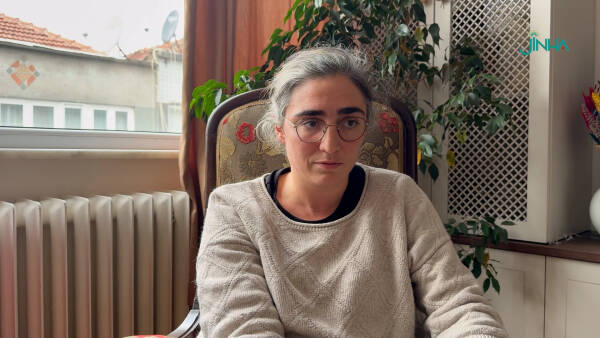
From a feminist perspective, feminist activist Feride Araleb shed light on women’s conditions across various fields, ranging from daily living conditions and economic policies to issues of violence and the peace process in 2025. She stated: “The declaration of the year as the ‘Year of the Family,’ along with deepening poverty, problems within the judicial system, and prison policies, were among the most prominent issues women faced throughout the year,” emphasizing that “2025 was truly a year in which women’s lives, bodies, and labor were crushed within the structure of the family, exploited, all with direct government support.”
She explained that the reality is clearly reflected in femicides: “Despite the absence of accurate official data, what we have documented through the media reveals that approximately 300 women were killed during 2025, in addition to an even higher number of suspicious deaths exceeding the officially recorded femicides.”
She added: “It can be said that 2025 was a year in which the lives of many women ended in mysterious and suspicious ways. A large portion of these deaths was covered up. We know that behind these cases there are, in fact, concealed femicides, as in the case of Rojin Kabaish.”
Feride Araleb also drew attention to the messages directed at women by the government alongside these policies, explaining that 2025 was a year in which women were asked to bear the burden of the population crisis: “We were told by the government, ‘Form families, we will provide child support, we will support childbirth, have more children, at least three. We have a population crisis, and women must bear its burden.’”
She highlighted the impact of harsh economic conditions on women, stating: “2025 was a year in which women were systematically impoverished. They experienced violence within poverty, were subjected to exploitation and oppression, and were pushed back into the home.”
She noted that the minimum wage remained below the hunger threshold, and that studies show only one out of every three women is employed, while only one in five women has registered full-time employment. She stressed that “the minimum wage is fundamentally a feminist issue,” explaining that depriving women of economic independence leaves them facing violence with no alternatives and makes resistance far more difficult.
She emphasized that 2025 was a year in which women were directly targeted: on one hand, through sexual and discriminatory attacks against women politicians, and on the other, through legislative attempts aimed at releasing those involved in child exploitation. “We lived through a year in which the clothing of a music band, song lyrics, or a consensual relationship between two adults could be labeled as deviance, while pressure and violence were transformed into something resembling an imposed moral standard,” she said.
She also noted that 2025 was an important milestone in legal struggle, referring to the case of Serap Avcı, which she described as a symbolic ruling recognizing that systematic violence cannot always be proven with evidence—representing a significant gain against entrenched “male-dominated justice.”
Feride Araleb believes that 2025 also carried signs of a search for peace: “This year was associated with attempts to find a democratic solution to the Kurdish issue. It may be called a peace process or a path toward resolution, but it remained on the agenda.”
She stated that this process is still shrouded in uncertainty, as the legal framework that could form its basis has yet to become clear, noting that “despite the discourse on peace, the government did not take concrete steps in this direction throughout the year.” She added: “2025 was also a year in which genuine political will for peace was absent.”
She also addressed the continued implementation of the guardianship system, noting that more than ten municipalities are still governed in this way, where women-specific projects and policies have been abolished and services directed at women have been completely halted.
Evaluating the situation in prisons, she said: “2025 was a year in which prisons were filled with people defending their rights—youth, women, mayors, politicians, and journalists.”
In this context, she outlined women’s demands: “We demanded the abolition of the Anti-Terror Law, the release of political prisoners, and the release of sick prisoners. Within the framework of the peace process, we also demanded that sexual violence be confronted seriously.” She highlighted the link between war, nationalism, and gender-based violence, stating: “Whenever some attempt to ignite war, the first thing they do is target a woman politician.”