
Eight Years of Journalism and a Journey That Does Not Stop
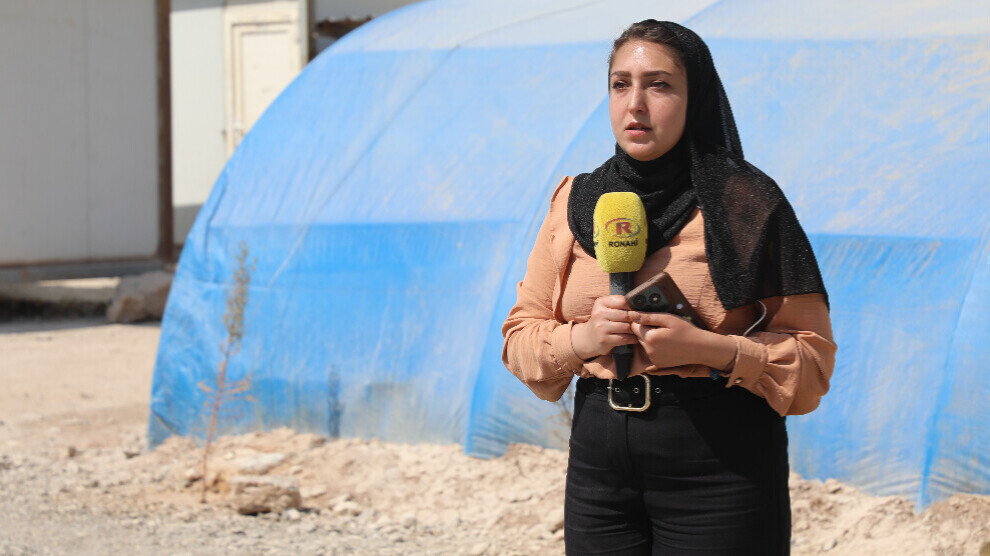
Microphone in one hand and daughter in the other summarizes Ronahi TV journalist Heba Fattah’s Daily life, balancing eight years of jurnalism passion with motherhood resposibilites in the field.
RONIDA HAJI
AL-HASAKAH– Media is considered one of the most prominent fields that documents the details of life and conveys people's voices to public opinion, and sheds light on their problems, pains, and experiences. In this field, women have imposed their presence, especially in field journalism, which requires a permanent presence in the heart of events and the ability to deal with different circumstances.
Among these female journalists is Heba Fattah, born in 1997 in Tabqa city, and currently residing in Hasakah city. Heba has been working in the field of journalism for eight years, and during this period she has kept pace with societal issues in several areas of northern and eastern Syria, where she documented the conditions, challenges, and suffering of the population, and sought to convey their voices and issues to public opinion.
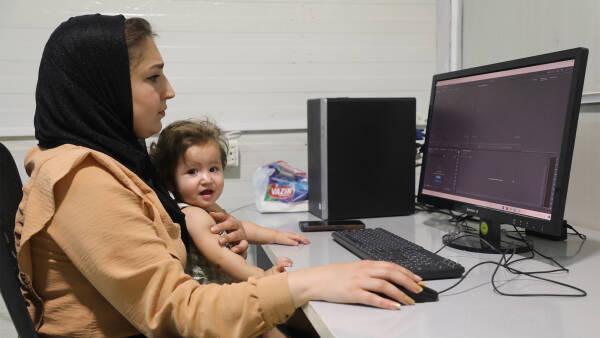
Alongside her journalistic work, Heba Fattah is undergoing another experience no less responsible: she is a mother of three children, and tries to balance between the profession she chose out of love and the responsibilities of motherhood. In many cases, her young daughter "Mila" accompanies her to the field of work, making the child part of the details of her journalistic day.
Journalism Is Part of Life
Over eight years, Heba Fattah has worked in various political and economic fields, but she does not view journalism as merely a profession or a job. For her, journalism means being close to people, seeing the details of their lives, and conveying their issues and voices to public opinion.
She says: "After these eight years of experience, I cannot see myself in another field. I can work in any field, but I see myself among people, in the field of journalism, and among societal issues. For me, this work is not just a profession, but part of my life."
During her career, Heba Fattah has worked in Tabqa, Raqqa, Deir ez-Zor, Manbij, Deir Hafir, and Maskana, alongside many villages. She was, in particular, close to the people of Tabqa for about seven years, where she documented their daily lives, pains, activities, culture, and customs.
She also worked in areas that witnessed war and attacks, and documented with image and word what happened in them, and participated in various community activities, alongside her work with women and highlighting their experiences, pains, and achievements.
"The Challenges of Female Journalists Are Like a Battle"
She points out that the path of female journalists in the media field is not free of difficulties, and that women face multiple social and professional challenges, especially in environments where women's presence in journalism was not a familiar matter. "Female journalists have taken great steps in this field and proven their place in society. We work in a society that did not easily accept the presence of women as journalists in the past, especially in Arab society. But women today play an important role in the media field and prove their existence through the work they do."
Heba Fattah believes that media work requires from the female journalist strength, persistence, and the ability to continue, especially when the nature of the work intersects with social and political obstacles. "Sometimes some people look differently at a woman who goes out to the field of work carrying a camera or a microphone, and there are people who refuse to conduct interviews with them. I see all these things within the challenges we have overcome during the past eight years. For me, this is like part of the battle that female journalists must wage in the field of work."
Between Work and Family
Field journalistic work for Heba Fattah is not linked to specific working hours; the journalist may be called at any time, and must be ready to follow events, developments, and issues that concern society.
Hence, combining field work and family responsibilities was not easy for her, especially with three children. "Two of my children can go to school or kindergarten, or stay with the family when I am at work. As for Mila, who is now one year and two months old, she is almost always with me. Therefore, achieving balance between work and motherhood is a subject of struggle for me."
A Microphone in One Hand and Mila in the Other
One of the most prominent challenges facing Heba Fattah today is reconciling her journalistic work with the presence of her young daughter with her in the field. She may find herself throughout the day on roads, in markets, events, marches, meetings, and live programs, while at the same time being responsible for caring for her daughter.
In many of those situations, Mila is with her mother in the field of work. "Sometimes when I conduct an interview or present a program live on air, Mila is in one of my hands and the microphone in the other. Sometimes the photographers or the people present at the event help me."
Despite the difficulty of moving and working accompanied by a small child, Heba Fattah chose to bring Mila with her, because she does not want her daughter to be far from her, but wants her to grow up seeing her mother's life and understanding the nature of the work she chose. "I do not want Mila to remain far from me. I want her to grow up by my side and see my life. Therefore, despite all the difficulties, I bring her with me wherever I go."
She Does Not Want to Be Far from Her Work or from Motherhood Responsibilities
Heba Fattah confirms that her love for journalism and her connection to Ronahi TV channel constitute a fundamental motive for continuing on this path, despite the difficulties she has faced over the past years. "After eight years of work and overcoming many difficulties, I cannot abandon my work. If I leave it, I will feel as if I have returned to point zero. I love my work, and I do not want this love to be a reason for me to be far from my children."
She tries to maintain a balance between her work, her children, and her family life, and believes that the difficulties she faces are part of the path she chose. "Every difficulty I overcome on this path is, for me, the price of the thing I love. I love my work, and at the same time I want to be a mother to my children."
The Dream She Wants to Leave for Her Children
Heba Fattah does not want her experience to be limited to being the story of a female journalist and a mother struggling for balance between work and family, but hopes that her experience will be a lesson for her children in the future, and that they will know that difficulties should not be a reason to abandon dreams. "I want my children in the future to know that their mother did not abandon her dream because of difficulties. Children learn a lot from their mothers, and I want my children also to learn that difficulties should not be a reason to abandon dreams and goals."
Among her three children, Heba Fattah hopes that Mila will one day choose her own path, and perhaps take the same path her mother took in the world of journalism. "Mila may tomorrow take the microphone from my hand. The child who is today with her mother in the field of journalism may tomorrow choose her mother's path and become a journalist."