
A Young Palestinian Woman Recycles Waste by Incorporating Palestinian Embroidery
The Palestinian woman embodies a symbol of strength and steadfastness, striving to reclaim her unquestionable right to live on her land and to create beauty out of nothing.
RAFEEF ASLEEM
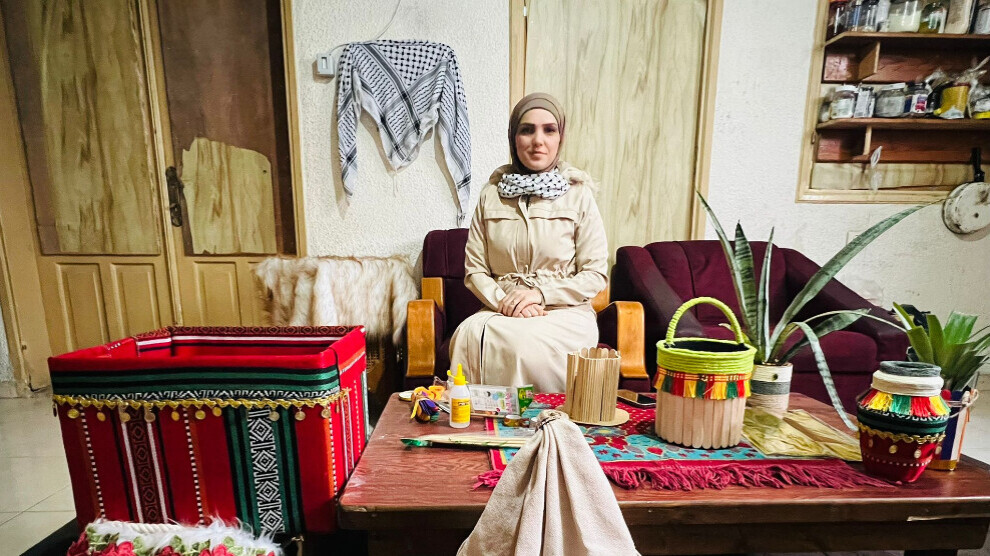
Gaza — What were once merely cardboard aid boxes, plastic, glass, or metal containers, and discarded fabrics scattered on the ground with no value, became the foundation of creative, environmentally friendly handicrafts with a traditional character when Taghreed Abdullah decided to transform them. Her work integrates these recycled materials into various uses, such as Palestinian weddings, home furnishings, and more.
Taghreed Abdullah, from the Gaza Strip, explains that her recycling idea began amid the suffocating siege imposed on the city and her need, as a woman, for household necessities. Instead of throwing away cardboard boxes, she began turning them into storage units for clothes or shoes; glass and metal containers became plant pots; and plastic crates were repurposed into trash bins.
She points out that the idea goes beyond recycling alone. By adding authentic Palestinian heritage elements, each piece gains its own spirit and national identity. The colors she uses also carry specific meanings. She notes that she never wanted to purchase raw materials from the market, even though doing so might have been easier and yielded better results, preferring instead to search for alternatives within her own home or those of friends and relatives.
An Important Project for a Healthy Environment
Taghreed believes her project contributes to a healthier environment: “We are not only helping the environment, but primarily helping ourselves, as the Gaza Strip exists within an inescapable hotspot of pollution.” Instead of allowing waste to accumulate in landfills and mix with sewage water, she collects these materials and envisions how they can be transformed into household furniture—from the initial idea to the final product—before adding finishing decorative touches that give each item a distinctly Palestinian flavor.
She says, “When family members see high-quality cardboard boxes, they now contact me and ask for ideas on how to recycle them.” She recalls one instance when a friend called to say she had received a package made of thick cardboard resembling biscuit boxes. Taghreed asked her to keep it. Upon inspecting it, she found it was indeed of good quality and turned it into a small wardrobe for storing clothes, decorating it with Palestinian colors and embroidered ribbons, transforming it into a distinctive piece of home furniture at a low cost.
Through these creations, Taghreed Abdullah aims to address the world at large: “As Palestinian women, we are present here through art, culture, and awareness.” She remained committed to combining recycling with heritage and created an Instagram page, where her number of followers grew daily, believing that art is a universal language understood by everyone without linguistic or cultural barriers.
The rubble of bombed homes, houses, camps, aid distribution centers, and even followers themselves are all sources from which she can obtain raw materials. From waste, she creates heritage-inspired art pieces to deliver a powerful message: “Even if Gaza is bombed, destroyed, and reduced to piles of ashes, it will return and be reshaped more beautifully than before through women’s ideas and efforts.”
She is well aware that before the attacks, every Palestinian home possessed heritage items, many of which were bombed, demolished, or stolen. When she resumed posting photos of her work online, she received wide engagement and numerous messages from women and girls asking how to recycle what they had. She expressed immense happiness as she replied to them, helping them transform gray colors into new, vibrant hues full of life.
Returning to Palestinian Heritage
She recalls one message from a young woman who told her she was a bride living in a displacement tent with no place to store her personal belongings. Taghreed thought, “Why don’t we return to Palestinian heritage and use the bridal chest once again?”—a box where the bride could store her clothes, cosmetics, and other essentials. She explained that traditionally, the bridal chest was prepared by the groom’s family on the night of the henna celebration, filled with nuts, henna, and adornment tools, and presented as a gift to the bride. Today, this idea is being revived in a new form.
She pointed out that if she were to produce these items using newly purchased raw materials, the cost would be many times higher, and she would not be able to create many pieces. She noted that she has not offered any of her products for sale, keeping them for herself instead, as her primary goal is to spread and promote the idea so it becomes a lifestyle for women and girls rather than just a hobby—marking the first steps toward environmental recovery in the Gaza Strip.
She emphasized that anything no longer suitable for its original use can be recycled: a blanket burned during bombardment can be repaired; fabric scraps, worn-out socks, and buttons can be turned into dolls; metal, wooden, plastic, and glass boxes—“all of these can be transformed into beauty by adding your own personal touch that brings elegance and creativity to everything around you.”
As Taghreed Abdullah concludes, the woman in the Gaza Strip—“no matter how exhausted she is by wars, and no matter how much she is abandoned by the international and Arab communities—will remain like the phoenix, rising again from the ashes, a symbol of strength and steadfastness, until the Palestinian woman regains her unquestionable right to live on her land and reclaim all her rights that occupation will never strip away.”