
Myra... When Monuments Narrate the History of a City, the Goddess, and the Woman
More than 2,500 years of history are stored in Myra, where the traces of politics, trade, religion, and social life intersect, and symbols reveal an aspect of the city's culture, goddesses, and memory.
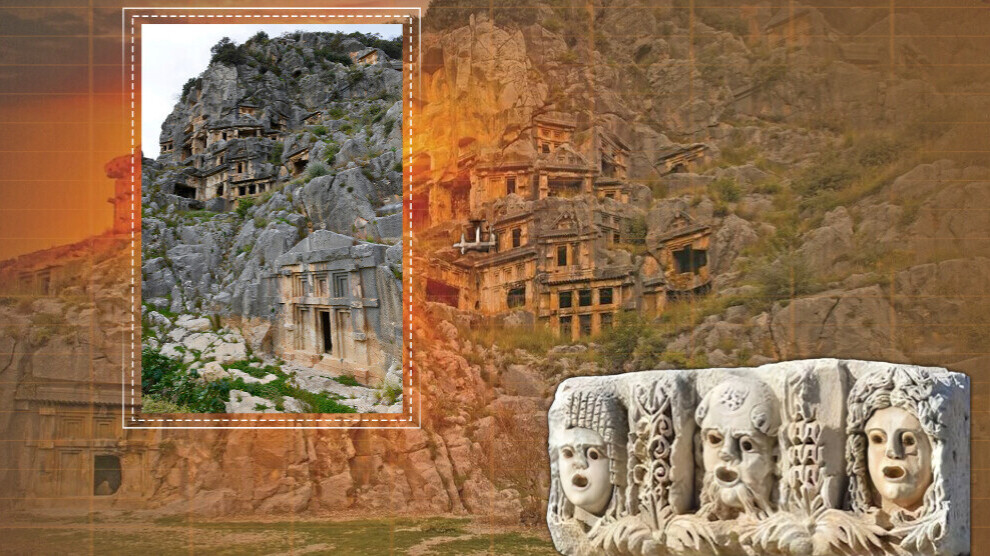
NewsCenter – The ancient city of Myra, one of the most prominent cities of Lycia, narrates multiple chapters of Anatolian history through its monuments extending over more than 2,500 years.
Myra is considered one of the important cities in the history of Lycia. Although the exact date of its founding is not known, the rock-cut tombs, inscriptions in the Lycian language, and discovered coins indicate its existence since at least the fifth century BC. From this standpoint, Myra cannot be viewed as merely an archaeological city, but as a historical site where the traces of social and cultural transformations witnessed by the region over long centuries intersect.
Myra was one of the six major cities in the Lycian League and enjoyed three votes in the voting council, which reflects its political status at the time. The city also witnessed remarkable growth in its political and economic importance, especially during the Roman era. The second century AD was one of the most prominent periods of its prosperity, as new buildings were constructed and existing facilities underwent restoration and renovation.
The nearby port of Andriake helped connect Myra to the sea, which enhanced its role in trade and economic exchanges. Thus, the city became an important center not only at the political and religious level, but also at the commercial level.
Architecture Bearing Witness to Society and Spaces of Memory
The rock-cut tombs are among the most prominent monuments that still bear witness to the history of Myra. These tombs were inspired in their design by models of traditional wooden architecture in Lycia, then carved and adapted into the rocks.
Some tombs include prominent reliefs depicting the deceased and members of their families, while other tombs bear written inscriptions that provide information about the persons buried in them and about their society.
Hence, the tombs of Myra transcend being structures related to death and burial; they also represent spaces of social memory, through which one can learn about the way members of society wanted to immortalize themselves, their relationships, and their status.
The Female Goddess in the Religious World of Myra
Myra acquires particular importance from the perspective of studying women's history, given the prominent presence of the female goddess figure in its religious world. The religious traditions in the city are linked to the figure of Artemis, whose representation in some contexts is linked to the ancient Anatolian goddess Cybele.
The appearance of Artemis in a form linked to Cybele on coins minted in the name of Myra is an important indicator of the overlap between different religious traditions in Anatolia, and of the status occupied by female symbols in the religious culture of the city.
These evidences, alongside inscriptions, rock-cut tombs, coins, and other monuments, provide important material for studying the presence of women and symbols associated with them in the social and religious memory of Myra.
A City Where Politics, Religion, and Society Intersect
The history of Myra, extending over more than 2,500 years, makes it an important witness to the history of Lycia and Anatolia. The rock-cut tombs, inscriptions, coins, theater, and the port of Andriake all reveal a city that was not merely a political or religious center, but a living and prosperous society in which social, cultural, religious, and commercial life intertwined.
Through these monuments, Myra can be read as a historical space where the stories of society, beliefs, family relationships, and representations related to women intersect, offering a more comprehensive picture of life in one of the most important cities of ancient Lycia.