
From the Caucasus to Kobani... The Displacement Journey of a Circassian Family and Their Cling to Identity
Sabah Mousa al-Nahas recounts her Circassian family's decades-long displacement from the Caucasus to Syria, facing repeated tragedies while preserving their language and culture despite harsh conditions.
NOURCHAN ABDI
Kobani — The historical and original homeland of the Circassian people extends to the North Caucasus region, specifically on the eastern coast of the Black Sea. Their roots in Syria trace back to the tragedy of forced displacement and migration in the second half of the 19th century. The Circassians fought fierce wars that lasted for over a century to defend their lands and rights against the colonial expansion of the Russian Empire, which ended with the fall of the great Circassian resistance in 1864.
On this basis, hundreds of thousands were forcibly displaced across the Black Sea to the lands of the Ottoman Empire, of which Syria was then a part. The authorities distributed them along the peripheries of the Levantine provinces—including Syria, Jordan, and Palestine—to protect trade routes, populate rural areas, and enhance security and stability in those regions.
The Circassian presence within Syrian territory was concentrated in several strategic and vital areas, most notably Quneitra in the Golan before the 1967 war, as well as Damascus and its countryside, Homs and its villages, and Aleppo and its countryside. The Circassian community contributed prominently and effectively to building the history of the societies in which they settled, integrating fully into the Syrian social and cultural fabric, yet maintaining their heritage and ancient language.
Our agency documented scenes of the suffering and tragedy of displacement of a Circassian family originally from the Caucasus, who were displaced more than ten times until they reached the city of Kobani in Rojava.
The Journey of Displacement and Suffering
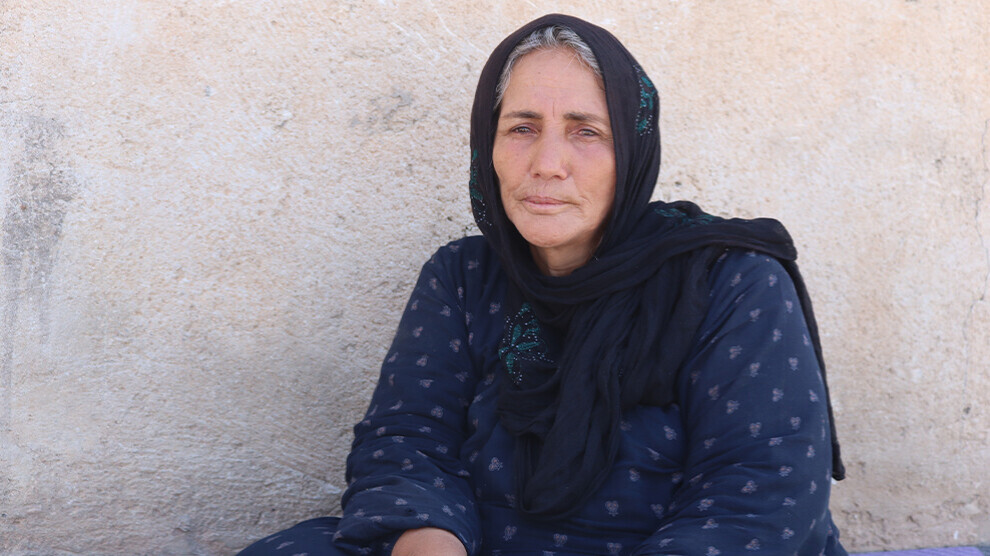
Sabah Mousa al-Nahas, 51 years old, a mother of two daughters and four sons, recalls the journey of displacement and suffering that has accompanied her and her family through long decades. She says: "From the very moments of my birth, we as a people and as minorities have faced the danger of genocide, massacres, and displacement. To this day, we still live with the effects of this tragedy."
She recounts, based on what she heard from her mother and grandmother, that her family's displacement journey began from the Caucasus region, where they were forced to leave toward Palestine, then to Oman, and then to Syria, fleeing killings and massacres and fearing for their lives. She affirms that moving between countries was a forced choice in search of safety and stability.
She adds: "For decades and to this day, we live in harsh conditions, full of fatigue, hard work, and constant striving to secure the most basic necessities of life and provide a livelihood for our children. The life of displaced people is not easy; we always feel that the danger of displacement pursues us, and that stability is still far from our lives and the lives of our children and grandchildren."
She explains: "I was born in the Levant, and when I was five years old, my family was displaced to the city of Aleppo in Syria, where I grew up, was raised, and got married. During our stay in Aleppo, we discovered that we had relatives and families from our people living in Syria, so we began searching for them until we were able to reunite after a long and painful displacement journey, to live together again in one city and one neighborhood."
She adds: "Over time, there were about a thousand Circassian families in Damascus and Aleppo. We maintained communication among ourselves and held onto our social and cultural ties despite years of displacement and suffering." She noted that "we were living in Aleppo, specifically in the Sheikh Maqsoud neighborhood, a relatively stable and secure life. But with the outbreak of the Syrian events in 2011, the neighborhood was attacked by armed groups identifying themselves as the Free Army, as part of the conflict the country witnessed, which forced us to leave the neighborhood and be displaced toward the city of Raqqa."
Regarding her years of residence in Raqqa, she says: "We lived about ten years in Raqqa. At first, our life was based on coexistence among the city's various components, without discrimination or fear due to our Circassian identity." She adds: "But after ISIS took control of Raqqa, we began to hide our original identity, and we were forced to say we were from the Arab component, for fear of ISIS's practices, as they constantly asked us about our affiliation."
She notes: "After conditions stabilized somewhat in Aleppo, we returned to our home, only to find it completely destroyed. Despite that, we tried to adapt and live in it for about four years, until the neighborhood was subjected to a new attack, returning us to the cycle of fear and suffering."
She points out that due to the sounds of shelling, clashes, and the intensity of the attack targeting the area, they were once again forced to experience displacement and migration. "We left with displaced families in a convoy that first went to Raqqa, and then we moved to Kobani."
"We Strive to Preserve Our Culture and Teach It to Our Grandchildren So It Does Not Perish"
She explains the reason for choosing Kobani to live in: "The people in Kobani enjoy, to some extent, a state of stability and safety, so we decided to come here in search of a quieter life. True, we live as displaced people without a permanent home or shelter, but we feel comfortable and stable in this city. My family and I currently work on a poultry farm and try to secure our needs and continue our lives despite the conditions of displacement."
Despite what the Circassian community has endured over long decades of genocide, massacres, and displacement, Sabah Mousa al-Nahas remains attached to her cultural and national heritage, striving to preserve her language and identity through passing them on to her children and teaching them to her grandchildren.
She says: "A person cannot forget their origin, language, culture, and history—whether Arab, Kurdish, or Circassian. Language represents the identity of every society and every individual, and it is the bond that preserves the memory of peoples. Therefore, despite the fear and massacres we have endured throughout history, my family and I still speak our Circassian language, preserve our culture, and teach it to our grandchildren so it does not perish."
Sabah Mousa al-Nahas concludes her remarks by affirming: "Whatever circumstances we live in, and whatever difficulties we face in the days ahead, we will not abandon our identity. We will continue to preserve our Circassian culture and hold onto it until the very last moment of our lives."