
Tunisian activists express solidarity with women of Aleppo
Tunisian activists expressed their solidarity with the communities that are subjected to political, social and religious violations in Syria, in light of the recent escalation in the city of Aleppo.
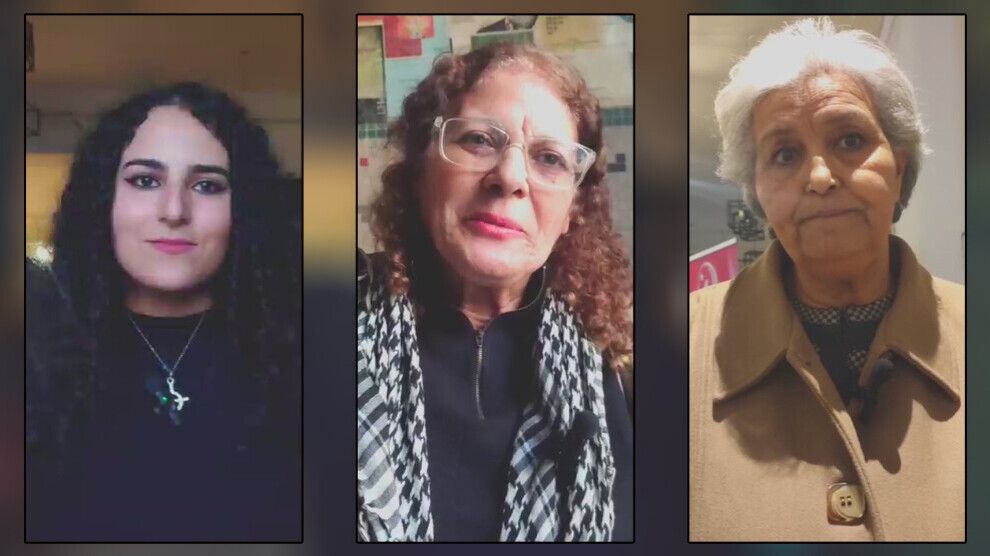
Zohour Al-Mashriqi
Tunis – Neighborhoods in the Syrian city of Aleppo have witnessed an escalation in violence as clashes continue with an interim government that has opted for a military solution instead of a political one. Serious violations against civilians have been documented, including the storming of homes and the forced displacement of residents in Kurdish neighborhoods.
Meanwhile, human rights calls continue for solidarity with affected communities and with peoples facing violations of state sovereignty and international law, amidst simultaneous crises in several regions of the world, including Syria and Iran.
Tunisian activists have expressed their solidarity with the Syrian communities subjected to political, social, and religious violations in Syria, amidst escalating violence and the accompanying serious violations against civilians in the Sheikh Maqsoud and Ashrafieh neighborhoods of Aleppo.
These activists held the interim government in Syria responsible for the practices that affect basic rights and exacerbate the humanitarian situation in the region. This position of solidarity extends to other peoples facing complex crises and violations of their sovereignty and rights, in an international context that is witnessing an escalation of conflicts and interventions, and direct repercussions on the most vulnerable groups, foremost among them women.
Violence has reached unprecedented levels
Rafika Rguig, a leading member of the Tunisian Workers' Party, stated that one of the party's fundamental principles is solidarity with all oppressed peoples and groups, whether due to authoritarian regimes or foreign interventions. "We raise our voices in support of all peoples suffering from oppression, and we reject all forms of exploitation of their resources under various pretexts," she said.
She emphasized that the Workers' Party, as a political actor, expresses its support for the rights of peoples and nations in the face of injustice and stands with those subjected to various forms of violence and repression.
Feminist political activist Fadila Mohamed asserted that women are currently the most affected group in the Syrian conflict, where they are subjected to multiple forms of violations, including double violence, forced displacement, and starvation.
She pointed out that what is happening targets the gains of women, especially in Syrian regions known for their sectarian and religious diversity. “Today, Syrian women, regardless of their sect, are not only being punished, but are being killed in full view of the world, and grave violations are being committed against them under a religious and sectarian cover.”
She emphasized that Syrian women are living through one of the most difficult periods in their modern history, noting that the current level of violence has reached unprecedented levels. "Even in previous periods of the conflict, the situation did not reach this level of killing and violations against the various communities," she said.
Joint Action and Regional Solidarity
The youth activist Rahma Lasud explained that the region is facing a complex international context where political conflict intersects with deteriorating humanitarian conditions. She pointed out that various societal groups, including Syrian communities, are subjected to grave violations in a number of conflict zones, including Syria and Palestine.
She added that communities in Syria are facing compounded forms of oppression and violence, and women have been among the most affected. "What is happening includes serious violations that specifically target women, including violence, abuse, and coercive practices, within the context of conflicts where the authorities and armed groups are intertwined."
The young woman, Rahma, expressed her solidarity with the women of Aleppo, who face violations based on their identity and their social and cultural particularities. She pointed out that the wars and violations suffered by the peoples of the Global South necessitate clear stances of solidarity based on coordination and unity that transcends borders, far removed from any religious, sectarian, or identity-based considerations, in order to confront these situations.
She emphasized the importance of joint action, stating that regional and international solidarity constitutes an essential tool for confronting what she described as the repeated attacks on peoples in several regions of the world.