
The “Tuknan” Initiative Restores Hope for Girls Who Dropped Out of Education in Sudan
Girls’s illiteracy in Sudan threatens future generations, while initiatives like ’ Tuknan’ Offer practical solutions through education and empowerment.
Salma Al-Rashid
Sudan — Literacy rates among girls in Sudan remain high, exceeding half in some areas, making girls’ education a fundamental challenge to development and social stability efforts.
Illiteracy is one of the most prominent challenges facing Sudan, especially in peripheral and rural areas, where economic, social, and cultural factors intertwine to make girls’ education a complex issue. Despite community efforts, illiteracy rates among women remain high, prompting local initiatives such as the Tuknan Association to devise alternative solutions that promote education and break traditional constraints.
Nafisa Ahmed, founder of the “Tuknan” Association, says that illiteracy poses a major challenge in eastern Sudan, particularly among girls, which motivated her to launch the Tuknan initiative. The name “Tuknan” means “knowledge” in Bedawiyet, the language spoken by the Beja tribes—an indigenous Cushitic Nubian ethnic group known for its deep historical roots and distinctive dialect. She noted that the initiative aims to promote education and eradicate illiteracy among women in the region.
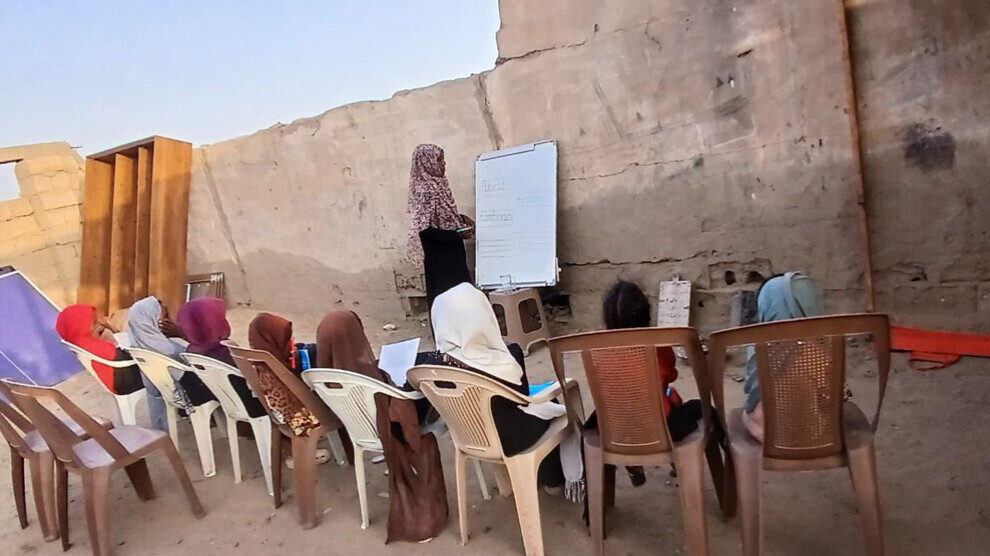
Ahmed explained that she founded the association in 2021 amid difficult circumstances in Sudan marked by military coups and internal conflicts. The vision of Tuknan is based on bringing girls together and identifying their needs. Experience has shown that girls’ education is a top priority; therefore, the association provides alternative education and literacy programs in a girl-friendly environment, free from traditional constraints such as school uniforms or daily school attendance.
She added that education at Tuknan relies on special learning circles delivered in the mother tongue (Bedawiyet), which has helped reintegrate a number of girls who had dropped out of school, aged between 12 and 16 years—some of whom were forced into early marriage.
Ahmed also noted that the association seeks to expand its activities to other localities in Red Sea State in the coming year, in addition to supporting economic empowerment through small projects that help families generate income to enable their daughters to continue their education.
Economic and Social Challenges
In the context of the international campaign to combat violence in Sudan, which lasted 16 days, Ahmed stressed the importance of using it as an opportunity to shed light on the situation of women in eastern Sudan, particularly with regard to girls’ education. She described education as the greatest challenge due to weak community awareness of its importance, emphasizing that the problem is not the absence of education, but the absence of awareness of its value.
She explained that the challenges are divided between economic and social factors, considering the latter to be more influential due to discrimination against women. Society prioritizes boys’ education over girls’, while the distance of schools from residential areas and the difficulty of access roads further discourage girls from attending school.
Economically, she noted that most families in eastern Sudan have limited incomes, making education costs a heavy burden. Another obstacle is that curricula are written in Arabic and English, which poses a barrier for non–Arabic- and non–English-speaking communities.
Ahmed called for adopting the mother tongue in the first stage of education, followed by a gradual transition to Arabic and other languages, stressing that countries which have implemented this system have achieved notable progress. As a primary school teacher, she believes that the absence of mother-tongue instruction leads to poor academic achievement and increased school dropout rates.
She also pointed to other challenges, such as some girls’ lack of interest in education due to social and cultural reasons, the difficulty of convincing families to re-enroll their daughters after dropping out, shortages of teachers and school furniture, and the lack of basic services at the Tuknan Association’s premises, such as electricity and air conditioning. Additionally, she highlighted the impact of traditional community leaders who oppose girls’ education