
Gaza Women: Repairing Worn-Out Tents Beyond Our Financial Means
Women's suffering is doubled in the Gaza Strip; the shelter is unsafe, and its pegs are secured in the ground, it remains uninhabitable, and women are unable to light a fire inside it.
Rafif Islim
Gaza — Women in the Gaza Strip are suffering from the problem of tents wearing out and turning into pieces of worn-out fabric or plastic sheeting unfit for use. Repairing them has become an unavoidable daily task, especially with fluctuating weather conditions; at times, a scorching sun pierces them, and at others, weather depressions uproot them from their places.
In the besieged Gaza Strip, thousands of women live in worn-out tents that have, over time, turned into pieces of fabric and plastic that offer no protection from heat or cold. Between fierce winds that uproot the pegs, a scorching sun that pierces the roof, and rain that seeps into the bedding, women wage a daily battle to preserve what remains of a shelter that is unfit for living. Amidst this harsh reality, stories emerge of women who have lost their homes and security, now facing the burdens of life alone, with constant fear of fire, cold, and disease, waiting for a solution that restores their right to a dignified life.
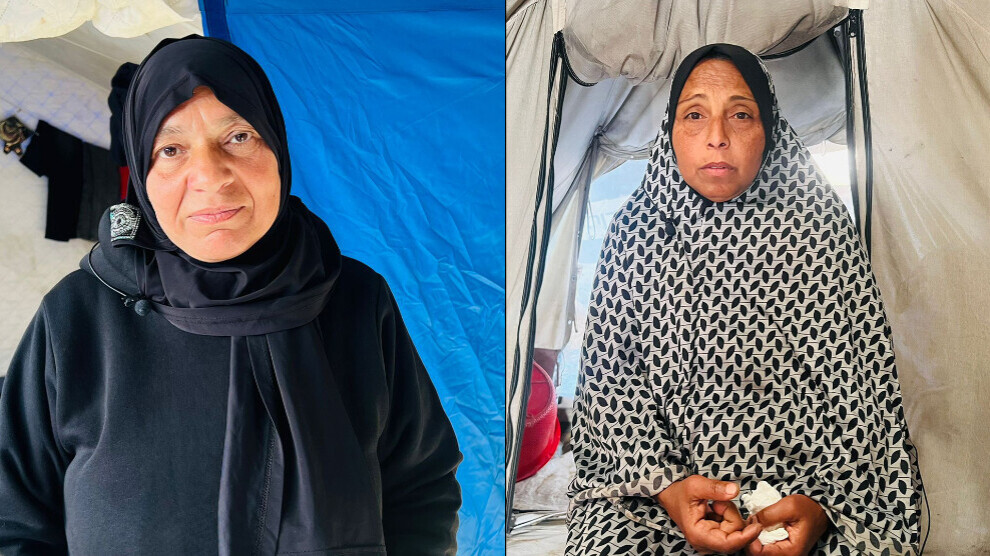
Fatima Diab lives in a tent full of holes from every side due to the ongoing bombardment, weather conditions, and rodents invading Gaza City. It has become a collection of connected pieces of fabric leaning on iron poles, requiring anyone passing through to bend over completely until they sit down. If a stormy wind comes, it uproots it from its place and blows it far away, unless the family manages to grab hold of it to secure it.
This forty-year-old woman lost her husband in the 2014 offensive on the Gaza Strip and was left with two children she devoted herself to raising. She used to show compassion to the poor and those with no shelter or income, as she worked as a teacher in a government school in the Strip. But today, she finds no one able to help her. Her house, which once stood on the seashore, has turned into a worn-out tent in one of the camps of the besieged city.
She recounts that a few days ago, she needed to prepare food. Since she didn't have a flame to light a fire, she borrowed some embers from her neighbor to start one. An ember fell onto the tent, and the flames spread inside her tent and burned it. She said that at that moment, she couldn't do anything but scream and cry, as she was certain her fate would be death by burning. Neighbors rushed to rescue her and pulled her out, but the tent and its contents were severely damaged, which added to her accumulating burdens.
Repairing the tent requires a financial cost beyond the displaced women's ability to afford. Fatima Diab explains that to prevent water from seeping into the tent, she covered it with three tarpaulins, each costing 50 dollars, not to mention the bedding that gets wet and becomes unusable, forcing her to buy replacements. She points out that this living situation makes her more susceptible to viruses, especially since she suffers from chronic diseases like diabetes and thyroid issues, which makes her body more prone than others to contracting illnesses.
Fatima Diab believes that no matter how much a tent is repaired and its pegs are fixed in the ground, it remains unfit for living. The purpose of making tents is to set them up for a trip, whether on the beach or in the woods; they were not made to live in full-time for years. She points out that the solution to the problems women are experiencing is the introduction of caravans and getting rid of the pieces of fabric stretching across the length and breadth of the Gaza Strip, replacing the concrete homes destroyed by the offensive.
Daily Risks Threatening the Lives of Women and Children
As for Manal Nour, she explains that during every weather depression or when the wind picks up, her tent does not stay in place. Despite being firmly anchored in the ground, it flies through the air like a balloon. She and her children run to put it back in place, noting that the scene is both funny and sad. Her personal belongings are scattered all over the area, draining a lot of her time and effort until she resecures it and rearranges her personal possessions as they were.
The financial situation of families in the Gaza Strip is extremely dire due to the lack of a steady income. So how can they cope when an additional expense of nearly 150 dollars is imposed weekly or with the arrival of every weather depression to repair the worn-out tents? She adds that she has no choice; if she doesn't repair them and buy what's necessary, where will she live? There is no shelter other than those worn-out pieces of plastic.
She points out that women all over the world, when a weather depression hits, stay home and don't go out until it's over. But the women of the Gaza Strip, when the weather worsens and temperatures drop, have nowhere to sit. They cannot light a fire for warmth for fear of burning the tent, nor can they manage to make a warm drink. What makes this catastrophe worse is that they are forced to spend money on something that will be ruined in a matter of days.
She explained that many women and their children have lost their lives recently as a result of lighting fires in the tents, causing a corner to catch fire, with the flames spreading from one tent to another and devouring dozens of tents. They die while asleep. This has consumed the mental health of the remaining women in the camp and left them in a constant dilemma about what to do, as they have no control over anything except to wait for reconstruction or the arrival of mobile homes, hoping they might protect them from the rain and wind.