
Between Firewood and Books... A Palestinian Woman Creates Hope for Her Family from the Rubble
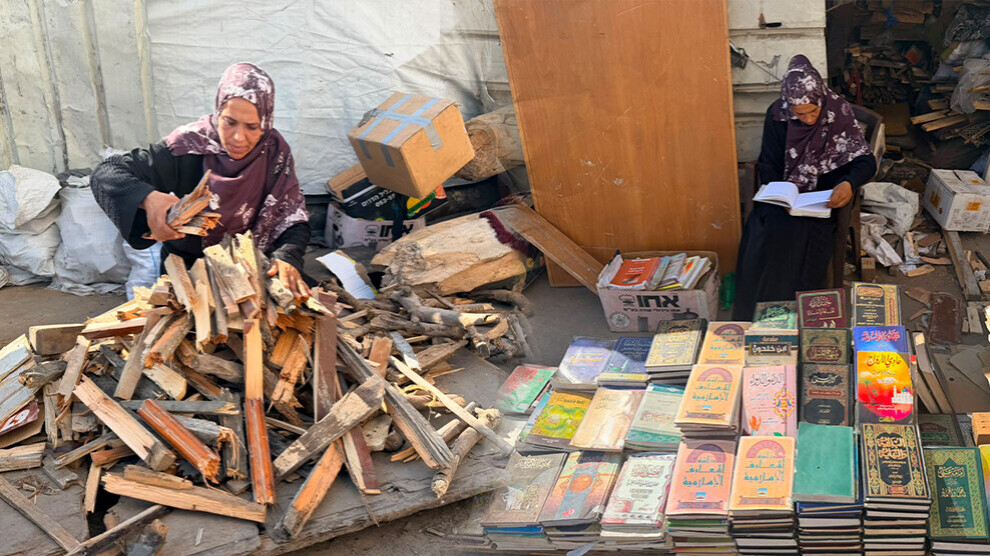
A Palestinian mother struggles to support her family by collecting and selling firewood, while rescuing books from among the rubble to give them new life amid destruction.
NAGHAM JAJAN
Gaza — Niveen Al-Gharabli no longer searches among the ruins of homes for firewood alone, but for a means to keep her family alive. From the rubble left by war, she carries what she can on her shoulders, walking alongside three girls who have been burdened by responsibility before they have known the meaning of a normal life. In every arduous journey, small hands reach out to pick up pieces of wood, while behind the scene lies the story of a mother who found herself confronting poverty, displacement, and illness together, without surrendering.
Niveen Al-Gharabli is 41 years old, a mother of seven children, three of whom have disabilities resulting from brain atrophy and require constant care amid the absence of health services and the deterioration of humanitarian conditions. Her husband suffers from high blood pressure, which has left him unable to work, making her solely responsible for supporting the entire family.
Since her first displacement from the Shuja'iyya neighborhood east of Gaza City to Rafah, she found no choice but to take up the trade of collecting, breaking, and selling firewood. With the intensifying crisis of cooking gas shortages and thousands of families relying on fire to prepare food, she would set out from the early morning hours, covering long distances in search of any piece of wood that could secure the price of a loaf of bread.
When the ceasefire came into effect at the end of October 2025, she gathered all she had saved and spent it on transport costs to return to Gaza City with what remained of her family's belongings. There, she set up a small tent on one of the streets west of the city, beginning a new struggle—this time in a city where most neighborhoods had been reduced to piles of shattered cement.
Daily Journeys Through the Rubble
The path to sources of firewood was neither close nor safe. Most days, she walks with her three daughters to the Sheikh Radwan neighborhood, and sometimes to Beit Lahia, covering long distances on foot, carrying bags and simple tools, and beginning the search for usable wood.
The girls appear to carry ages beyond their years. Instead of school desks, they spend long hours under the sun, amid dust and rubble, lifting heavy pieces of wood and gathering what remains of trees, shattered doors, and windows. Their hands crack from the harshness of the work, and their faces bear marks of exhaustion.
Niveen Al-Gharabli says, watching her daughters as they busily collect wood: "What pains me most is seeing my daughters carrying this burden instead of their school bags. I wish I could give them a life befitting their age."
She adds, her voice choked with sorrow: "Every time they go out with me, I pray they return safely. I never imagined that searching for firewood would become their daily work, but need is harsher than all hopes."
Despite the hardship, she tries to ease the harshness of the journey for them, sharing the load of wood and exchanging conversation with them along the way, so they do not feel the length of the distance or the weight of what they carry. Yet fatigue remains evident in their slow steps and in their glances that reveal the weight of responsibility imposed upon them through the years of war.
After hours of moving among the ruins, Niveen Al-Gharabli and her daughters would return laden with what they had gathered, to begin another phase no less harsh: breaking, sorting, and tying the wood into small bundles for sale to families who rely on firewood for cooking due to the gas shortage.
Giving Readers Hope Amid War
While her hands were occupied with the axe to chop wood, her eyes would catch books that had survived the destruction among the rubble. She would wipe the dust from their covers, keep them inside the tent, and read them one by one whenever opportunity allowed. The first book she found bore the title "Arabic Poetry," and she was captivated by the beauty of its language, turning its pages with admiration, despite not having completed her formal education. She adds: "Every book I found, I felt as though I was saving a soul from under the rubble. I could not leave it to decay or burn. I read everything that came into my hands."
Before long, some passersby began to notice what she was collecting. One offered to buy them for use as kindling, while another wanted some to use their pages for rolling cigarettes—but she refused.
She says firmly: "I may sell firewood to support my family, but I will only sell books to those who will read them. Burning knowledge is a loss no less painful than the loss of homes. I felt that these books survived the war just as we survived, so I have no right to let them burn."
From that simple idea, a small project was born that gave the place a different character. For seven months, she set aside a modest corner beside the piles of wood and cardboard she collects, arranging the books by size and subject, offering them to those interested in reading at symbolic prices ranging between eight and ten shekels.
Her goal was not profit but rather to deliver books to those in need. Often, young men or children who could not afford the price would come, and she would allow them to borrow and return them after reading. She says with a smile: "I do not want anyone to be deprived of reading because they cannot afford a book. When I see someone return to tell me they have finished reading, I feel my effort has not been wasted." Although circumstances prevented her from completing secondary school, her passion for learning never faded. She continued teaching herself English via phone and television, until she became able to speak it fluently, believing that learning is not limited by certificates nor stopped by wars. She explains: "I was denied school seats, but I did not allow anyone to deny me learning. Every page I read makes me feel like I am reclaiming a part of myself that war tried to take from me."
Before October 7, 2023, Niveen Al-Gharabli worked in a garment factory, packing clothes into plastic bags. With her modest income, she managed to pay her daughter's secondary school fees and provide for her family's needs without having to ask anyone for help.
Today, the family lives in a tent that lacks the most basic necessities: no private bathroom, no adequate shelter. Niveen and her daughters must carry jerrycans long distances and cook over wood fires amid thick smoke—a scene that has become part of their daily routine.
Her heart aches whenever she looks at her youngest son, five years old, who has not begun his education as he should, and spends most of his time beside her, helping arrange wood and watching over the books. She says in a voice filled with sorrow: "I dreamed of seeing him carrying his school bag, not carrying firewood with me. I fear his childhood will grow up inside the tent before he even knows what school means." She concludes: "I do not ask for a luxurious life—I want a home to shelter us, education for my children, and a job that preserves our dignity. As for the war, it has taken enough from us."