
Shadiya Mannab: There Is No Genuine Women’s Literature Unless Women Write Their Own Stories
Kurdish literature has long rooted women in oral tales and epics. With social and political shifts, new women’s voices are now emerging in written literature.
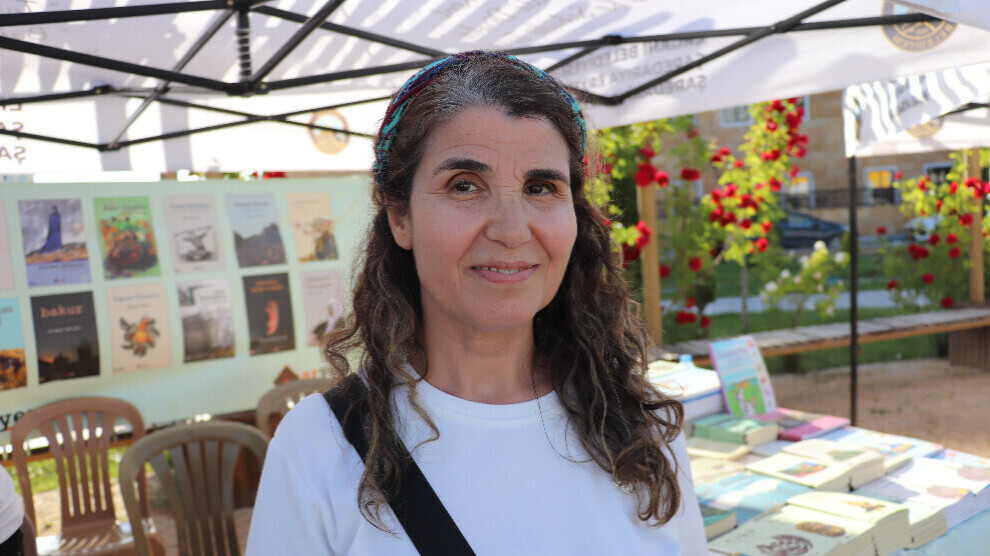
MIMIHAN HALBIN ZEYDAN
Van_For many years, Kurdish women remained in the background of the literary scene due to social pressures and the traditional roles imposed upon them. Yet today, they are waging an ongoing struggle to prove their presence in written literature and to shape their own voice.
In various sociecties, women are the primary bearers of oral literature, playing a pivotal role in transmitting heritage and folk narratives across generations, making them carriers of cultural memory. Today, women are no longer content with being central characters in novels; they strive to become the storytellers and writers themselves. Through documenting their personal experiences, collective memory, and stories of resistance, women writers are building a new narrative that challenges male dominance in literature, while simultaneously contrinuting to the strengthening of the mother tongue and women’s issues-as Kurdish women writers do through preserving the Kurdish language and enriching its literacy output.
Writer Shadyia Mannab embodies this path. She was arrested in 1992, and during her nearly thirty years of imprisonment, she wrote numerous texts and poems. After her release, she published her poetry collection "Water Also Writes."
Shadyia Mannab affirms in her statement to our agency that Kurdish women hold a well-established place in literary history, noting that the art of "Dengbêjî" (oral sung narrative) was in its early days in the hands of women. She said: "Figures like Adûle and other women presented this art," affirming that women contributed to its development before it passed to men.
She points out that in literary and social history, women were not treated as a formal or secondary element but were social, cultural, and literary actors with an enduring role. "As we approach the present, we see that women's role in literature declines—the word and writing pass from women to men. As power shifts to masculinity, the colour of literature gradually changes. Nevertheless, it can be said that Kurdish women to this day develop literature to some extent, and in the context of the struggle for freedom, they have begun to express themselves and present their vision for building society and freedom through literature."
Shadyia Mannab emphasizes the need to increase women's presence in literature, saying: "In my opinion, Kurdish women still have a great deficiency in this field. We have stories and experiences, but unless these stories are written, no genuine women's literature will emerge. Even if a man writes about women, that does not mean it is women's literature. There is development, but there is also a deficiency."
She cited a saying of the indigenous peoples of America: "Until the lion learns to write, all stories will glorify the hunter." She affirms that women must write their own history, because those who do not write their history will have no history, and that theoretical history alone is not enough to understand society without literature.
She believes that the increasing number of Kurdish women writers in recent years has not yet been reflected at the level of actual presence, and she explains the reasons by saying: "It is due to women not having developed sufficiently in this field, not fully realizing the importance of writing, and lacking self-confidence and belief in their ability to create."
She also says that the development of literature and the history of writing are also linked to sexual, social, and cultural awareness, and that there is a quantitative deficiency in this field, despite the existence of qualified women.
Shadyia Mannab, who spent more than 30 years of her life in prison, affirms that "when we write about society, we can develop more creative literature by integrating individual, militant, and literary experience, and institutions and organizations must prioritize this subject."
Who is Shadiya Mannah?
Shadyia Mannab was born in 1968 in the village of Khashkhashka, in the Korni Rash area of the city of Urfa. She lived for years in Sere Kaniye(Ras al-Ayn) in Rojava and in Amed (Diyarbakir) in northern Kurdistan. She was arrested on December 1, 1992, in Urfa, and was tried before the State Security Court in Diyarbakir on charges of “belonging to an organization,” receiving a life sentence.
She served her prison terms in Urfa, Midyat, and finally the Gbza Women’s Prison.
After approximately 30 years and 8 months of imprisonment, she was released to freedom, In April, her poetry collection titled "Water Also Writes" was published by Aryan Publishing House, featuring poetic texts on freedom, companionship, and human experiences.