
“Fajin” Institute: An Artistic Revolution Nurturing Generations to the Rhythms of Kurdish Culture
Kobani's "Fajin" Institute trains children and youth in music through academic courses, aiming to build a musically skilled and culturally aware generation.
NURSHIN ABDI
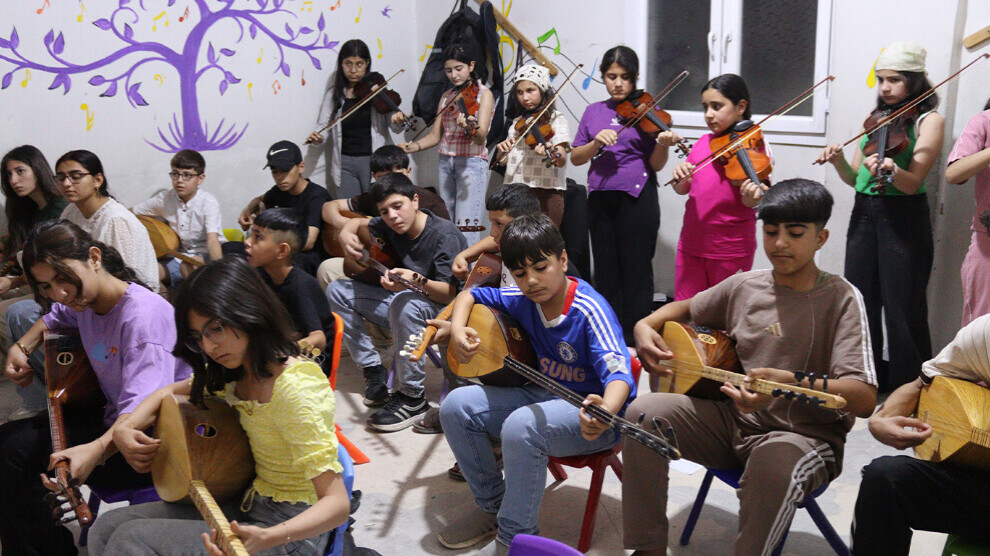
Kobani_ The “Fajin” Insitute in the city of Kobani, Rojava, contributes through its music courses to the academic development of children’s musical and vocal talents. Through these events and trainings, it works to preserve the culture, heritage, and folklore of Kurdish music specific to the city of Kobani.
Developing children’s musical talents is a positive step for the generations, as musical empowerment is a launchpad for building a culturally creative generation and a conscious society.
Therefore, the presence of specialized music centers and institutes within communities is essential.
The “Fajin”Institute was opened in 2019 in the city of Kobani. It is an artistic and musical center that provides academic education in various fields of music for children and young people. The institute accepts students from the age of 7 allowing them to choose the musical instrument they wish to learn. The institute also organizes various events and activities, including musical evenings and participation in festivals and cultural events within the city.
Developing Children's Talents Academically
Regarding the nature of work within the institute, music teacher at the "Fajin" Institute, Amal Bozan, said: "In the city of Kobani, especially in recent years, we have noticed a decline in the professional musical level. Therefore, through this institute, we seek to provide academic training that develops the abilities of young people and the rising generation in the field of music." She added: "This place is a space for teaching children singing and playing the instruments they choose."
She explained that the training includes various musical instruments, while the choice of instrument is left to the child and their family. She noted that some children begin learning a specific instrument, such as the bağlama, and later wish to switch to another instrument. Once a student masters a specific instrument, they begin training in voice, rhythm, and solfège.
She pointed out that when the institute opened, the number of students was small. However, after students participated in musical evenings and their progress was observed, demand increased significantly, reaching approximately 150 students today, with numbers growing during the summer break.
She also noted that the majority of students are girls, considering this a positive development. Previously, it was rare for society to accept women practicing music, but today the region is witnessing notable progress in the participation of women and young women in various areas of life, including music and art.
Students receive lessons on various instruments such as guitar, violin, bağlama, oud, and solfège—which includes voice and rhythm exercises.
Amal Bozan affirmed that the institute organizes various events and activities, including participation in festivals and celebrations, and hosting musical evenings, with the aim of encouraging students to develop their skills and enhance their self-confidence.
In conclusion, she explained that learning music, singing, and playing is not tied to a specific age—music "knows no boundaries or standards," and anyone with the desire can develop themselves. Therefore, the institute welcomes all age groups without exception.
"With the Encouragement of My Mother and Institute Teachers, I Mastered Singing and Playing"
In turn, 15-year-old student at the "Fajin" Institute, Ayfer Mustafa, said she began learning music at the institute three years ago to develop herself artistically. "It was important for me, as a lover of music and art, to receive an academic education. Before joining the institute, I thought music was limited to listening to pieces. However, after starting the training, I learned academically how to play and the techniques of playing the bağlama, in addition to singing methods and developing my voice through the vocal exercises I received."
She explained that she discovered her talent at the age of twelve, when she would hum musical pieces at school and for her friends, and at home in front of her mother, who encouraged her to develop her talent and work on improving her musical abilities.
She noted that she has participated in several musical events and festivals, the first of which was the "Arin Mirkan" Festival, where she took the stage for the first time at the age of twelve, describing that moment as a mix of joy and fear, but it was a special experience that marked a turning point in her journey.
Ayfer Mustafa pointed out that over three years of training, she has made significant progress in the field of music and has learned a great deal at the "Fajin" Institute, thanks to the teaching staff who are dedicated to providing academic education based on sound foundations, including training in singing and playing according to musical notation.
"I Was Influenced by the Feeling of the Violin, So I Chose to Learn to Play It"
For her part, 14-year-old student at the "Fajin" Institute, Susan Mahmoud, said she discovered her talent at the age of ten. Since the institute opened, she has joined the training with the support and encouragement of her parents, who motivated her to learn singing and playing.
She added that she has noticed significant development in her personality and skills since beginning the training, as she has mastered singing in terms of both vocal range and technique, and has learned the fundamentals of playing and musical rhythms.
Regarding her choice of the violin, Susan Mahmoud explained that she used to watch videos of violinists on social media platforms. She fell in love with the sound of this instrument and its distinctive feeling, which led her to choose it despite its difficulty and the small number of people who pursue learning it.
The experience of the "Fajin" Institute over the past years points to the vital role that artistic institutions can play in developing the abilities of children and young people, and opening new horizons for them in the world of music. Between the students' passion, the efforts of the teaching staff, and family support, the institute continues to contribute to building a generation that possesses artistic awareness and the ability for creative expression, affirming that music is not merely a hobby but a space for refining personality, building confidence, and creating a more open and cultured society.