
Women’s Struggle in the Face of Political Conspiracies and Their Role in Achieving Equality
Women’s active political participation and self-defense efforts challenge male-dominated social and state structures, positioning them as essential to building a free, equal society for all.
Perîvan Zîlan
The continued active participation of women in politics and their efforts to defend themselves are having a tangible impact on the traditional social order and the male-dominated structure of the state. Women are emerging as a fundamental force in the establishment of a free and egalitarian society that serves all segments of the community.
The world and the region are witnessing an escalation of conflicts and non-conventional wars that increasingly rely on semi-military forces, amid the redrawing of the geopolitical map—particularly in the Middle East. These changes are opening the way to new possibilities that go beyond the goals of the dominant powers. The war in the Middle East and Kurdistan now has a clear impact on the region and the world, alongside the Russian-Ukrainian conflict and U.S. interventions in areas such as Venezuela, as well as other moves that threaten the stability of countries like Cuba and Iran. The rising tension between the United States and Iran may affect not only their bilateral relations but the entire region, prompting countries such as Saudi Arabia, Turkey, Iraq, and Qatar to reassess their strategic positions. In this shifting landscape, crowded with actors and volatile alliances, outcomes remain unclear and final predictions are prone to error.
The Kurds and the Creation of an Alternative Model
Within the framework of what is described as the Third World War in Syria, the Paris agreement led to a large-scale attack on 6 January on the Sheikh Maqsoud and Ashrafiyeh neighborhoods of Aleppo, with the participation of multiple regional and global forces. The attacks carried out by jihadist groups such as Hay’at Tahrir al-Sham and ISIS extended to the areas east of the Euphrates, where they were used as secondary tools against the Kurds to weaken them in line with the converging interests of nation-states. This collusion, which targeted self-administration through these groups, served the interests of dominant regional and international powers and sought to destroy a social model led by women. Ahmad al-Shara (al-Julani) did not have an ideological conflict with the existing system; he understands the limits of his influence and has moderated his rhetoric internationally. As an indigenous people of the region, the Kurds present a model of cultural freedom and women’s leadership, which has led capitalism to view them as a threat to its structure and to attempt to neutralize them by all means. These developments have led to events in Syria being described as a second international conspiracy after 15 February.
Special and Psychological Warfare
Alongside the international conspiracy carried out during this process, which targeted the annihilation of the Kurdish people, there was an intense campaign of media manipulation aimed at concealing the suspicious alliance by focusing on the “reasons for the Kurds’ defeat” and their “shortcomings.” Public opinion was distorted within a narrow framework of limited military success and failure in order to suffocate and eliminate hope.
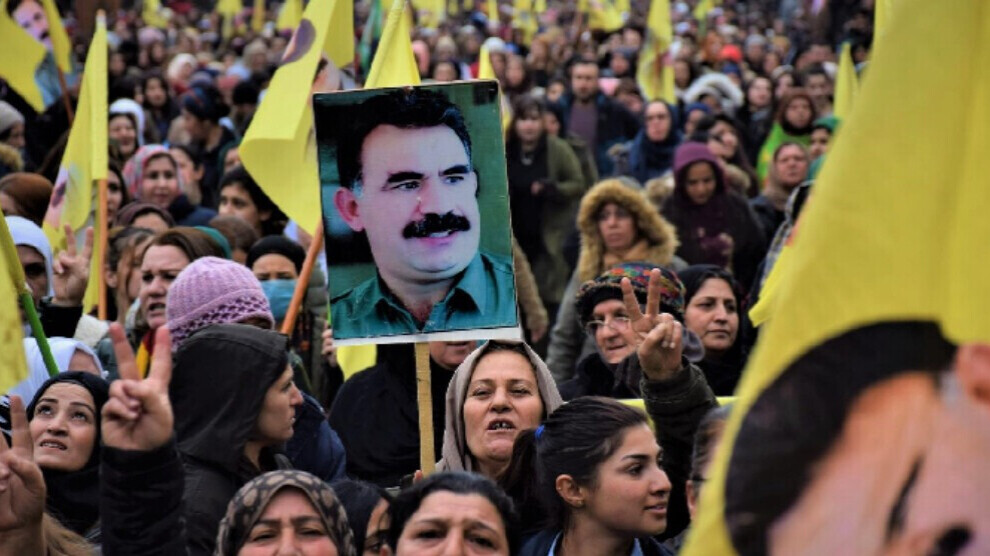
These orchestrated attacks—targeting leader Abdullah Öcalan—revealed the depth and scope of the conspiracy. The model of the democratic state was portrayed as unrealistic and fragile. The aim was to diminish Öcalan’s role in the struggle for the freedom of peoples and women and to reduce his global influence, even to the point of suggesting that women’s liberation was nothing more than an unattainable dream. Within this special war, psychological warfare was promoted intensively and comprehensively, while the poison of primitive nationalism was injected into societies. Confronting the discourse of hatred, sectarianism, and racism, and setting a clear agenda to address these challenges, is indispensable in responding to these attacks. However, the desired goals will not be achieved unless the number of political actors increases, networks of struggle in various fields are strengthened, and organizations based on a shared vision that includes all principled groups are established.
The Impact of the Freedom Movement
Dominant international powers have long shaped their foreign policies according to their own interests, ignoring social, ethical, and political standards. In this context, defining “power” as a terrorist threat is not based solely on its intention to use violence but also on the possibility of controlling it. The primary reason for targeting Öcalan’s approach and the Kurdish freedom movement is not limited to their defense of Kurdish identity and rights; it also lies in the threat posed by their attempt to establish an alternative system. The movement’s model for women’s liberation and its vision of the democratic nation carry the potential to unite peoples of different beliefs and viewpoints on a common basis. The global impact of this movement became evident during the defense of Rojava, which generated fear among the forces opposing this vision.
Öcalan’s role was decisive in halting genocidal operations before they reached their peak. Moreover, five decades of continuous struggle unexpectedly contributed to building a stable system in Rojava that has left a global imprint. This achievement sparked waves of solidarity and supportive responses at both national and international levels, confirming the profound influence of the Kurdish movement in shaping a new vision for societies and the future.
The Need to Intensify the Struggle
With the emergence of a new conspiracy similar to that of 15 February, the need to strengthen dialogue, alliances, and joint struggle has become urgent. This must be based on the concept of the democratic nation, which includes all components—Kurds, Alawites, Druze, Syriacs, Armenians, Christians, Arabs, and others—in the face of incitement, divisions, and the fueling of conflicts. Developments underscore the importance of achieving mutual recognition, building trust, and consolidating the foundations of the democratic nation more strongly than before. Only through this approach can the dangers of massacres and genocide be confronted; otherwise, the likely consequences will be further chaos and destruction threatening both women and peoples.
The attacks stopped after the 29 January agreement, but fears of their resumption remain. The current situation is marked by uncertainty about future developments, while the legitimate struggle in the self-administrated areas has gained unprecedented attention among Kurds and their allies, especially women and democratic public opinion. The recent period has seen a notable strengthening of national unity through democratic efforts and initiatives that reinforce a sense of collective ownership inside and outside Kurdistan. Globally, broad international mobilization has had a significant impact on Kurdish resistance and their defense of existence, comparable in importance to their struggle against ISIS.
In the coming phase, after the agreement, struggles are expected to continue to achieve comprehensive goals within a framework of democratic integration. These include the democratization of Syria and ensuring that identity, belief, and freedom of thought are recognized as fundamental rights of citizenship in the constitution. In this context, the role of women is becoming increasingly prominent, as they will continue to play leading roles through their active contributions to reconstruction and decision-making, as well as their growing and decisive participation in political, military, diplomatic, and local administrative fields, and across various media platforms.
Violence Against Women
In particular, the Middle East and Kurdistan are sliding into a spiral of gender-based, national, religious, and militarized discrimination. We are living in a period in which women’s achievements are being targeted more than ever. At the same time, women’s rights, the risks facing their gains, and the intensification of the struggle against them have become more visible than ever before in the Middle East and the world. There has been remarkable activity both in state policies and in arenas of struggle. In this context, the saying that “24 hours is a long time in politics” gains special significance, and the question of how to wage an effective women’s struggle becomes crucial.
Within a globally interconnected context, fascist power structures biased against women have intersected for decades with armed jihadist groups in several regions. These frameworks have never hesitated to exploit this alliance locally, leading to a rise in violence against women—especially during wars and internal conflicts entrenched by the patriarchal system and its dominance—where women’s bodies become battlefields and symbols of national honor, making them direct targets of attack.
On the ground, these assaults manifest in direct violence and killings of women in Afghanistan, Iran, Syria, and elsewhere. Yet the dynamic is not limited to these regions; its reflection is visible in Western countries in different forms. In recent years, the influence of right-wing systems with gender bias has increased, accompanied by a notable rise in attacks against women. The focus of far-right parties in Europe and the United States on issues such as family, fertility, and national values represents a clear attempt to re-entrench gender-discriminatory ideology.
In this context, the Epstein case files provide a stark example of the level of violence directed against women within the capitalist system, revealing the hidden face of structural relations that enable this form of oppression and rights violations to flourish. What is noteworthy is that this systematic violence is not confined to battlefields or the use of weapons; it extends to become part of the social and economic structure.
Despite this, the similarities are striking between the practices of extremist jihadist groups and the sexual violence resulting from elite power; both stem from a unified logic of authority. Yet while states often treat crimes of violence against women with leniency, they impose strict repressive measures on women who move politically to confront them.
Ultimately, it becomes clear that the ongoing attacks on women—whether due to their resistance and demands for freedom or as part of dominant systems in the West—reflect a fundamental interaction with prevailing global politics. Violence against women is thus used as a key tool to ensure the continuity of the current global power system.
Discriminatory, Racist, and Fascist Policies
In Turkey, women still suffer under discriminatory, racist, and fascist policies, in addition to economic crises, migration, the consequences of war, and unemployment. The rights won by women and peoples through struggle can easily be taken away when politics is confined to concepts such as security and nationalism. Whenever women take to the streets, raise their voices, organize themselves, engage in political work, or aspire to become political actors, they are viewed as a threat. The experiences of Iran and Afghanistan clearly show why women’s rights are a systemic and structural issue. Policies such as compulsory veiling and the deprivation of women from education and work are not merely “moral regulations”; they are declarations about who will use the public sphere and how. These practices are the product of a patriarchal, anti-women strategy based on the mentality: “If you want to control society, control women.” A submissive society is the goal, because if women are liberated, the family bonds that reproduce power will disintegrate, male authority will be questioned, national ties will dissolve, and the religious hierarchy will lose its meaning. From here, gender discrimination emerges—and it is not confined to the countries concerned but is continuously reproduced as state policy through law, media, education, and religion.
In light of these developments, the Kurdish women’s movement plays a pivotal role. Just as the slogans “Woman, Life, Freedom” and calls for freedom were raised in the uprisings of Iran and Rojava, these symbolic protests have laid a solid foundation for solidarity. The Kurdish women’s movement is working to build an alternative system through its organizational network and self-defense. The liberation of women and the establishment of a democratic system—both a source of fear for authority—represent the only hope for broad segments of the population, women, and societies. In the reality of Rojava, this was the main target of the counter-revolutionary attacks.
Women’s Engagement in Politics and Self-Defense
The social transformation led by the Kurdish women’s liberation movement will continue to rise as a liberatory political option. A self-administration system centered on women’s liberation is not merely a struggle for rights; it is a shared commitment to democratic governance in the face of existing authority. Women’s active engagement in politics and self-defense will continue to shake the traditional social order and the male-dominated structure of the state. Women will affirm themselves as the foundation of peace and as founding actors of a free and egalitarian society open to all segments of the community. They will demonstrate their ability to transform the women’s struggle—whose social momentum has had a global impact—into tangible political achievements