
Rojava: A Revolution That Transcends the Logic of the State
Once declared ended, history instead continued: Rojava proves alternatives endure, transcending state-centered revolution and opening a new political horizon shaped and led by women globally.
Farida Yilmaz
News Center —In the Middle East, politics is still largely interpreted through the language of states: who has gained power and where, who controls which city, which force is strongest at the negotiating table, and what each agreement has granted—and to whom. While this language may help explain military and diplomatic balances, it does not fully capture historical reality.
Power in the Middle East is not determined solely by borders and armies; it also manifests in patterns of social organization, gender-based social systems, and culturally embedded structures of meaning. Therefore, reducing the current situation in Rojava to a mere agreement with Damascus, or to a binary of “defeat or victory,” narrows our understanding of the revolution’s true significance.
The widespread circulation of “defeat” narratives today does not merely reflect a shift in power balances on the ground; it reveals a deeper ideological reaction. Revolutions do not end solely through military defeat; more often, they are dismantled by stripping them of meaning—even if they are not materially defeated. When a revolution is portrayed as having been defeated, there is an attempt to erase the political possibilities it generated from collective memory.
Thus, the discussion is not limited to ongoing political maneuvers in Rojava, but extends to how history itself is read: When do revolutions end? In what forms do they persist? And what does “defeat” truly mean?
Beyond the “End of History”
Rojava emerged in the post–real socialism phase of global revolutionary history. To understand today’s interpretations of “defeat” directed at Rojava, one must examine the disintegration of twentieth-century revolutions and the subsequent rise of the “end of history” thesis.
The collapse of real socialism was not interpreted merely as the dissolution of a political bloc, but as the end of the search for alternatives. In his “End of History” thesis, Francis Fukuyama argued that liberal democracy and capitalism represented the final political forms humanity could reach. This claim functioned as an ideological discourse aimed at marginalizing the idea of revolution and relegating it to the past. According to this thesis, the era of grand ideologies had ended, rendering the search for alternative systems futile.
Yet the history of revolution has never been linear. The defeat of the Paris Commune did not end the idea of revolution; the events of 1968 demonstrated that freedom cannot be reduced to state power. Likewise, the collapse of real socialism did not eliminate the pursuit of equality—it revealed that this pursuit would take new forms. What collapsed was not the principle of equality itself, but the state-linked organizational model through which it was pursued.
Critiquing the State-Centered Revolutionary Model
Following the collapse of real socialism, an ideological climate prevailed that sought to marginalize historical alternatives. However, this period also witnessed important theoretical interventions that re-examined revolutionary failures from a state-centered perspective.
In this context, Abdullah Öcalan’s critique of capitalist modernity—articulated in his defense writings—holds particular significance for understanding the Rojava experience. Öcalan does not attribute the crisis of twentieth-century revolutions solely to political defeat; rather, he identifies the core problem in their state-based organizational form. He argues that the modern state is not merely a governing apparatus, but a historical institution of power, within whose structure the oppression of women is embedded.
According to Öcalan, the exclusion of women from social life constitutes the first link in the chain of social hierarchy, class inequality, and state formation. Therefore, women’s liberation is a fundamental prerequisite for building a democratic society.
This approach transforms the concept of revolution from seizing state power to reorganizing society itself. Although real socialism aimed at equality, its integration into bureaucratic state apparatuses created a gap between revolutions and society. Öcalan’s perspective on democratic modernity critiques these historical experiences and proposes localized political decision-making, strengthened social organization, and the institutionalization of women’s liberation as solutions to the crisis of authoritarian modernity. Within this framework, women’s liberation is viewed as the essential guarantee for the continuity of a democratic society.
Women at the Core of the Revolution
The most radical aspect of this transformation lies in placing women’s liberation at the heart of the revolution. In the Middle East, the state is not merely a political institution, but also an institutionalized form of patriarchal domination. The confinement of women to the private sphere and their control through family and honor systems constitute some of the oldest foundations of political power.
Women’s leadership in Rojava shattered this historical system. When women become a collective will that decides, governs, defends, legislates, and builds institutions, it is not only women’s status that rises—the entire structure of power is shaken simultaneously.
YPJ: A Break with Patriarchal Logic in War and Politics
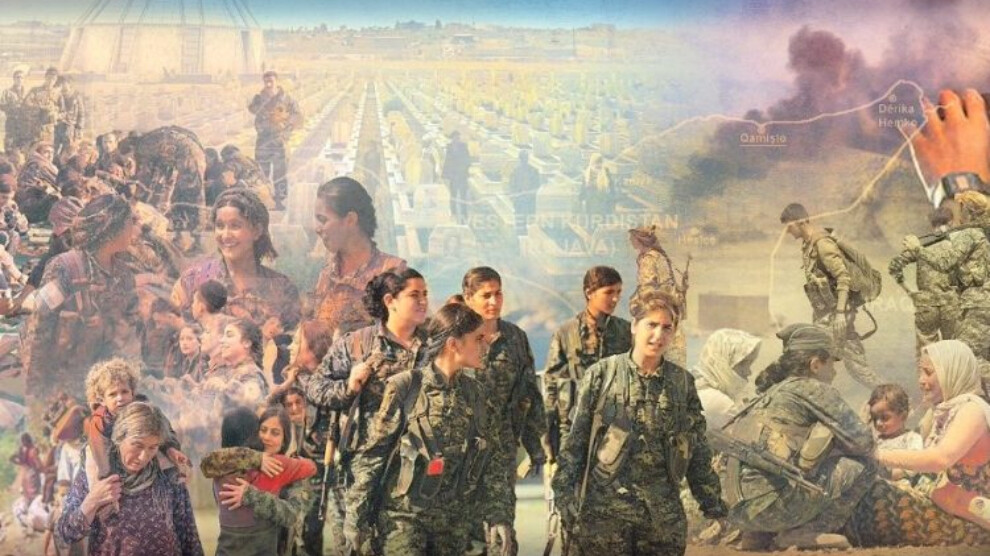
This transformation reached a historic turning point with the emergence of the Women’s Protection Units (YPJ). In the Middle East, war and security are almost exclusively male domains; the army represents both the material force and cultural legitimacy of a male-dominated order.
Thus, women’s armed organization is not merely a military phenomenon—it represents a rupture in mentality. The YPJ broke with the equation of “men protect, women are protected,” revealing not only women’s struggle for survival, but also their will to shape the future of society.
When an official from Hayat Tahrir al-Sham was asked, “What is your opinion of the Women’s Protection Units?” he replied, “We want them to return to their homes—that is our view.”
This response exposes the obsession of Middle Eastern patriarchal systems. Every attack on the YPJ, every attempt to defame them, and every call for women to “return home” is an attempt to push women back into the private sphere, into obedience and marginalization. In essence, it is an attack on the core of the women’s revolution.
A System Without a State
In this context, Rojava’s pursuit of a “stateless system” is not a utopian dream, but a political response to the region’s historical impasse. In the Middle East, the nation-state has often evolved into a structure that suppresses diversity, restricts political action, subjugates society, and uses security as a pretext to abolish freedoms.
By placing itself above society, the state suffocates it. What Rojava proposes is the return of politics to society—governance not from a single center, but through local wills and collective organizations. This project, however, cannot endure without women’s leadership, because the return of patriarchy inevitably brings back centralization and hierarchy. As women’s revolution becomes institutionalized, the stateless system ceases to be merely a form of governance and becomes a way of life.
The concept of the Democratic Nation, proposed by Abdullah Öcalan, provides the political and methodological framework for an alternative way of life beyond the traditional nation-state. While nation-states in the Middle East have often imposed unity through force by suppressing identities and treating difference as a threat, the Rojava experience demonstrates that Kurdish freedom can be achieved through a social contract that enables coexistence among peoples.
This model reflects genuine political pluralism, where identities are not confined within the limits of state tolerance, but where society builds its own independent political foundations—making unity synonymous with coexistence rather than repression.
Women’s leadership is central here, transforming coexistence from a political slogan into a lived daily reality. While masculine politics historically drew borders and divisions, the women’s revolution rewove social and political life in a way that opens space for a democratic, pluralistic, and egalitarian society.
Beyond the Win–Lose Binary
Current communications with the new administration in Damascus must be assessed within this historical context. Interpreting these negotiations automatically as “defeat” stems from a perspective that treats the state as the sole measure of political gain. Yet Rojava’s uniqueness lies precisely in the fact that its politics do not target the state, but rather focus on organizing society outside—and against—it.
The real question is not whether negotiations are taking place, but what will become of the women’s revolution at the negotiating table. Agreements, in reality, are battlegrounds between two mentalities: the return of centralized state power on one side, and a revolutionary life based on women’s liberation and social democracy on the other.
Therefore, instead of confining Rojava to a simplistic “winner–loser” equation, we must recognize that over more than a decade, Rojava has transformed the reality of women in the Middle East. Women are no longer merely instruments of oppression, victims of war, or prisoners of tradition. They have redefined themselves as active agents in defense, governance, and social reconstruction.
This transformation cannot be measured by military scales, nor erased by border lines. The deepest impact of revolutions lies not in institutions, but in how people perceive themselves—and in society’s redefinition of what is possible.
The Women’s Revolution of Rojava: A Historic Achievement
In any discussion of Rojava’s future, the primary criterion must be whether the model of women’s liberation will endure, whether its institutions will grow, and how obstacles to its consolidation within society will be overcome.
Most revolutions in the Middle East are exhausted by their collision with the state. Rojava, however, confronted—and dismantled—the ideological system established by the state even before confronting the state itself. Thus, what is portrayed today as “defeat” is merely an attempt to obscure a deeper truth: the women’s revolution in Rojava is a historic victory against patriarchy—the oldest form of power in the Middle East.
For this very reason, Rojava’s greatest achievement can be summarized in a single sentence:
Kurdish women have launched a new mentality in the Middle East—a historical reality centered on life rather than the state, on freedom rather than power, and on rebuilding society under women’s leadership