
“What Is Happening in Syria Threatens to Repeat Genocide Against All Components”
Violations against Syria’s indigenous religious and sectarian communities are escalating amid troubling international silence and a clear failure to provide any form of protection or accountability.
Asmaa Mohammad
Qamishlo — Crimes are being committed in Syria in full view of the world, targeting civilians, places of worship, and religious symbols, reviving bloody chapters of genocide and systematic violence that have marked the past 15 years of the crisis.
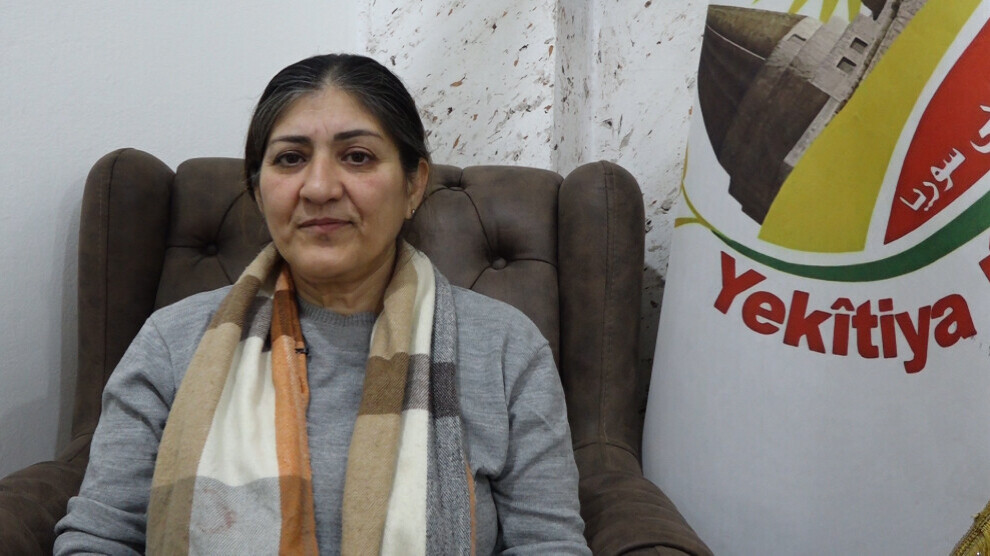
Suad Hasso, an administrator at the Women’s Council of the Yazidi House, held the Syrian Interim Government fully responsible for the escalating violations against Alawites, Druze, and Christians, stressing that ignoring these crimes opens the door to new massacres that threaten the essence of coexistence and civil peace.
She condemned the growing violations targeting Alawite, Druze, and Christian communities inside Syria, considering that what is happening today cannot be separated from a systematic pattern of violence based on religious and sectarian discrimination, carried out amid the absence of accountability and the spread of impunity.
Genocide Is Imminent
Hasso warned that the continuation of this approach constitutes an existential threat to Syria’s cultural and religious diversity and undermines any hope of building a Syria based on justice and equal citizenship. She cautioned that ignoring these crimes reproduces the conditions that previously led to genocide against entire communities, foremost among them the Yazidis, including the systematic targeting of women and attempts to erase identity and existence.
She recalled one of the bloodiest chapters in the region’s recent history: the ISIS massacres against the Yazidis in 2014, particularly crimes that directly targeted women. “Those massacres were not random acts of violence but a fully fledged genocide project aimed at uprooting the Yazidi community from its historical roots, destroying its cultural and religious identity, and erasing its authentic presence in the region.”
She noted that thousands of Yazidi women were subjected to enslavement, abduction, torture, and killing solely because of their religious identity—crimes amounting to genocide and crimes against humanity. “More than 7,000 women fell victim to these violations amid shameful international silence and a clear failure of the international community to deliver justice or hold perpetrators accountable, leaving deep wounds that remain open to this day.”
Occupied Areas Are Suffering
According to Hasso, the current situation in Syria—especially in areas occupied by the Turkish state—carries dangerous indicators of a re-enactment of genocide scenarios. She stressed that ongoing violations exceed all provisions of international law and humanitarian conventions, whether through targeting civilians or imposing exclusionary and terrorizing policies based on identity and affiliation.
Women and children bear the greatest burden of these violations, facing multiple forms of physical, psychological, and social violence as a result of “an extremist mindset based on denying diversity and rejecting the other—the same mindset that previously paved the way for the massacres of Sinjar and Afrin, and which is now reasserting itself through different tools and methods.”
Silence Is Complicity
Hasso believes that continued international silence regarding crimes committed against Syria’s indigenous communities, along with selective engagement with grave violations, only “entrenches a culture of impunity and opens the door to further massacres and organized violence.”
She placed full responsibility on the Interim Government for what she described as a “deliberate state of security chaos” and the failure to take any serious measures to hold those involved in crimes against civilians and places of worship accountable. “Attacks on churches and mosques, including bombings carried out during religious holidays and occasions, constitute a blatant violation of the sanctity of holy sites and a systematic attempt to destabilize security, spread fear, and tear the social fabric through inciting hatred and division.”
These practices have also targeted the sanctity of graves and religious and cultural symbols, reflecting, as she described, “an exclusionary mentality that does not recognize the other’s right to life or existence,” and seeks to impose a reality based on violence and intimidation.
“Building a Safe and Just Homeland”
Despite this grim reality, Hasso affirmed that the peoples of North and East Syria will continue to resist all forms of violations and attacks and will remain “one hand in the face of attempts to undermine stability and coexistence.” She pointed out that the experience of the Rojava Revolution over the past 14 years has represented “an advanced model of social cohesion and protection of cultural and religious diversity,” where communities have preserved their heritage and identities and built an administration based on partnership, justice, and democracy—making it an example for anyone seeking to build a safe and just homeland.
Ahmed al-Sharaa “al-Jolani” Is Responsible
The Syrian reality, Hasso said, has not witnessed any tangible improvement in terms of security or justice. “Crimes continue to be committed without accountability, agreements remain unimplemented, and chaos persists amid the absence of real guarantees to protect civilians, especially members of targeted communities.”
She directed a direct message to Ahmed al-Sharaa “al-Jolani,” stressing that responsibility for stopping security chaos and holding criminals accountable lies directly with him. She also demanded an end to hate speech that has deepened divisions, noting that “the Interim Government has not taken any legal action against Hatem Abu Shaqra, accused of assassinating martyr Hevrin Khalaf; instead, he was appointed to a leadership position within the Interim Government.”
Building a Syria for All
Suad Hasso called for building a Syria that embraces all its components without exception and guarantees the safe return of displaced people to their areas. “Thousands of displaced persons are still living in camps under harsh humanitarian conditions—cold, exhaustion, and the absence of basic necessities. Therefore, human rights organizations and all international bodies, including the United Nations, must assume their legal and moral responsibilities and take urgent action to stop violations, ensure accountability, and secure a dignified and safe return for the displaced. Achieving justice and protecting diversity are the only path to preventing the recurrence of genocide scenarios and building a Syrian future based on peace and human dignity.”