
Tafka Mohiuddin Leads a Green Scientific Revolution to Protect Trees
Tafka Mohiuddin has developed the world's first biological technology for treating tree wounds and cancer, leading a green scientific revolution in the city of Halabja in the Kurdistan Region.
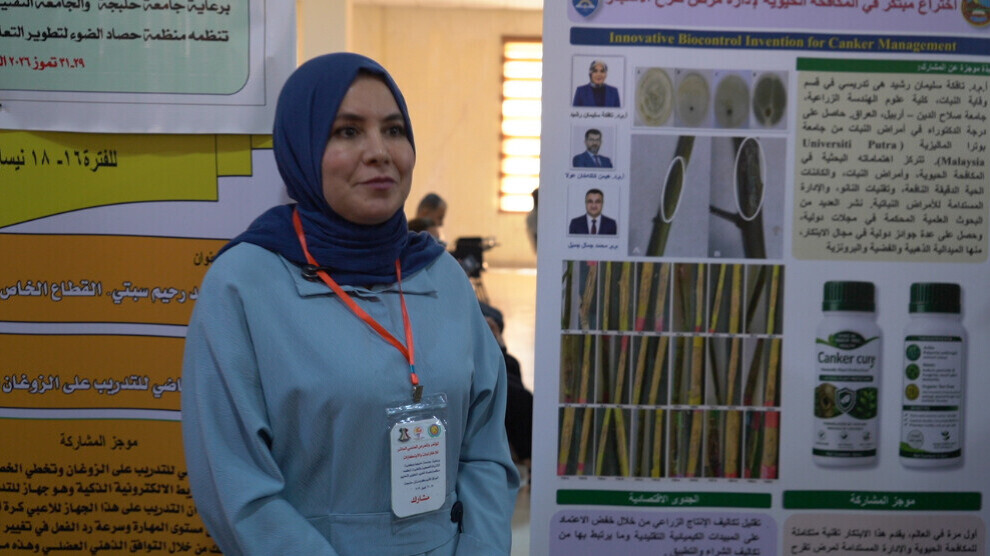
MEHRIBAN SALAM
Halabja — At a time when the world faces the challenges of climate change, and international concerns grow over the destructive effects of chemical pesticides on soil, alongside water and food security problems, local and national scientific capacities are emerging to offer innovative solutions that guide humanity toward a more sustainable future.
Dr. Tafka Mohiuddin at Salahaddin University in Erbil, Kurdistan Region, has succeeded in developing a comprehensive treatment for tree cancer—a scientific achievement for which she earned a bronze medal at the global level. Work is currently underway to apply it practically, particularly on infected trees.
This scientific achievement represents a prominent model for transforming academic research into applied projects that serve the environment and agriculture and protect trees. The treatment has achieved a 100% success rate in eliminating tree cancer in laboratory settings using biological technology, offering hope for saving millions of fruit-bearing and ancient trees worldwide.
The impact of this innovation is not limited to environmental protection; it opens new horizons for investment in organic products, and affirms that a smart return to nature, supported by the latest scientific tools, represents the safest option for achieving sustainable global food security and ensuring the future of generations to come.
A True Revolution for Achieving Agricultural Ecological Balance
Dr. Tafka Mohiuddin, the first specialized researcher and holder of the world's first integrated biological technology for treating tree cancer, stated that this discovery represents a radical and sustainable solution for tree cancer, which appears as cankers and wounds on trees. It is based on the scientific concept of employing nature itself in combating agricultural pests—constituting a true revolution in the concept of biological control and achieving agricultural ecological balance.
"Tree Cancer Causes Significant Economic Losses Annually"
She explained that the core idea for this innovation came after observing farmers' suffering with tree cancer and wounds, which "causes significant economic losses annually."
She added: "For the first time worldwide, we have developed an integrated biological technology aimed at managing the disease sustainably without any chemical intervention. We focused on completely moving away from traditional pesticides that leave toxic residues in fruits and soil, and offered an alternative based on a carefully studied mixture of beneficial microorganisms (a group of beneficial bacteria) that are environmentally friendly. Our core motto was to offer a product derived from nature and supported by solid scientific evidence."
Dr. Tafka Mohiuddin pointed to several scientific results achieved by the project: "Numbers do not lie, and they are what gave our innovation its global standing. In precise laboratory experiments, the beneficial microorganisms proved absolutely effective, managing to halt the growth of pathogenic fungi and bacteria at a rate of 100%. Our ambitions did not stop at the laboratory; we moved the experiments to agricultural fields to evaluate the technology's effectiveness under natural conditions."