
Regional Seminar in Tunisia Discussed Personal Status Laws in the Region
Participants in the seminar emphasized the importance of exchanging experiences and expertise in service of women’s rights in North Africa,which faces major challenges and clear regressions in terms of equality,equal opportunities,and freedoms.
ZOHOUR AL-MASHIRQI
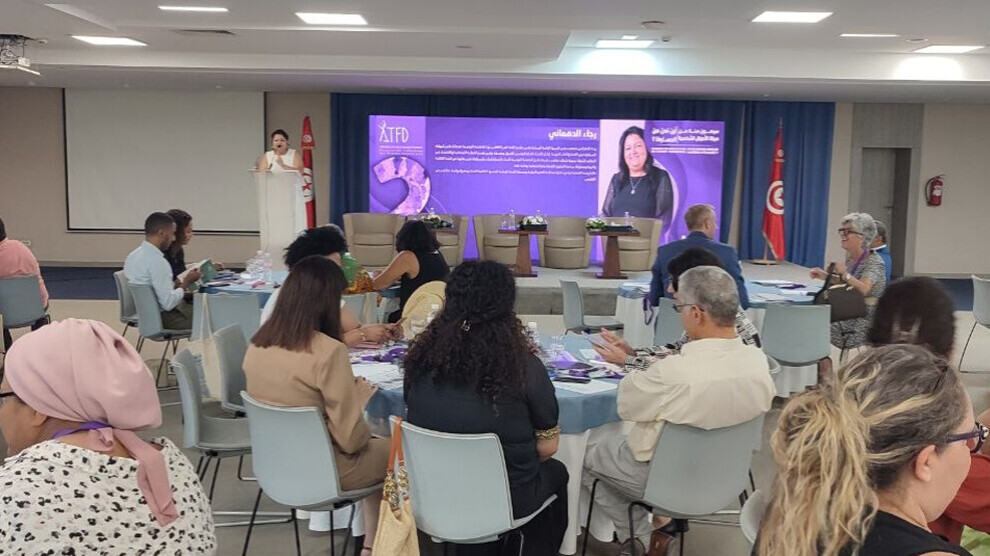
Tunis_The Tunisian Association of Democratic Women held a regional seminar yesterday,Wednesday,August 12, with the participation of activists from Tunisia and abroad,in celebration of the 70th anniversary of the promulgation of the Personal Status Code.
This seminar comes within the context of commemorating seven decades since the Code's enactment, as a landmark legal reform that contributed to transforming family relations and building a state of citizenship. It also coincides with a global context witnessing the regression of women's gains, the rise of conservative and far-right movements, the exacerbation of economic and environmental crises, and the resulting inequalities.
The seminar is grounded in reports issued by UN Women on March 8, 2025, which affirm the global regression of women's and girls' rights and the increasing threats they face—discrimination, violence, and a shortage of resources allocated for their protection. It also takes place amid continuing discrimination in family and legal areas, such as divorce, guardianship, lineage, and inheritance, making this gathering an international space for feminist and human rights organizations to meet, support the path of freedoms, and strengthen women's economic and political autonomy.
The Tunisian Experience with the Personal Status Code
Raja Al-Dahmani, President of the Tunisian Association of Democratic Women, opened the international seminar hosted by Tunisia with the aim of evaluating the extent to which equality within the family has been achieved, exchanging experiences, and developing a joint roadmap for advancing women's rights in the region. She emphasized that Tunisia cannot be separated from the regional and international context, which is experiencing conflicts and regression in women's rights, making coordination and the exchange of experiences among feminist movements with the same goals imperative.
She noted that Tunisia is witnessing a regression in rights discourse—a regression that fluctuates in intensity depending on circumstances and general political will. She considered that "Tunisia possesses pioneering provisions (such as the prohibition of polygamy), but today other countries are somewhat more advanced in the field of women's rights and equality."
During the seminar, the question "Where do we stand regarding equality?" was raised, in light of challenges still facing women in Tunisia, including proposals to remove divorce from court jurisdiction and the potential impact on women's and children's rights, alongside high unemployment rates among women and the continued need for material and moral support to ensure their independence and confront life's difficulties.
Raja Al-Dahmani stated that legislation concerning women's rights still reflects manifestations of discrimination and gender power relations, despite legal reforms in a number of countries, noting the persistence of discrimination in areas of marriage, divorce, guardianship, lineage, protection from violence, and economic autonomy.
She affirmed that the current situation poses a danger to women's rights and the gains of the feminist movement, calling for dialogue, resistance, and for the government to assume its responsibilities, particularly regarding respect for its international commitments and the alignment of national laws with them.
Responding to messages from the Ministry of Women warning of family breakdown, addiction, and other phenomena, she emphasized that the Personal Status Code and the demand for equality are not responsible for these problems. She directed responsibility toward conducting a comprehensive and complete review based on sociological and psychological studies to identify the direct causes of social phenomena, warning against targeting women's rights and disparaging them under these pretexts.
The Rojava Experience Is Unique and Inspiring
In an exclusive interview with our agency, Nobahar Mustafa, a Kurdish feminist activist from Syria, stated that participation in the seminar marking the 70th anniversary of the Personal Status Code in Tunisia was based on the exchange of experiences between countries and personal status laws in the Middle East and North Africa region. She noted that her presence aimed to speak about the "Rojava" experience and its law on women, which is more progressive and developed relative to other regional laws, in order to highlight the experience of the women's revolution in northern and eastern Syria.
She affirmed that the personal status laws in Rojava are based on a women's social contract that brings together various political, social, and civil currents on principles of equality, justice, and women's leadership empowerment. This has resulted in the organization of family and women's laws that have raised questions among women's movements in other countries regarding issues such as equality in inheritance, custody, alimony, abolition of dowry and polygamy, amendment of children's guardianship, prohibition of child marriage, and the imposition of penal and financial sanctions on violators.
She added that alongside the adoption of these laws, women's movements in the region have worked to establish academies and hold seminars and lectures for both women and men to achieve a societal renaissance that is not limited to legal texts and sanctions alone, but is grounded in a firmly established societal mental conviction.
Nobahar Mustafa explained that Kurdish women have led a secret and public struggle for forty years encompassing all segments of society, despite security pursuits, arrests, and trials by the Ba'ath regime, but they resisted for their rights. She emphasized the importance of laws being applied based on societal conviction and individual conviction regardless of gender.
Women Lost Their Rights in the Amendment of the Family Code
From Iraq, feminist activist Bushra Abu Al-Eiss said that the ruling parties in Iraq pushed for a sectarian amendment to the Personal Status Law based on Article 41 of the constitution, reinforcing the adoption of Ja'fari jurisprudence in organizing family matters.
She explained that the amendment faced popular opposition and the formation of the "188 Alliance" to defend the law, which they considered an important gain for women's and children's rights, as it is based on Sharia provisions and formulates them in clear legal articles that consider family rights.
She added that the amendment was unanimously passed without sufficient discussion of its articles or the Ja'fari code, raising criticism from civil society, democratic parties, and jurisprudence specialists.
She affirmed that the new code, comprising approximately 320 articles, contains provisions that deprive women of some rights guaranteed by Law 188, particularly in matters of marriage, divorce, custody, and inheritance.
The Family Code Must Be Revised
In the comparative context, participant from Morocco Aatifa Timjerdine noted the existence of a previous family code from 1958 that was reformed in 2004, amid criticism of sanctifying that text, which has become completely inconsistent with the reality of women who are now educated, contributors to economic production, and active participants in political life.
She highlighted that the 2004 reforms established judicial divorce, shared responsibility, and regulated the age of marriage and guardianship, but did not include the inheritance system. Despite the constitutional entrenchment of the principle of equality and setting the marriage age at 18, the Family Code still faces challenges, most notably the persistence of child marriage and the difficulty of activating the principle of shared responsibility.
She added that women's contribution to society is real and tangible, whether in structured or unstructured work, while alimony remains the husband's and father's obligation. She noted escalating demands for reform of the Family Code since 2023, especially after the royal call for its review to keep pace with societal reality and guarantee women's rights.
She explained that the committee tasked with the review heard from various parties and received 138 proposals, but adopted only 17, about which opinions ranged between acceptance and rejection.
She concluded by affirming that proposals related to inheritance and the marriage age did not meet the aspirations of the feminist movement, especially with the marriage age set at 17 instead of 18. She emphasized the continuation of struggle and advocacy for genuine reform of the Family Code that guarantees women's rights and full citizenship.