
Shira Osei: A Democratic Syria Cannot Be Built Without Guaranteeing Women's Rights and Participation
Shira Osei, a member of the Presidency Council of the Syrian Democratic Council (MSD), affirmed that Syrian women face serious dangers at this stage of redrawing a new map for the Middle East, calling on them to build their own alliance.
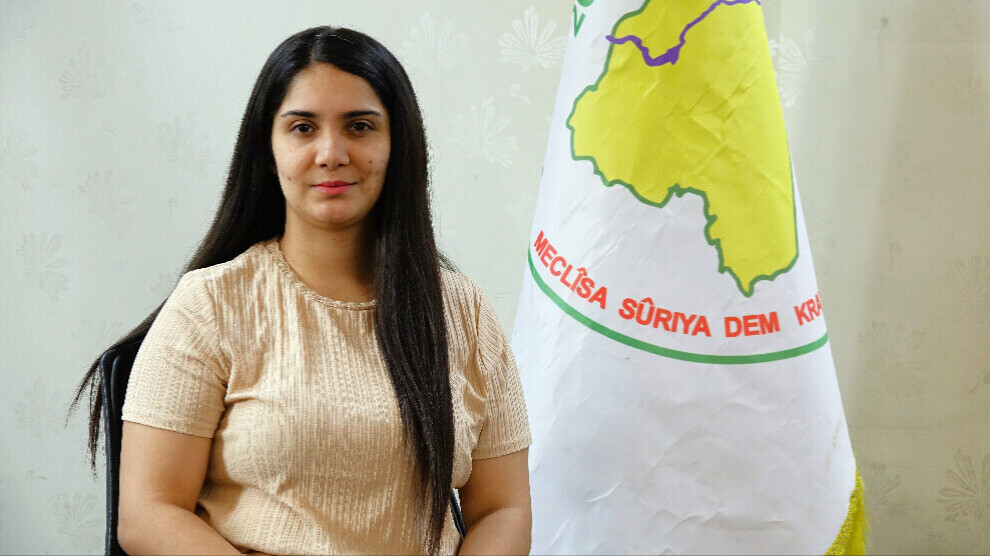
SORKEL SHEIKHO
Qamishlo— Syria is living through a complex transitional phase where political, security, and economic crises intersect, at a time when human rights and equal citizenship issues continue to pose a fundamental challenge to building a democratic state that accommodates all its components.
Amid these transformations, the issue of women's rights and their political, social, and economic participation has emerged as one of the key criteria for measuring the seriousness of any path toward building a new Syria based on equality and justice.
The Disorder Continues
In this context, Shira Osei, a member of the Presidency Council of the Syrian Democratic Council (MSD), explained that the Middle East has become a region teeming with wars and conflicts, noting that Syria has become a center of crises in the region, and a field for regional and international settling of scores and achieving interests.
She added: "A new map of the Middle East is being drawn, and Syria occupies an important and central position in it. This phase began with the fall of the Assad regime and the arrival of the interim government to power, which extended its control over various sectors and centers of the Syrian state."
She noted that "despite two years having passed since the interim government took over the administration of Syria, chaos and disorder continue, and no exit or solution to the country's fate has been found. Economically, about 90 percent of Syrians today live below the poverty and destitution line. At the security level, the situation remains extremely dire; civilians continue to be killed, abducted, and tortured. We have witnessed this in the events that occurred in Homs, Aleppo, Idlib, Damascus, and Suwayda. Wars and clashes continue in a number of Syrian cities."
An Ongoing Struggle for Freedom, Equality, and a Democratic Syria
On the hopes of the people and women for building a democratic and multi-colored Syria that guarantees the rights of all its components: "The People's Assembly is the most prominent example of this. Syrian women were at the forefront of the struggle, taking to the squares from the very beginning despite the pressures of the Ba'ath regime, demanding freedom, rights, and equality."
She noted that during half a century of Ba'ath Party rule, women were deprived of their rights, with the Personal Status Law and the Women's Union being among the most prominent tools that contributed to keeping them away from politics and decision-making centers and confining their roles to specific areas.
She added that women were among the forefront of participants in protests from the beginning, paying a heavy price, including losing their lives in the regime's prisons. The scenes of women emerging from Sednaya prison with their children revealed the scale of suffering they endured. She affirmed that Syrian women were revolutionaries, carrying hopes of building a democratic and multi-colored Syria based on equal citizenship, yet these hopes have not yet been realized.
Women Are Living in a State of Frustration and Brokenness
Shira Osei explained that through her communication with Syrian women, she has sensed a growing state of frustration and brokenness. "Women were not present in many of the steps taken. Their representation in the People's Assembly was very low. It was painful for us, the women of the Syrian Democratic Council, to see assembly sessions with only a woman here and another there."
She added that another reason is the drafting of the constitution with a masculine mentality, without sufficient recognition of women's rights or involving them in its drafting, in the absence of laws guaranteeing and protecting these rights.
Shira Osei called on the interim government to provide clear answers about the "Sisters' House"—its nature, the parties present in it, and who runs it—affirming that these issues cannot remain ambiguous. "Women's rights do not have a genuine presence in the interim government, and the voices of women politicians are being marginalized because the government fears these voices, so it does not give them real space to participate in political life and constitution drafting."
Necessary Steps That Must Be Included in the Syrian Constitution
Shira Osei highlighted a number of steps she sees as necessary to include in the Syrian constitution: "Rights must be effectively activated in Syria, not remain merely formal rights. A year has passed since the constitution was written, but where are the laws that have been activated? There are no such laws, similar to the 2012 constitution and those before it."
Shira Osei emphasized the need to entrench the principle of equal citizenship, putting an end to discrimination and violence against women, guaranteeing mothers' rights to their children, and changing the mentality that treats children as the father's property. She also called for enacting laws criminalizing violence perpetrated by some families against women, and putting an end to the authority of fathers, brothers, or husbands to perpetrate violence and murder with impunity.
She affirmed the necessity of achieving economic and political equality, including equal wages for women and men, ensuring their participation in decision-making centers and the constitution drafting committee, and raising their representation in the People's Assembly from 4 to 40 or 50 percent.
She noted that Syrian women possess expertise qualifying them to contribute to building state institutions, calling on the interim government to activate laws guaranteeing their rights and safe lives.
She also emphasized the need to protect the gains achieved in northern and eastern Syria, including the Women's Agreement, the co-presidency system, equal representation in institutions, and ensuring that the Women's Protection Units (YPJ) have a place within the Syrian army. She considers that these experiences can form an important foundation for strengthening women's rights in Syria, and that they today, more than ever, need a force that guarantees their right to defend and protect themselves.
The Absence of Laws Exacerbates Violence Risks
Shira Osei reminded of the crimes and violations committed against women and children in Syria, highlighting the dangers facing women and girls in the absence of laws. "It is a dangerous and painful situation when a girl is sexually assaulted by her uncle, then killed by her father. We also see newborn infants found in front of mosques, and other children forced to beg on the streets."
She added: "The main reason for this is the continuation of the crisis in Syria to this day, along with the absence of laws protecting women's and children's rights, which has led women and children of this country to reach this state. Children are also deprived of their rights in Syria, and are subjected to killing and rape. All the murder incidents witnessed in Syria confirm a security collapse, and the government bears the responsibility of enacting necessary laws to address these conditions. Previously, the excuse was that the fallen Assad regime was unable to control this collapse, but Syria today is going through a transitional phase."
She questioned: "Two years of the four-year period allocated for this phase have passed. Will the hopes of protecting women and children be realized in the remaining two years? The absence of laws is one of the reasons for the continued chaos and crises in Syria. Therefore, legal, security, and economic steps must be taken so that we can protect the rights of women and children and address crimes of murder and rape."
Syrian Women and Their Needs
Shira Osei addressed a message to Syrian women: "Syrian women face great danger, in the absence of their political, administrative, and legal rights. What we want is for Syrian women to gather around one table, and seriously discuss their issues and demands."
She continued: "Today, we need to build women's alliances in Syria. Therefore, Syrian women residing outside the country should head toward Syria and contribute to building this alliance. Today, as Syrian women, we must come together and develop our own strategy."
In concluding her remarks, she said: "At the beginning, we must work to secure and win our legal and constitutional rights. The voices of Syrian women are being increasingly marginalized today. Therefore, we must raise our voices to participate in political life, win our rights, and impose our presence. We therefore call on Syrian women to begin building women's alliances, and to work for a Syria based on the rights of women and children, equality and justice, and guaranteeing the rights of all components of the people. This is our time, and we must work together."