
On March 8, 2026…Rojava’s Women Face the Challenge of Protecting Their Achievements
To secure their place in Syria’s constitution, women must be included in upcoming committees, with nominees ensuring participation across sectors and meaningful roles in decision-making processes.
Nagham Jajan
Qamishlo — This year’s women’s struggle has confirmed that women’s rights in North and East Syria are no longer a secondary demand, but a firmly established reality in law, institutions, and decision-making bodies.
Significant achievements have been realized, from strengthening the co-chair system to expanding women’s roles in governance, the economy, and social life—reinforcing women’s presence as essential partners in shaping the region’s future.
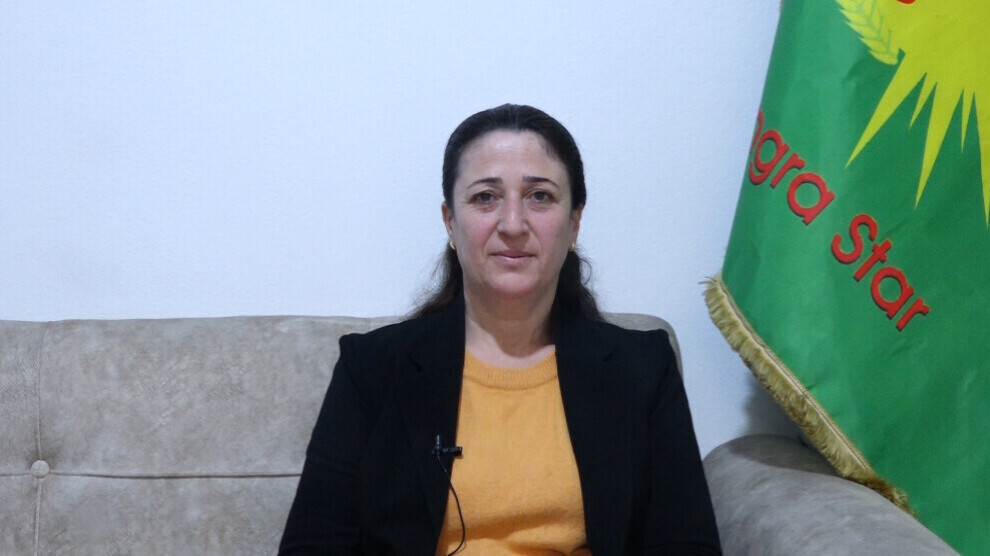
Klistan Kalo, a member of Kongra Star in the city of Qamishlo in Rojava, stated that women’s struggle has continued since the beginning of the Rojava Revolution in Kurdistan until today. “Women have waged a عظيمة struggle and led the revolution. The Rojava Revolution has transformed into a women’s revolution. In 2025, the level of women’s representation within the organization reached its highest point.”
She explained that women were given opportunities for education in all areas of society—associations, councils, and academies—allowing thousands of women to receive training. “Women achieved many accomplishments in both the military and administrative fields. The co-leadership system, which has become a model for the world, was implemented in Rojava Kurdistan.”
Women have worked to secure their rights, protect laws concerning women, and combat violence against them. The Women’s House (Mala Jin) has played a significant role in this struggle. She added that “2026 represents a new phase for North and East Syria; with the beginning of this year, we have entered a new stage.”
She noted that the regions of North and East Syria were subjected to attacks by international forces and alliances. “Throughout the years of the revolution, women administered the regions, built their own system, and managed their institutions based on the model of the democratic nation that encompasses the components of the region. North and East Syria became an example for all of Syria, attracting many people from outside the region seeking safety and stability.”
Kalo also referred to what she described as an international conspiracy launched against North and East Syria on January 6, stating that its aim was the eradication of the Kurdish people. She drew a parallel with the international conspiracy against Abdullah Ocalan, saying that broad attacks were carried out against the region.
She highlighted the unprecedented resistance in the neighborhoods of Sheikh Maqsoud and Ashrafieh, and noted that thousands were killed as a result of the attacks on North and East Syria. She added that the Syrian Democratic Forces and the interim administration reached an agreement on January 29.
“We Have a Great Struggle”
Klistan Kalo stated that the interim Syrian government does not recognize women. “The interim administration does not recognize women’s rights because it does not recognize their identity, will, or existence. Nevertheless, women have led North and East Syria and have become role models.”
She explained that all women’s institutions and organizations announced a mass campaign on February 18, demanding the protection of all women’s rights and the safeguarding of the gains of the women’s revolution within the new Syrian constitution. “Equality between women and men must be realized in the new Syria.”
She stressed that “women will not accept the chains of servitude in the twenty-first century,” and that numerous events will be organized for March 8. “As we stated in our campaign, there will be many activities on International Women’s Day.”
Regarding how to legally safeguard the achievements of the women’s revolution, she said: “How we ensure the continuation of women’s struggle in all spheres of society is what we will announce during our International Women’s Day events. Our slogan this year is: ‘With the philosophy of woman, life, and freedom, we will protect the achievements of the women’s revolution,’ because these gains are under threat. Women’s organizations continued their struggle even under the Baath regime, and they will continue today. Women will not accept servitude in the twenty-first century.”
“The Co-Chair System Does Not Exist in Many Countries”
Kalo noted that the co-chair system has sparked debate. “Syrian society does not accept a single-color, single-nationality system. Syria cannot truly represent the will of its people under this administration represented by al-Jolani. He will not be able to govern Syria entirely. The co-chair system does not exist in many countries worldwide. It has been a new model in Kurdistan, where men and women share responsibility in all aspects of life.”
“The Twenty-First Century Is the Century of Women’s Freedom”
Klistan Kalo concluded by emphasizing: “Our struggle will always continue; the twenty-first century is the century of women’s freedom. The interim administration fears women’s struggle. For women to secure their place in the Syrian constitution, the committees that will be formed must include women. Many women have been nominated so that women can participate in all fields, play a role in decision-making, and protect their achievements.”