
Italian activist: Women’s liberation key to peace, Öcalan’s freedom responsibility
Italian women’s rights activist Laura Coagliolo said the “power first, then women” mindset is flawed, stressing that empowering and organizing women, and amplifying their voices, is essential for genuine, lasting peace.
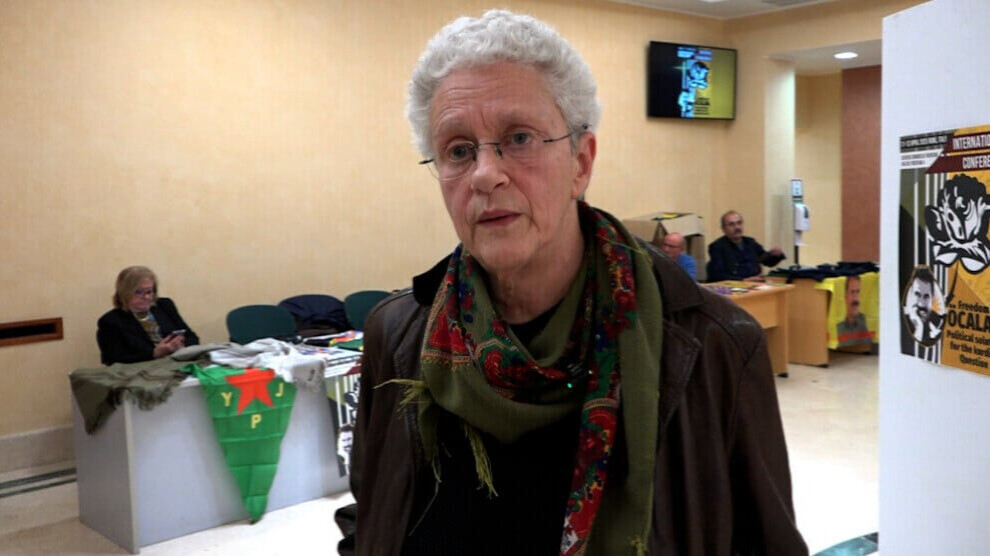
News Center — Laura Coagliolo called on the international community and European human rights organizations to fulfill their responsibilities regarding the case of Abdullah Öcalan, end the policy of isolation, and release political prisoners in Turkey, describing these steps as essential to advancing the peace process.
In a statement to ANF News Agency, women’s and human rights activist Laura Coagliolo stressed that the policy of isolation represents the greatest obstacle to achieving lasting social peace. She noted that Abdullah Öcalan has for years called for a unilateral ceasefire, stating that “peace can only be achieved through a vision that prioritizes rebuilding society and places women’s liberation at the heart of any transformative project.”
She explained that the isolation imposed on Abdullah Öcalan clearly reflects the scale of violations faced by political prisoners in Turkey, emphasizing that ending these violations is a fundamental prerequisite for peace and social reconciliation. “Respecting human rights and releasing political prisoners are crucial steps to enable the peace process to move forward,” she said.
“The Goal Is to Build an Ethical and Political Society”
Coagliolo highlighted that one of the most significant aspects of Abdullah Öcalan’s model is its strong focus on women’s liberation. She noted that recent calls particularly emphasize the leading role women must play in rebuilding society. This approach, she said, fundamentally differs from traditional peace processes, which are often imposed from the top down. Instead, it views peace as a social process that grows from the grassroots upward.
She stressed that this understanding seeks coexistence based on mutual respect among peoples, religions, languages, and cultures. “The goal is to build an ethical and political society, and therefore this process must serve the people,” she added.
Addressing current global discourse on peace, Coagliolo referred to the situation in Gaza, stating that “a situation where bombardment continues and the rights of an entire people are marginalized cannot be described as peace.” She emphasized that genuine peace must be understood as a long-term process aimed at rebuilding society from its foundations, calling for Öcalan’s peace vision to be assessed within this broader context of reconciliation and social justice.
She also pointed out that Abdullah Öcalan’s ideas are often deliberately stripped of their political context, arguing that this is a conscious choice intended to weaken their true substance. Describing Öcalan as one of the most influential thinkers of our time, she said that his project of democratic confederalism represents a highly significant model whose relevance extends beyond the Middle East and carries global value in the pursuit of justice and peace.
“Women Have Not Yet Been Fully Liberated”
Coagliolo emphasized that a model placing women’s liberation at its core is exceptionally unique. She explained that analyzing the historical roots of the patriarchal system is essential to understanding the current reality of women. “Women were the first group to be colonized in history, and they have yet to achieve full liberation. They have also paid the heaviest price in wars and oppression,” she said.
She added that gender studies play a central role at this stage, as they allow for rethinking history, society, and science from a new perspective—one that opens the door to a more just and equitable vision. “Women’s liberation is an indispensable field of struggle, as many approaches that define themselves as socialist remain insufficient in this regard,” she noted.
Rejecting the notion of “power first, then women,” Coagliolo stressed that organizing women, educating them, and enabling them to articulate society’s needs are fundamental elements for achieving genuine peace. She added that the international community does not sufficiently recognize the Kurdish freedom movement’s determination to achieve peace, underscoring the need for greater efforts to support this path.
“We Must Take Responsibility for Öcalan’s Freedom”
Coagliolo concluded by urging European human rights organizations to take concrete steps to secure Abdullah Öcalan’s freedom. She referred to initiatives launched in the Italian city of Genoa to grant him citizenship, describing such efforts as highly significant for the peace process and for understanding the essence of the model he represents.
“We must take responsibility,” she said. “The struggle is not limited to demanding Öcalan’s freedom, but also to explaining what this model means for the peoples of the Middle East and for the world as a whole.”