
Fawza Youssef: We Must Be Prepared for All Scenarios
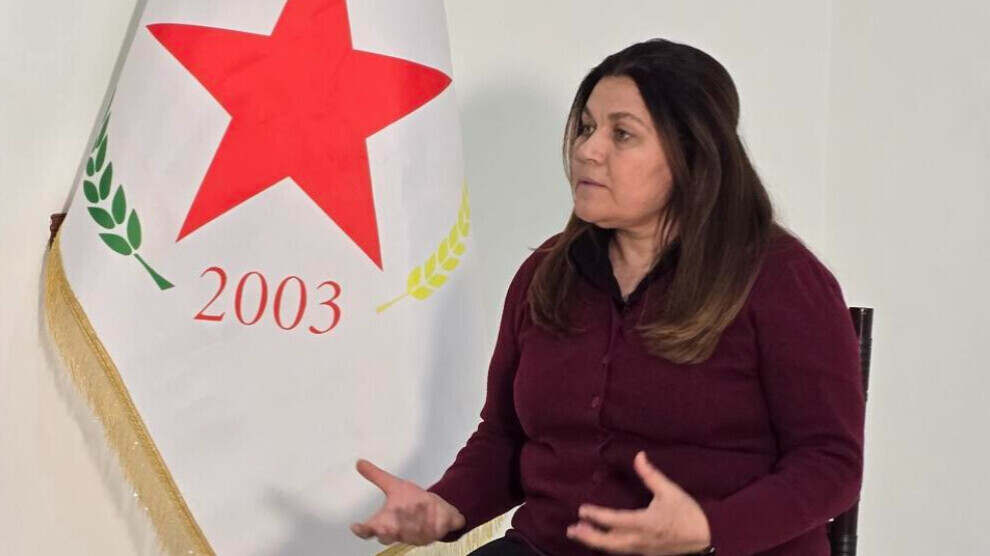
Fawza Youssef, a member of the Presidential Council of the Democratic Union Party (PYD), stressed that Rojava’s integration process is closely tied to women’s struggle and readiness for all scenarios.
Berîvan Ênatci
News Center – Since January 6, a broad conspiracy has been unfolding targeting the gains of the Kurdish people in North and East Syria. On January 29, an agreement was reached between the Syrian Democratic Forces and the Syrian Interim Government to prevent a massacre that was allegedly being planned against the region. This agreement marked the beginning of a process of democratic integration that has now entered into force. Although this step succeeded in halting the conspiracy at its outset, the threats facing the revolution remain and continue to pose a serious danger to its future.
In an interview with our agency, Fawza Youssef, member of the Presidential Council of the Democratic Union Party (PYD), assessed the current situation, pointing to the integration steps that have begun to be implemented, the ongoing risks threatening the region, and the prospects and future of women’s struggle under these conditions.
“A Second International Conspiracy”
As the anniversary of the international conspiracy of February 15 approaches, Abdullah Öcalan considers the attacks on Rojava to represent a second international conspiracy. How can this assessment be evaluated in light of current developments?
Öcalan’s description of a “second conspiracy” fully reflects the current reality. When comparing the 1999 conspiracy with what we are witnessing today, many similar and intertwined issues become apparent. Once again, the goal was to break the will of the Kurdish people, embodied in Rojava. In 1999, Öcalan himself and the idea of the democratic nation were targeted. Leadership was again a primary objective. Fundamentally, the aim was to drive Kurds and Arabs into conflict with one another.
Öcalan once described it as “throwing a fire flower onto Turkey so that the conflict would continue for another hundred years.” This conflict extended into North Kurdistan as well, and the danger remains. Turkey’s continued role in massacres in Rojava suggests that the process initiated there may continue in North Kurdistan too.
The 1999 conspiracy targeted women’s freedom and the ideas of liberation proposed by Öcalan, and this continues today. The women’s revolution is not merely the product of fifteen years, but of decades of struggle, which is precisely why it is being targeted. The same forces involved in the February 15 conspiracy are also playing roles today. Therefore, Kurds and women must understand the nature of this conspiracy deeply and avoid superficial interpretations in order to confront it effectively.
Who Is Behind the Escalation?
After the Paris agreement on February 5, attacks began on January 6, accompanied by massacres and a harsh media campaign. Who led this process?
Öcalan emphasized that this war was imposed on Kurds and Arabs, the result of a pre-planned strategy. Previously, when clashes occurred in Sheikh Maqsoud, shelling and brief confrontations would happen, followed by intervention—either by Damascus or the Americans—to stop the escalation. But on January 6, this changed.
Drones targeted both local forces. Who sent them? Who planned this? It was clearly organized in advance. Meetings had been requested repeatedly. On January 8, a meeting was expected to reach an understanding, yet the other side acted hastily, suggesting prior plans.
In Deir Hafer and Maskanah, the situation was clearer. The Syrian Democratic Forces declared their readiness to withdraw, yet ceasefire terms were not respected. Everything had been prepared beforehand, showing insistence on continuing the war.
Impact on the Peace Process and Rojava’s Future
Developments in North Kurdistan affect all parts of Kurdistan, as borders are used as tools of anti-Kurdish policies. Events in Rojava are linked to what is happening in Turkey, where regional plans seek to increase instability.
If the democratic nation project advances in Rojava, it could foster positive developments between Syria and Turkey and pave the way for a democratic Syria. A democratic Syria could establish stable and beneficial relations with Turkey, serving both Kurdish and Turkish peoples.
However, a civil war involving Kurds and Arabs would produce an unstable, anti-democratic state, as seen with the emergence of ISIS, which destabilized the region. Weakening the Autonomous Administration or the democratic nation project may seem advantageous to Turkey in the short term, but in reality, crises would expand beyond borders.
Social and Political Achievements of Rojava
Over fifteen years, Rojava has witnessed a unique experience in which peoples proved capable of self-administration without a nation-state. A system emerged allowing all ethnicities and beliefs to freely express their identities and languages. Women’s participation and the establishment of a women’s system formed the foundation of this model.
The “Social Contract” reorganized life, making Rojava a bright chapter in Middle Eastern history. Languages once threatened with extinction, such as Syriac, were revived. Kurdish moved from secret education to becoming strong and vibrant within fifteen years—something not achieved in two centuries. The Armenian community also found space to express itself.
Living without fear is sacred. This experience granted all components the opportunity to live in freedom and equality.
Integration Process and Future Steps
Several steps have been taken toward integration: ceasefire implementation, integration of internal security forces, and postponement of discussions on factories and oil fields. Military withdrawals have begun in Hasakah, involving both the Syrian Democratic Forces and Damascus-affiliated forces.
This process will significantly affect the Autonomous Administration system. Adjustments are underway according to the Social Contract’s provisions for new agreements. While the current system resembles a general Syrian administrative structure, it is not identical.
The priority remains preserving achievements while maintaining self-governance. For the first time in Syria’s history, Kurdish existence has been officially recognized after decades of denial.
The key issue now is continuing legal and political struggle to ensure rights are secured in Syria’s future constitution, opening nationwide political participation while enabling local administration.
Women’s Struggle Moving Forward
Women must continue their struggle as Kurds do. The conspiracy targets women seeking freedom through physical and media attacks. The experience since 2011, especially in Kobani, proved that perseverance creates miracles and draws global solidarity.
Retreat is death and betrayal; persistence brings hope and strength. Women must strengthen their organization, continue activism, and defend their rights legally. The fate of Kurds and women is intertwined with democracy; without it, women cannot live freely.
The current stage requires renewed strategies and broader discussions. After years of war and gains, the situation remains uncertain, making reorganization essential.
U.S. Conference on Kurdish Recognition
Some politicians familiar with Rojava have documented war crimes and presented evidence before Congress. The United States, as a major actor in Syria and the Middle East, bears responsibility. Laws like Caesar sanctions were significant examples of U.S. influence.
Many American politicians say the world owes a debt to the Kurds. That debt should now be repaid in a just and humane manner in recognition of Kurdish sacrifices.
Prepared for All Scenarios
Attacks may continue amid regional instability and multiple international agendas affecting Syria. Therefore, preparedness for all scenarios is essential. Although an agreement exists and there is hope for its positive implementation, the multiplicity of actors—some acting in bad faith—makes the future uncertain.
Kurds and women must be ready for every possibility so they are not taken by surprise. A new path based on unity lies ahead. Much has been achieved, and much remains to be accomplished. The struggle must continue without pause.