
Hopes Glowing in the Heart of Ashes… Gaza’s Women Welcome 2026 with New Visions
After two years of bombardment, killing, displacement, and societal collapse, Gaza’s women look toward 2026 with cautious hope for safety, dignity, and the restoration of human rights and humane living.
Nagham Karajah
Gaza — At the moment of transition between two years, women in the Gaza Strip stand at a crossroads laden with a complex mix of pain, longing, and hope, following two years of the most violent shocks ever etched into Palestinian collective memory. Gaza—ravaged by relentless bombardment, mass displacement, and the near-total collapse of infrastructure—welcomes the year 2026 with eyes fixed on a future driven by ambition despite the harshness of reality.
According to the latest statistics from the Palestinian Ministry of Health in Gaza, more than 70,000 people have been killed since October 2023. UN reports indicate that women and girls constitute nearly 70% of the total victims, highlighting the heavy burden borne by women throughout this prolonged conflict. In addition, more than 557,000 women are suffering from acute food insecurity, placing them in a daily struggle against hunger and the lack of basic services.
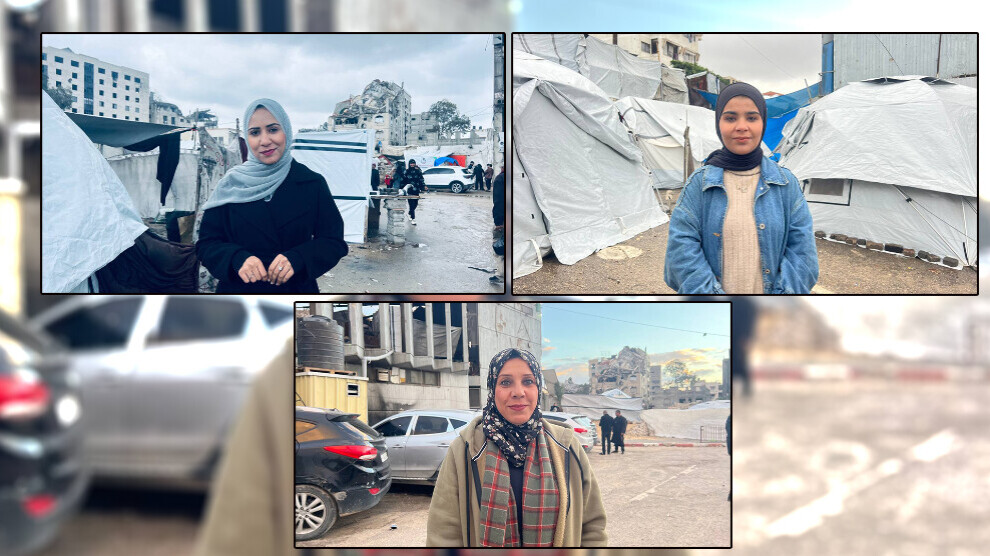
Suha Sukkar, whose spirit of hope has not been extinguished by the bombardment but rather strengthened by it, says:
“If pain has shattered our homes, it will not shatter our determination. In 2026, we look forward to peace accompanying our paths and to smiles returning to people’s faces. Every woman in Gaza carries in her heart a seed of hope that the war will end and a new chapter of dignified and decent living will begin.”
She affirms that women in displacement camps have not lost faith in their abilities:
“These years have taught me that hope is not measured by the number of days free from shelling, but by our ability to stand up after every collapse. We want sustainable education for our children, healthcare that honors human dignity, and work that guarantees us a life of dignity.”
“2026: A New Opportunity for Women’s Renaissance”
For her part, Heba Krizem views 2026 as an opportunity for a new women-led renaissance:
“We do not want to leave our land; rather, we want to be seen as active partners in rebuilding society. We have endured loss and displacement, but we have also gained strength and the ability to organize ourselves into strong solidarity-based communities. Our hope is that the new year will mark the beginning of economic programs that benefit women, and that real training and employment opportunities will be made available—so that the same hand baking bread in a tent is not the one left without any source of income.”
Iman Al-Ajla describes these hopes by saying:
“We are not just numbers in reports. We are mothers, daughters, sisters—women who raise their hopes high toward a new year. We wish that 2026 will be a year of peace, a year of rights, a year of well-being; a year in which every woman has enough food, shelter to protect her from winter’s cold, and dignity that shields her from the humiliation of war.”
Reliable statistics demonstrate the vital role women have played during the crisis. They have been at the forefront of community empowerment efforts—organizing family support networks, pooling food resources, coordinating humanitarian aid, and striving to maintain education within tents and informal settlements despite immense challenges. Although these efforts are not always documented in official statistics, they form a genuine fabric of daily life in Gaza and highlight women’s ability to endure and innovate under harsh conditions.
“How Do We Live with Dignity?”
Despite the destruction of infrastructure, the decline of healthcare services, and the spread of disease and malnutrition—foreshadowing a severe public health crisis—women continue to ask the same questions: How do we live with dignity? How do we provide our children with a better future? These questions are not mere dreams but fundamental human rights recognized under international law, rights that every woman and girl in Gaza and around the world deserves. As such, women place their faith in girls’ education as a means of changing reality.
This hope persists even as living conditions in Gaza remain at their most challenging. More than 70% of the infrastructure—including health, water, and education facilities—has been destroyed, making access to basic services a daily miracle. Patients, young and old alike, stand in long lines to obtain potable water. Pregnant women face compounded risks due to the shortage of medical services, while the healthcare sector suffers from near-total collapse.
Furthermore, UN studies have confirmed that approximately 96% of women in Gaza have experienced some form of gender-based violence during the conflict, ranging from verbal and economic abuse to physical harm—underscoring the urgent need for psychological support and preventive services.
Despite these harsh realities, women in Gaza do not stop dreaming. They see 2026 as an opportunity to reshape life—not merely by surviving the war, but by achieving sustainable human victories: education for girls, economic empowerment, stable healthcare, and solidarity-based communities that protect human dignity, not just survival.
“Our Hope Is That 2026 Will Be the Year We Move from Survival to Reconstruction”
In closing, Iman Al-Ajla said:
“Our hope is that 2026 will be the year we move from a state of survival to a state of rebuilding. We want it to be a year remembered as the one in which Gaza’s women rose up and took their communities by the hand toward a brighter future.”
These lived testimonies are more than words; they are voices of resilience and determination emerging from the heart of an experience that has not been weakened by trauma, but rather deepened and enriched by it. They carry an unshakable hope that draws closer the reality they aspire to—one that recognizes Palestinian women as active partners in public life and a fundamental pillar in any genuine process of recovery or peace.