
Amid Political Pressure… Tunisian Women Discuss the Path of the Feminist Movement and Its Current Challenges
A meeting by the Tunisian Association of Democratic Women highlighted the evolution and legacy of Tunisia’s independent feminist movement amid democratic regression and increasing restrictions on civic space.
Zohour Al-Mashriqi
Tunis — Participants in the meeting affirmed that unstructured feminist activism has returned to the forefront in recent years due to increasing pressure on organizations, accompanied by restrictions that have reached the suspension of associations’ activities and the arrest of several activists.
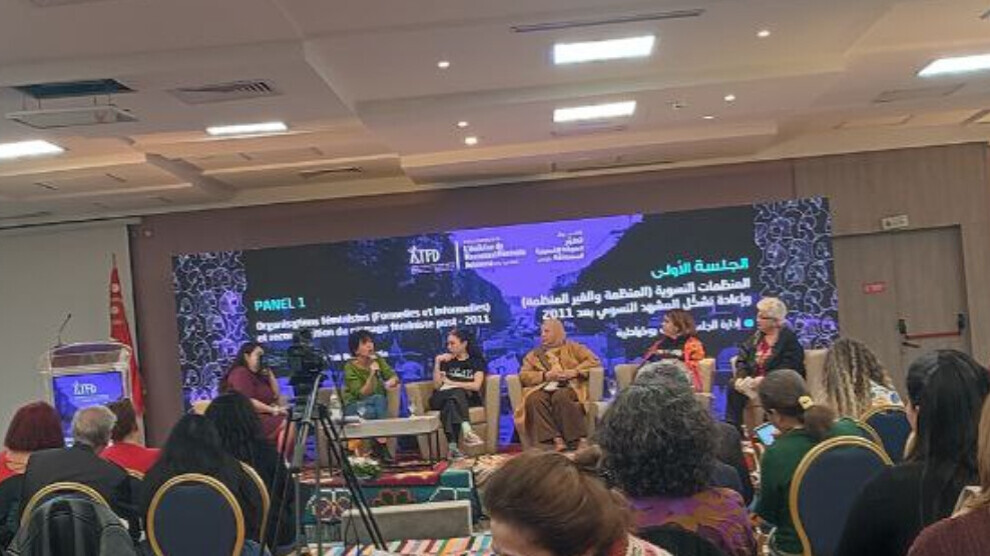
On Friday, December 26, the Tunisian Association of Democratic Women organized a meeting on the evolution of the independent feminist movement in Tunisia. The discussion addressed the political contexts in which the movement emerged—contexts characterized by authoritarianism, repression, and restrictions on freedoms. The meeting emphasized that the movement was established as a space of critical resistance against state feminism and the instrumentalization of women’s rights, through developing forms of organization and mobilization deeply rooted in Tunisia’s social reality. It noted that the movement was built on foundational principles, most notably the defense of a secular approach to women’s rights and a firm commitment to core feminist values and militant practices.
Participants considered that independent feminists carried a vision of women’s rights grounded in the universality of human rights, equality in citizenship, and freedom of conscience, in a context where religious discourse was often used to justify inequality and restrict individual freedoms. Consequently, feminists positioned themselves as opponents of patriarchal norms and defenders of women’s autonomy against attempts to control their bodies and choices.
The meeting also addressed the period following the 2011 revolution, which marked a surge in political and social mobilization characterized by the emergence of new feminist voices, the formation of independent groups, and the creation of innovative forms of expression. This phase revealed both a reconfiguration of the feminist landscape and the emergence of internal dynamics within it. Today, amid democratic regression and a shrinking civic space, feminist activists in particular are facing political and judicial pressure, including prosecutions, summons, and arrests. In the face of these attacks, the importance of transmitting feminist legacy, strengthening solidarity, and reaffirming the movement’s founding principles has become more urgent than ever.
The meeting sought to contribute to collective reflection on the development of independent feminist movements in Tunisia, their legacy, transformations, and current challenges, while strengthening dialogue and the transfer of experiences between veteran feminists and younger generations.
“The Feminist Movement Is Not Separate from the Global Movement”
Raja Dhahmani, president of the Tunisian Association of Democratic Women, stated that the meeting brought together the association—founded in 1989—and feminist organizations that emerged after the revolution, all of which were the product of a strong and renewed social movement. The aim, she said, was to exchange experiences and develop approaches for learning and growth.
She noted that the feminist movement in Tunisia is not isolated from global feminist movements and approaches that adapt to economic, social, and political changes worldwide, including in Tunisia. She added that the association was founded on a comprehensive feminist approach, grounded in intellectual readings and a full philosophical vision aimed at a complete societal project within an integrated process—not an arbitrary one—and that this remains a principle the association upholds today. She stressed that feminism is not a single concept, but rather a set of intersecting approaches united in their vision to advance women’s rights.
Dhahmani explained that the association aligns itself with new feminist experiences, seeks to learn from diverse initiatives, and works to pass on its experience to younger generations, considering it the product of cumulative resistance and struggle against capitalism and imperialism.
“Networking Among Feminist Organizations Is Essential”
For her part, Monira Ben Salah, one of the founders of the Women Farmworkers’ Movement, said that the movement, which emerged after the revolution, culminated in the issuance of Decree No. 4 on the social protection system for women agricultural workers. She noted that women working in agriculture realized that traditional demands were no longer effective, prompting them to raise fundamental rights-based demands such as safe transportation, social security, and health coverage.
She added that the movement began spontaneously and without institutional support, but quickly gained backing from associations and organizations, expanding beyond Sfax Governorate to include various regions across Tunisia. This expansion gave the movement significant momentum and led to protests and marches that pressured authorities into issuing the decree.
Ben Salah stressed the importance of feminist organizations and centers that brought the suffering of women farmworkers and laborers into public view, creating public pressure that led to decisions in their favor, despite existing failures and obstacles that continue to hinder the full implementation of the legislation and decrees produced by feminist activism. She emphasized the necessity of networking among feminist organizations in Tunisia and working collectively to defend women and their rights, and to confront attempts to undermine the gains achieved through feminist struggle and resistance.
She concluded by noting that Tunisia has evolved from a stage where a single association defended women’s rights to a diverse feminist landscape—an achievement rooted in feminist resistance which, despite its challenges, continues its work and struggle.