
A young Palestinian woman sets up a photo exhibition in her tent
Marah Al-Zaanin proved creativity needs no resources, transforming her family’s small shelter into an art space showing Gaza’s daily life to visitors and the media.
Rafeef Aslim
Gaza- Over two continuous years of drawing, the paintings of the Palestinian artist Marah Al-Zaanin accumulated without any opportunity to organize an exhibition to contain them.
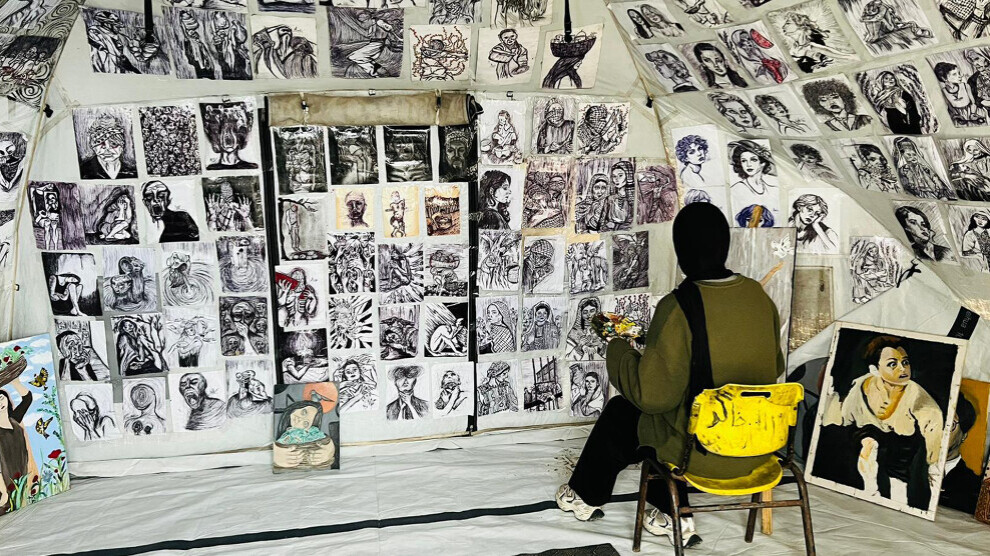
The young woman thought of a solution and asked herself: why shouldn’t these paintings have a studio like other female artists around the world? Since she lives in the Gaza Strip, the studio became a tent in which she gathered those paintings that speak about all the details of life experienced by the people of Gaza, especially women and girls. The school at the heart of the displacement camp turned into a destination for anyone who wants to experience art.
Marah Al-Zaanin explains that the idea came from her desire to open an exhibition for her paintings before the attack of October 7, but the number of paintings was not sufficient. When the attack took place and ideas began to throw themselves onto paper, the number of paintings doubled every day, reflecting displacement, refuge, loss, fear, and even some happy moments that women managed to steal from time to time.
Fearing for the paintings from damage—especially since many had already been ruined—Marah hung them inside a dedicated tent and divided the corners according to themes: a corner for famine, another for displacement, a corner for faces, and another for the Palestinian wedding. Everyone who entered the tent expressed admiration mixed with surprise, until one day the idea fully matured: why not make my exhibition here?
The place where Marah and her family sleep turned into an art gallery, sending a message to the world that limited resources are not an obstacle to achieving dreams. From her own experience, she found that a tent can become an exhibition, and another girl can benefit from another space. She receives many visitors every day, as well as media outlets, in support of girls of her generation and to encourage them to continue despite the circumstances. The most frequent question she is asked is: how does her family sleep among these tragic paintings?
She participated in preparing several illustrated books that include her drawings, accompanied by explanatory texts about their content. They have been translated into different languages so that people outside the Gaza Strip—who have never experienced war—can understand the impact of the attack and how it turns the lives of women and children from calm and beautiful into a series of obstacles and challenges they must face at every moment.
At first she drew faces, then she moved to ink drawing due to the lack of tools and resources needed to complete a full painting. When the ink ran out, she began drawing with the black ash left from cooking fires on the pot, documenting all her emotions during that period. She used Palestinian symbols such as pottery, watermelon, the Palestinian keffiyeh, the traditional dress, and many different embroidery patterns.
She says that some of her followers recognized these Palestinian symbols and interacted with them, but most needed someone to explain their meanings. She did this in one of the books she authored in several languages. She also noted that she used some Palestinian symbols to bypass restrictions imposed by social media platforms; instead of drawing the Palestinian flag, she used the symbol of the watermelon.
The number of Marah Al-Zaanin’s paintings reached 700, but only 500 remain due to displacement and other factors that caused damage. During periods of low-pressure weather systems, water seeps into the tent, causing the paintings to fall and their colors to blend. In extreme heat, humidity damages them in one way or another. Sometimes the movement of visitors inside the tent causes the paintings to fall or tear, and since they are drawn on paper, it is impossible to restore them.
Marah faced several difficulties during her journey of producing the paintings, most notably the loss of raw materials and the lack of alternatives. She used to draw and publish her paintings on the social media platform “X,” where people would buy them and hang them in their homes as support so she could continue producing more and more. Therefore, most of her paintings have been sold.
Women are present in Marah’s paintings in multiple forms. For her, they are a symbol of resilience, resistance, and family. She depicts a woman adjusting a man’s keffiyeh, standing at a charity food kitchen, and waiting in line for water.
Marah Al-Zaanin dreams of moving her paintings to a safer place, continuing her studies in fine arts, obtaining a university degree to develop her skills, and returning to painting in color instead of black and white.