
A Moroccan Artist Blending Zajal and Abstract Art to Express Humanitarian Issues
Naima Ouhmou combines painting and zajal, believing creativity is an emotional state that visits unexpectedly, driving the artist to express feelings in the form each moment requires.
RAJAE KHAIRAT
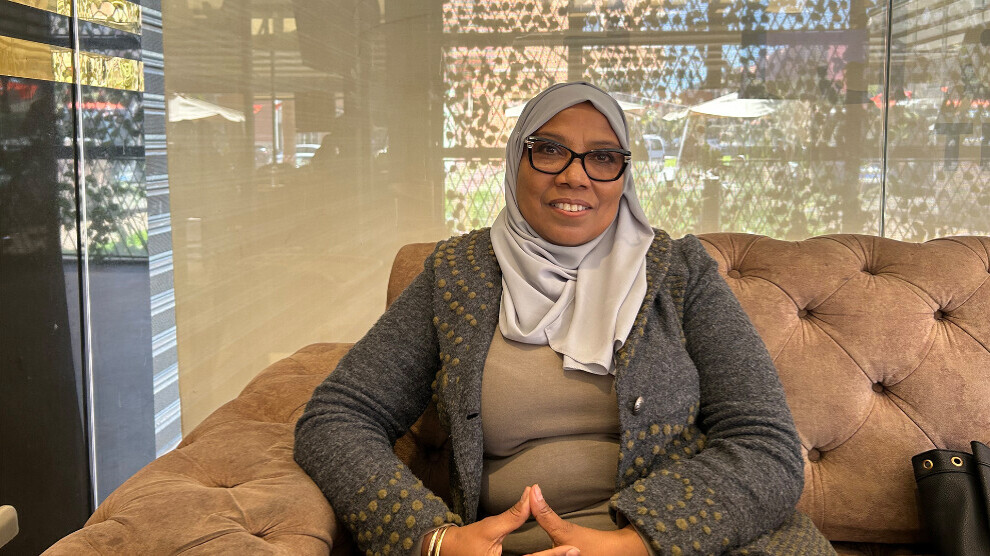
Morocco – Poet and visual artist Naima Ouhmou has adopted zajal (colloquial poetry) and abstract art as her means of expression, in harmony with her convictions about complex humanitarian issues, armed with the freedom of the word and the paintbrush.
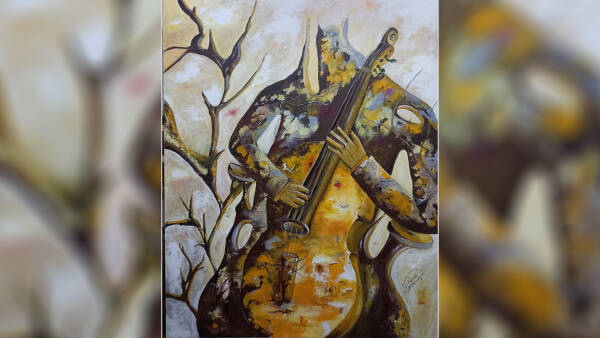
Despite the apparent distance between colloquial poetry and visual art—being two different modes of expression—Naima Ouhmou has brought them into a complementary harmony. Through both, she conveys the emotions that stir deep within her, reflecting a refined artistic sensibility shaped by human experience and engagement with social issues.
Whether through a zajal poem or a painting, she has chosen to embark on a human journey, drawing on beautiful meanings and humanitarian positions inspired by Moroccan social and cultural reality.
Zajal… A Journey of Life
Speaking about this experience, she says:
“I did not choose the zajal poem to express my inner feelings about what happens around me; rather, the poem chose me. I was at the funeral of my uncle’s wife, and they had a very strong relationship. I was deeply moved by the scene that remained stuck in my memory when I saw my uncle crying bitterly as he looked at the empty place of his wife, despite his strong personality. When I returned home, I found myself writing about the impact that scene had on me. That was the first poem I wrote, and after that, zajal poems followed on different occasions.”
She has written about heritage and about women, focusing on their issues, which she also embodied in her paintings. She believes that oral culture and popular proverbs—considered the essence of pure human experience—are fundamentally a female product, as women are the guardians of these proverbs that circulate in daily life.
“The zajal experiences of Moroccan women poets have gone beyond all the boundaries drawn for women. They excelled in crafting colloquial poetry and imposed their presence strongly on the cultural scene through poetry festivals, forums, and cultural gatherings dedicated to zajal.”
She notes that despite the strength of women’s colloquial poetic experience in Morocco, it has not received the critical studies it deserves.
She also highlighted the differences between male and female experiences in zajal. Men’s poetry tends to have a more political character, which has attracted critical attention, while women’s poetry focuses more on humanitarian and social issues and draws heavily on oral popular heritage for its meanings.
She emphasized that colloquial poetry, like classical Arabic poetry, relies on artistic symbolism, aesthetic structures, imagery, metaphors, and rhythm. It is also closer to people’s emotions because it uses the spoken dialect and draws from popular culture.
She stressed that her poetry addresses women’s issues and that women are the origin of life and stories, and that oral heritage is essentially a female creation.
Abstract Art as Self-Expression
Naima Ouhmou does not know when she turns to the brush and when she writes zajal; the expressive form changes according to the situations and scenes she encounters.
“I do not decide when to paint and when to write poetry. Creativity comes according to the emotional state that visits me—sometimes in the form of a zajal poem, and sometimes translated through the brush into an abstract painting. I may be busy in the kitchen and suddenly find myself searching for paper and pen to write fragments, which I later complete, or sketch the first lines of a painting project that I finish afterward.”
She believes that an artist in general does not decide when to create; it is an emotional state that visits and pushes the artist to translate feelings in the form that suits the moment.
Regarding visual art, she considers it a visual artistic practice.
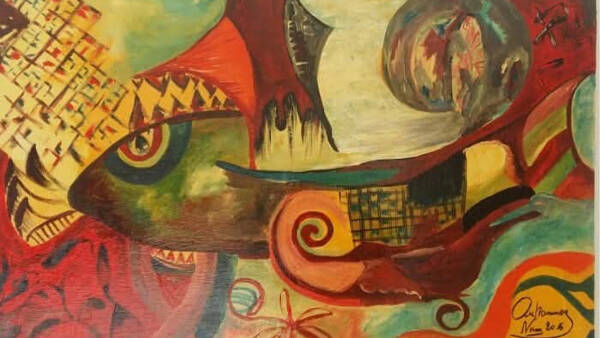
“I am a teacher of visual arts. I studied and specialized in it, and like other painters I passed through all classical schools, starting with realism and others, before settling in the abstract school where I found my true path. For me, painting is a space where I translate my emotions and impressions without speaking them in words.”
She previously participated in an exhibition held on the sidelines of the UN Climate Change Conference (COP22) hosted by Marrakech in 2016, alongside another visual artist. She presented two paintings, one titled ‘Moan’ about the environment, which is still displayed at the Regional Academy of Education and Training in Marrakech.
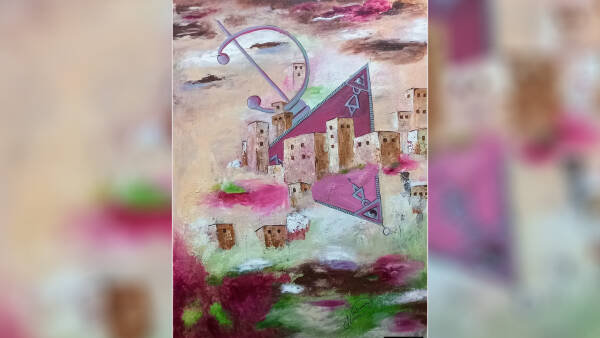
She explains that this art form gives her a wider space for self-expression through constant renewal and the use of multiple techniques. It has enriched her expressive style through colors and geometric shapes that create a powerful visual experience. This abstract approach also grants viewers the freedom of interpretation and creates interaction between them and the artist without the need for words.
In conclusion, the poet and painter Naima Ouhmou أكد that combining two different forms of expression—poetry and painting—has given her a vast space to express herself with all her ambitions, fractures, and hopes. They intersect at many points and are two means she cannot do without, as they are open windows onto the world