
From Resistance to Memory, and from Memory to the Future: The Flame of Newroz is L
An article by Arjin Dîlek Öngel
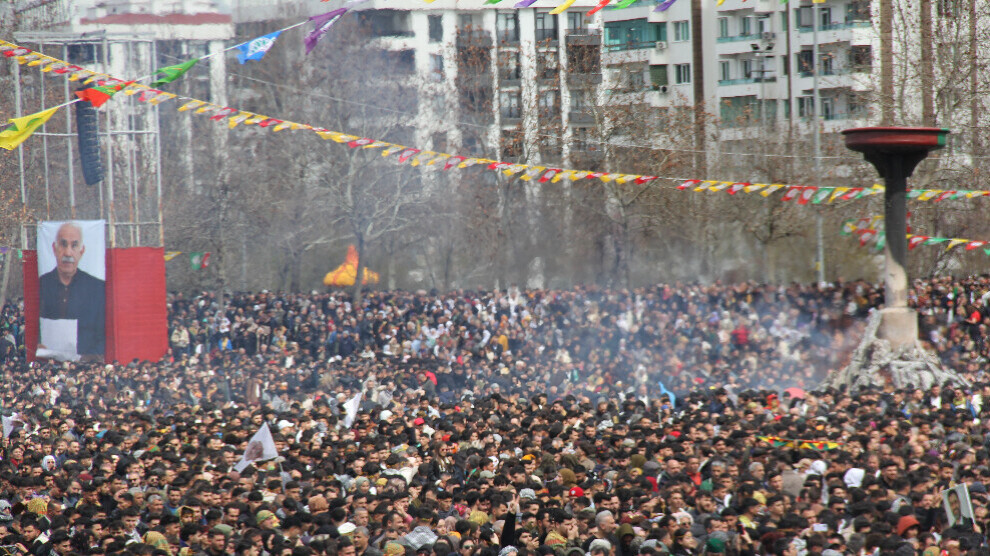
Newroz 2026 in Amed was celebrated in an atmosphere where the accumulated memory of resistance was directed toward building the future. The call of leader Abdullah Öcalan that “theory must be put into practice” was not merely a slogan echoed in the squares; it also served as a guiding orientation toward a new era. The long-raised demands for freedom, peace, and a democratic society found a genuine will for construction during this Newroz. The fire of Newroz was not only a symbol of past struggles, but also reflected a determination to establish a new social process.
For this very reason, the flames lit during Newroz 2026 were not just a continuation of present resistance, but also an inheritance from the past. These fires carried traces of Newroz celebrations that had been ignited in the streets for years despite bans, massacres, and repression. The demands voiced today in the squares, as a will for “construction,” were in fact a remembrance of a resistance that had once grown amid the smoke of burning tires.
In the past, tires hidden in narrow alleys, courtyards, and shop storerooms were prepared for Newroz. When speaking of such preparations, one is immediately reminded of the banned Newroz celebrations of the 1990s. Although labeled “forbidden,” the fires lit on every street corner only intensified the spirit of Newroz revolt. Regardless of conditions, children, youth, and elders took to the streets, dancing around the flames. The soot from burning tires marked their faces as a symbol of the pride granted by rightful struggle. These years also witnessed massacres, such as those in Nusaybin, Şırnak, and Cizre.
Years of Massacres and the Question of Existence
During Newroz 1992, tens of thousands of people were attacked in Şırnak, Cizre, and Nusaybin. In Şırnak, residents firmly refused to leave the streets. A high school student named Büşeng Anık was detained and killed. According to human rights reports, 38 people lost their lives and around 120 were injured during the Newroz celebrations in Şırnak that year.
Similarly, in Cizre, police prevented people from marching and opened fire on crowds attempting to participate. The attack resulted in 24 deaths and more than 60 injuries. In Nusaybin, people attempted to protest the events in Cizre and Şırnak. When prevented, they organized a sit-in. Shortly afterward, police vehicles stormed the gathering and opened fire, killing 16 people and injuring more than 50.
In more recent Newroz celebrations, police chased Kurds with batons through every corner of Bağlar district, beating them severely. As a child, these experiences led me to believe that the next Newroz would never be celebrated. But that was not the case.
Each subsequent Newroz became a foundational element of national unity, Kurdish identity, and the struggle of Kurdish women. Despite changes reflecting political developments and the spirit of the time, certain core themes remained constant: the status of the Kurdish people, the freedom of their leader, and Kurdish national unity. These demands stood out as central, and what distinguished Newroz 2026 was the strong collective will demanding the release of Abdullah Öcalan.
Newroz 2026 in Amed
Preparations began days in advance. When the Newroz fire was lit, its rising flames symbolized freedom and dignified peace. We set out early in the morning; the city seemed to awaken for Newroz. As we approached, the scene became increasingly familiar: roads and areas blocked by police barriers. Reaching the celebration area was difficult, yet people patiently endured the long journey, because at the end awaited the warmth of the Newroz fire—a symbol of rebirth and resistance.
The coincidence of Newroz 2025 with Abdullah Öcalan’s call for “peace and a democratic society” on February 27 created both excitement and astonishment. Images of Öcalan, imprisoned comrades, and the İmralı delegation were present in the area. While people remained determined in their demands, there were also uncertainties about the process.
This time, large posters of Abdullah Öcalan stood prominently in the square. The first groups entering eagerly took photos beside his image. It was no longer just a “picture,” but the clearest expression of the demand rising from the square. There was no longer any doubt—“Will we see our leader here?” The images stirred not only excitement but also deeply emotional moments.
What further heightened the significance of Newroz 2026 was Abdullah Öcalan’s message. His call to “embrace a new ethics of freedom” and his assessment that “Newroz must now become a practical embodiment” served as an invitation to implement a new roadmap. The excitement generated by the message, read in the Newroz square amid rising hopes for peace, remains etched in memory.
The message, once read in 2013 by Pervin Buldan and Sırrı Süreyya Önder, was this time read by Veysi Aktaş. The absence of Sırrı Süreyya was deeply felt, and the crowd experienced emotional moments during a video tribute prepared in his honor.
Despite warnings of rain, the square filled to capacity. The message elevated the enthusiasm to its peak. Perhaps never before had so many banners been seen at a Newroz celebration in Turkey or Kurdistan. With waving banners and chants, the celebration unfolded.
Women Ignite the Fire of Newroz
Despite rain and mud, women danced the halay—a symbol of peace and freedom—with defiance. The spirit of Newroz 2026, with its rain and mud, recalled the Newroz celebrations of the 1990s. Women’s traditional long dresses were covered in mud, yet no one cared as they continued dancing. Once again, women lit the Newroz fire.
How could they not? Were they not the ones who fiercely resisted against Zahhak? They defended their bodies against patriarchy, the state, and all forms of oppression. They burned to ashes, only to rise again—just like Zekiye Alkan and Rehşan Demirel.
Zekiye’s words, “The fire of Newroz is not lit with wood, but with human bodies,” did not speak of annihilation, but of rebirth. The fire she ignited became a torch in the hands of women during the first Newroz celebrated within the walls of Amed. That torch now burns brightly in the Newroz square of Amed in Northern Kurdistan.
Rehşan Demirel, the daughter of a migrant, was another woman who confronted injustice with her body. She became a symbol of Newroz 1992. In her message, she wrote: “We must take responsibility for Cizre, Mardin, and Nusaybin. These fires are now burning in Newroz celebrations and will never be extinguished. Today is Newroz. Everything has ended. They told us fire is a crime; we told them it is a cause.” She then set herself on fire in Kadifekale, İzmir.
These words rising from Newroz celebrations tell us that the heroines of Newroz are women. For women, every Newroz is a new beginning—like the arrival of spring. It is not merely a festival or a march; Newroz is the reclaiming and revival of identity.