
The "Pink Movement" in India... A Pink Sari and Bamboo Sticks in the Face of Violence
India's "Pink Movement" symbolizes a human rights movement fighting violence and discrimination against women through self-defense and direct intervention, using pink saris and bamboo sticks as symbols of social justice when laws fail.
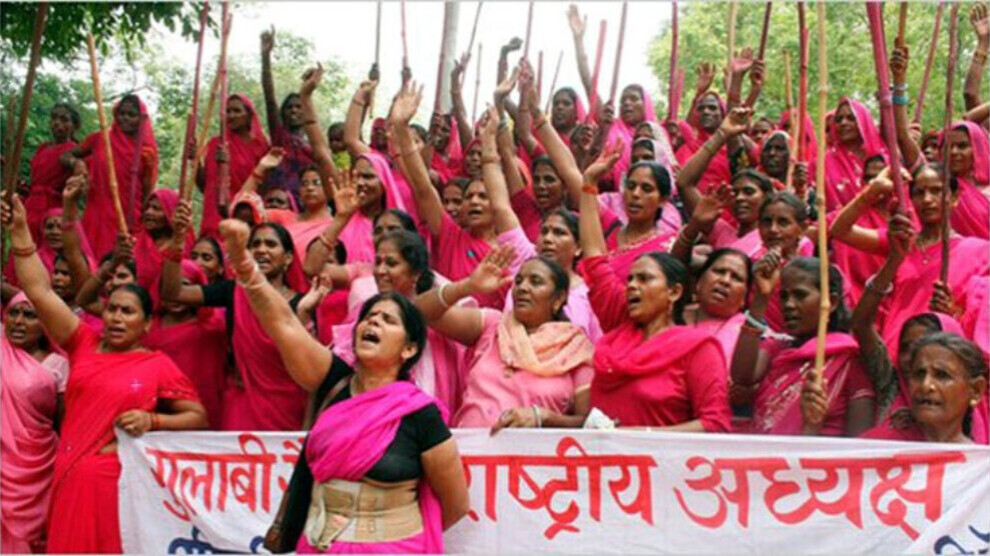
NEWS CENTER– In the state of Uttar Pradesh, one of India's poorest states, a women's movement led by Sampat Pal Devi was launched in 2006, initially consisting of only five women. Sampat Pal Devi's successes in combating domestic violence soon resonated widely throughout the region.
The "Pink Movement" was founded in Uttar Pradesh by activist Sampat Pal Devi with the participation of only five women at first, before her successes in combating domestic violence turned into a massive resistance force that attracted tens of thousands. Today, the movement's membership is estimated at hundreds of thousands of mothers, grandmothers, and young women between the ages of 18 and 60, who adopt the traditional Indian sari in bright pink as a uniform and a symbol of women's solidarity, given the color's neutrality and its non-representation of any political or religious group in the country.
In Indian society, the term "women in pink" symbolizes a human rights movement that has gained global resonance. This group is known as the Gulabi Gang (the Pink Movement), and it fights violence against women through self-defense methods in areas suffering from an absence of justice.
Struggle Against the Caste System and Violence
The official headquarters of the Pink Women's Movement is in Badausa Banda in Uttar Pradesh, one of India's most populous and poorest regions. More than 20% of Banda's population of 1.6 million, living in 600 villages, is subject to a harsh caste system.
In this region, where child marriage, femicide, assaults on women's bodies, and violence against them are widespread, the "Gulabi Gang" movement takes direct measures to protect women's rights, entrenching its position in society as a movement resisting the traditional caste system and the dominant patriarchal structure.
Members of the "Gulabi Gang" carry long bamboo sticks called "lathi" in cases where the police or judiciary are insufficient, or when women are marginalized. They publicly expose abusive men and corrupt government officials, and when necessary, they intervene with their sticks to achieve justice themselves.
Each woman's home within the movement constitutes a station and a meeting point. In these homes, women discuss their problems, strengthen solidarity, and receive self-defense training. These courageous women, whose number has now reached hundreds of thousands, have inspired literature and cinema, becoming one of the most important symbols of women's resistance and social justice in India.