
Arete of Cyrene… How Was Female Philosopher Lost from the Memory of Philosophy?
Arete of Cyrene broke men’s monopoly on ancient philosophy as the first woman leading a school of thought and authoring dozens of lost books, remaining an inspiring symbol for marginalized women’s and North African voices.
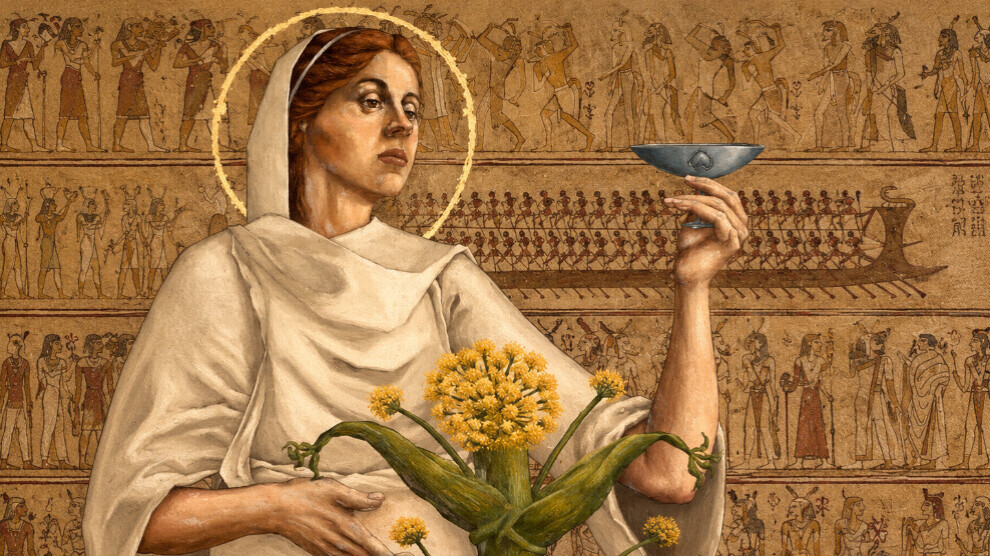
NEWS CENTER– Traditional narratives of the history of ancient philosophy show a monopoly of major male names such as Socrates, Plato, and Aristotle, suggesting that thought was their exclusive domain. However, excavating the margins reveals influential figures obscured from collective memory.
Arete of Cyrene comes as one of the most prominent of these marginalized philosophical figures. Despite the scarcity of information about her, historical accounts indicate that she was the first woman to assume the leadership of a philosophical school in the ancient Greek world, making her a symbol of a rich intellectual aspect that remained forgotten for centuries.
Her story is not just the biography of a woman who lived more than two thousand years ago, but is the story of forgetting itself; a forgetting that swallows not only individuals, but also ideas, books, and voices that found no one to preserve them in the face of time.
Her Upbringing
Arete was born in the city of Cyrene in North Africa, a prosperous civilizational and commercial center that linked the continent to the Greek world. In this rich environment, she grew up as the daughter of the philosopher Aristippus of Cyrene, who is considered one of the most prominent students of Socrates and the founder of the Cyrenaic School.
In this intellectual climate, she received her education. Ancient accounts indicate that she continued teaching philosophy after her father's death and assumed the leadership of the Cyrenaic School itself, which is exceptional in a world where intellectual life was almost exclusively male.
Perhaps the importance of this account lies in its significance more than in its details. The mere acceptance of a woman in a position of philosophical leadership in the fourth century BC reveals that Arete enjoyed a scholarly status difficult to ignore. It was not easy for philosophy students at that time to recognize an intellectual authority not based on real knowledge.
Some sources go further, attributing to her the authorship of forty books on philosophy and the teaching of more than a hundred philosophers over a career extending for long decades. But the paradox is that all these books disappeared. There is not a single manuscript bearing her name, no direct quotation from her writings, and no material trace that could help reconstruct her ideas.
Here, Arete turns from a historical figure into a philosophical question in itself. How could a female philosopher who is said to have led a school of thought and authored dozens of books almost disappear from history?
The loss of most of the history of the ancient world is due to two reasons: natural disasters and wars that destroyed thousands of works, and the mechanism of writing history that relies on selection; choosing what to immortalize and ignoring the rest, making what reaches us today only a small part of a vast intellectual output, most of which has disappeared.
Women were the most exposed to this obscuring, given men's historical dominance over the institutions of copying, preserving, and teaching books, which reduced the chances of their intellectual output surviving compared to their male contemporaries.
Therefore, Arete does not appear as an isolated case, but as part of a broader phenomenon that affected many female figures in ancient history. Just as few names reached us, such as Hypatia of Alexandria and Aspasia of Athens, many other names disappeared, leaving only scattered references in the books of historians.
Arete's importance increases when we look at her from another geographical and cultural angle. She is the daughter of Cyrene, the city located in present-day Libya, which was once one of the most important intellectual centers in the Mediterranean basin. Nevertheless, North Africa's contribution to the history of ancient philosophy is rarely mentioned, as philosophical narrative is often reduced to Athens and some other Greek cities.
Restoring Arete's name also means restoring part of the memory of Cyrene itself; the city that produced philosophers, scientists, and poets, and contributed to shaping the intellectual scene of the ancient world. It also reminds us that the production of knowledge was not monopolized by one center or one people, but was the fruit of a broad civilizational interaction extending across both shores of the Mediterranean.
Her Origins
As for the question of her Libyan or Amazigh origins, it remains open to discussion, given the ethnic and cultural diversity in Cyrene historically. But what is certain is that her thought grew in North Africa, and her biography is an integral part of Libyan cultural heritage.
Arete's true value lies in the ambiguity of her biography. The silence surrounding her proves the fragility of human memory and confirms that history does not always preserve the wisest, but rather those who had the luck of their works surviving and their names being circulated.
Hence, she becomes more than just a forgotten philosopher. She is a witness to a parallel history that was not fully written, and to voices that disappeared from the traditional narrative of philosophy, not because they were of lesser value, but because time chose to be less fair to them.
Between what we know and what was lost from her biography, the name of Arete of Cyrene remains an open invitation to reconsider the history of human thought, and the questions that remain posed until today: Who writes history? Who decides who deserves to remain in memory? And who are those still waiting to be rediscovered after centuries of silence?