
Annie Dillard: When Solitude Becomes a Window onto the Secrets of Existence
From nature's details to grand questions of life and death, American writer Annie Dillard crafted a literary world beyond the visible, winning the Pulitzer Prize for "Pilgrim at Tinker Creek."
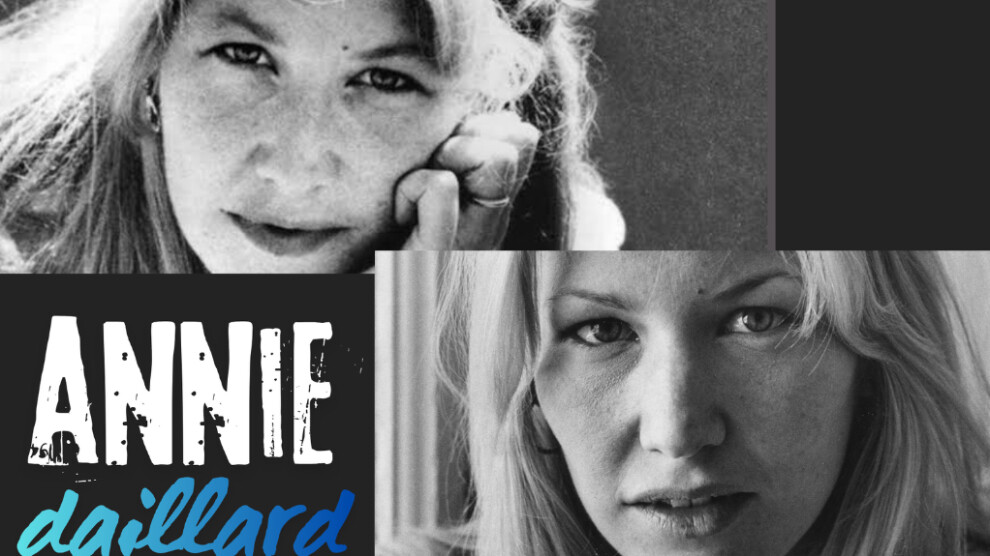
NEWS CENTER_Annie Dillard did not look at the world as a familiar scene we pass through every day, but as a mystery deserving of long contemplation. In her writings, trees, insects, and water do not appear as mere elements of nature, but as entry points to deeper questions about life and death, pain and beauty, and the human being's place in a universe that does not easily reveal its secrets.
Annie, whose original name was Meta Ann Doak, was born in the American city of Pittsburgh in 1945, and studied English literature at Hollins College. However, her most prominent literary presence came in 1974 with her book "Pilgrim at Tinker Creek," which recalls her contemplations of the nature surrounding Tinker Creek in Virginia. In 1975, she won the Pulitzer Prize for it in the general non-fiction category, becoming one of the most prominent American voices in nature writing and philosophical contemplation.
But what distinguishes Annie is not only her ability to describe nature, but her refusal to present it as an ideal space free of cruelty. The natural world, as it appears in her writings, combines beauty and violence, birth and mortality; the more a person pays attention to its details, the more they discover that life is more complex than our simple perceptions allow.
In her book "Holy the Firm," Dillard turns to questions of faith and pain, attempting to understand the contradiction between the existence of suffering and belief in a world that carries meaning. As for "Teaching a Stone to Talk," she gives contemplations and daily scenes space to think about our relationship with nature, and our need to listen to what transcends the noise of ordinary life.
The importance of solitude in this world is manifested as a different way of seeing, not merely a withdrawal from others. When familiar voices recede, one becomes more attentive to what was passing before them without being seen. However, this solitude does not offer final answers; it expands the questions and places the human being before the truth that they do not own the world merely because they live in it.
Annie's experience was not limited to nature contemplations, but extended to autobiography, the novel, and writing about the act of creation itself. In her book "The Writing Life," she addressed writing as a practice requiring courage and detachment, while in "An American Childhood" she revealed the features of her childhood and intellectual upbringing.
On 15 September 2026, Annie passed away at the age of 81, leaving works that re-raise questions that time does not render obsolete. Nature in her literature was not a subject separate from the human being, but a mirror revealing their fragility and the limits of their knowledge, and reminding them that existence is not a ready-made truth, but an experience deserving of continuous contemplation.
Perhaps the value of her writings lies in that they do not ask us to escape from the world in search of wisdom, but invite us to look at it more deeply; to see in small things grand questions, in silence an opportunity to listen, and in solitude a possibility to discover what habit has hidden from our eyes.