
Sudanese female journalists demand legislation to protect them and ensure they can carry out their mission
Following the arrest of a journalist for exposing corruption in Sudan's central bank, a number of female journalists have demanded guarantees for their freedom of expression and the enactment of new legislation to protect them from arrest.
Aya Ibrahim
Sudan — Amid the ongoing conflict between the Sudanese army and the Rapid Support Forces, and escalating security tensions, journalists find themselves facing an increasingly dangerous environment where the space for expression is shrinking and restrictions are mounting. A number of female journalists have called for the protection and safeguarding of their rights to access information without fear or persecution.
On March 25, Sudanese authorities arrested journalist Hajar Suleiman, months after she had been released. She was transferred to Dongola based on complaints filed by the prosecution regarding her articles about the Dongola prosecution office.
Authorities had previously released her on bail on October 13, following her arrest over articles exposing corruption within the Central Bank of Sudan — an arrest that sparked widespread international condemnation at the time as a violation of press freedom.
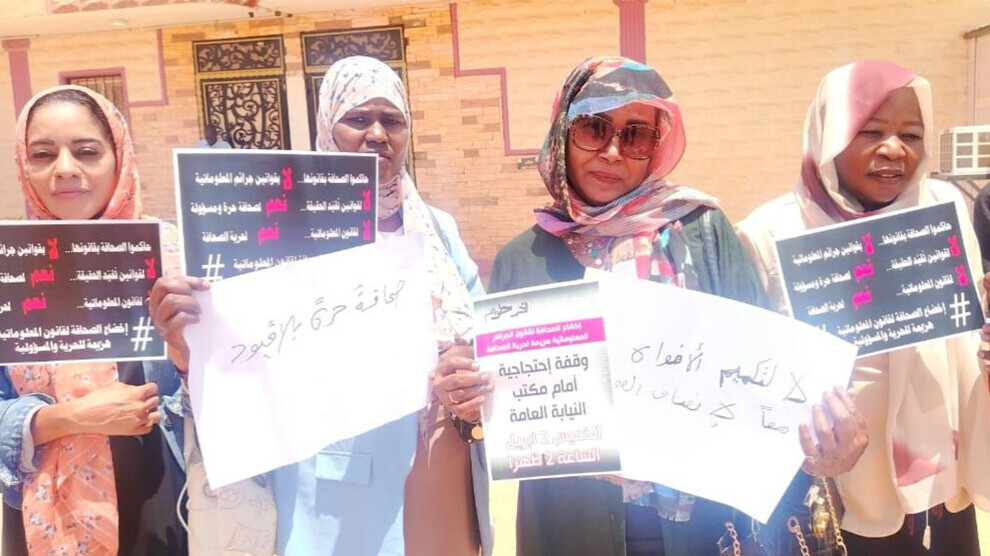
In response, a number of female journalists, along with other journalists, organized a protest on April 1 in front of the public prosecution offices in various Sudanese states, including the capital Khartoum. During the protest, they submitted a memorandum to public prosecution officials containing a list of demands.
The protesters raised the slogan "Press freedom... a red line," demanding amendments to the Press and Publications Act to ensure protection and freedom, and that journalists not be tried under the Cybercrime Law.
"Differing opinions must be accepted"
In this context, Ghada Othman Gawish, Director of Public Relations at the Supreme Council for Culture and Media in the Northern State, stressed that journalism and freedom of opinion require a great deal of wisdom, in addition to skills in gathering and disseminating information in a manner that does not harm any party, helping to correct course without recklessness. She emphasized the importance of respecting the profession of journalism and accepting differing opinions without repression.
She explained that journalism in Sudan has seen a notable decline recently following the outbreak of conflict between the Sudanese army and the Rapid Support Forces, leading to a decrease in the flow of information and difficulty accessing it. She noted that online journalism has become more prominent in the media landscape compared to print journalism, calling for the removal of obstacles facing journalists to ensure they can practice their profession objectively and smoothly.
Responsibility to uncover the truth
For her part, media professional Salma Awad Fadil stated that a journalist's true value lies in their honesty and high level of professionalism in handling events, affirming that a journalist who understands the limits of their work and what they should do should not be subject to persecution.
She pointed out that any journalist who raises an issue does so based on evidence, but some entities seeking to protect their interests may place obstacles and hindrances in their way. She explained that the harassment and persecution journalists face after publishing sensitive issues is unacceptable to her, stressing that rights must be secured through the law.
Demands for the protection of journalists
Meanwhile, media professional Mai Ezz El-Din, who participated in the protest, called for guaranteeing journalists' freedom and enacting new legislation to protect them from arrest, explaining that she, like many of her colleagues, has faced great difficulties in accessing information.
Mai Ezz El-Din reiterated her demand for providing real protection for journalists and acknowledging the extent of the suffering they endure under the harsh conditions imposed by the conflict.